AA
Share

 Las noticias del día en tu correo
Recibe lo más destacado de la cobertura de CONFIDENCIAL todos los días.
Más boletines
The best of our coverage, in English
Sign up for our weekly newsletter. We will send it to you every Friday at 10:00 am (Nicaragua time)
More Newsletters
PUBLICIDAD 4D
PUBLICIDAD 5D
Under Murillo’s “guillotine,” on her path to dynastic succession, the heads of several of Ortega’s key allies and confidants have rolled.

Bajo la vigilancia de Rosario Murillo, cualquier movimiento en falso basta para ser eliminado, como hace Young-HEE, de la famosa serie de Netflix “El juego del calamar”. // Ilustración: CONFIDENCIAL, inspirada en Squid Game.
Since Daniel Ortega’s return to power in 2007, Rosario Murillo has overseen a continuous “political decapitation” of figures close to and loyal to Ortega, consolidating her own influence within the inner circle of power. Murillo’s political purge intensified after she became vice president, and by 2025, upon taking the role of “co-president,” it shows no signs of stopping—appearing more ruthless than ever in a scenario where “anyone can fall under Murillo’s guillotine.”
In this purge, historical loyalty counts for nothing, and not even Ortega’s closest allies—or his family—are safe. Murillo’s consolidation of dynastic power, combined with Ortega’s declining health, fuels an authoritarian radicalization based on paranoia and the urgent need to place loyalists to her, rather than to Ortega.
At CONFIDENCIAL, we highlight the most prominent cases of those who have fallen under Murillo’s “guillotine,” affecting high-profile figures in the party, the state, the police, and the military.
Since Daniel Ortega’s return to power in Nicaragua in January 2007, Rosario Murillo initiated the political decapitation of Ortega’s closest and most loyal cadres, replacing them with her own political influence within the inner circle of power.

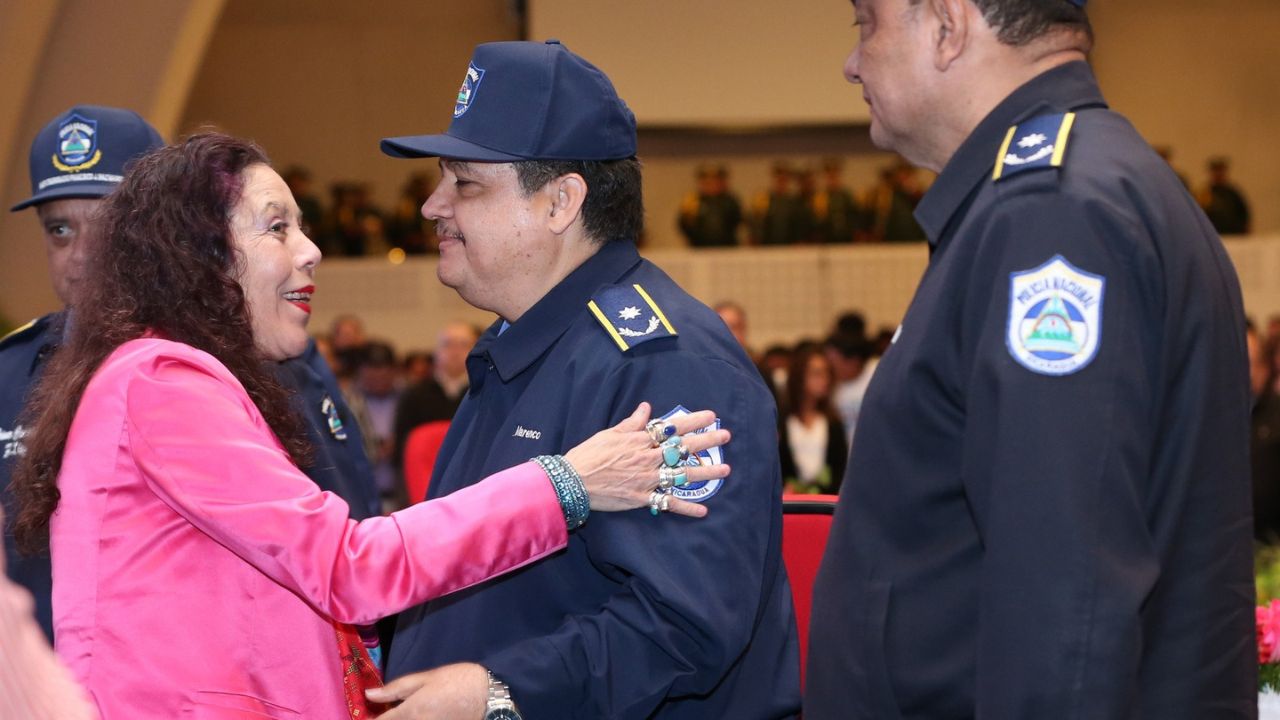
One of the first “decapitations” was Dionisio “Nicho” Marenco, the negotiator of Daniel Ortega’s pact with Arnoldo Alemán, about which he said in an August 2008 interview with La Prensa: “If it weren’t for that pact, the Sandinista Front would never have won the elections.”
The former mayor of Managua (2004–2008) also played a key role in opening economic relations with Hugo Chávez’s Venezuela and managing its multi-million-dollar cooperation, which Ortega and Murillo handled through private channels, becoming, until 2014, the dictatorship’s main source of funding.
Marenco was abruptly removed from the new regime’s inner circle in early 2007. In November of that year, he publicly clashed with Murillo, who accused him of being a “traitor” for criticizing the management of the FSLN. “Rosario Murillo accused me of being a traitor, and betrayals in the FSLN are like death sentences,” Marenco said.
At one point he was considered a potential presidential candidate, but he withdrew from public life in 2009 after finishing his term as mayor of Managua. He died at 73 on May 19, 2020, during the COVID-19 pandemic.

In April 2011, it was the turn of powerful retired Colonel Lenin Cerna, former head of the Directorate General of State Security in the 1980s and FSLN organizational secretary since 1999.
Cerna was removed from his position and expelled from the FSLN secretariat on Murillo’s orders. He fell out of favor due to his involvement in the so-called “Waltergate,” a corruption scandal in the General Directorate of Revenue, which also cost the position of its head, Walter Porras.
Cerna returned to Ortega’s fold after the April Rebellion of 2018 and, in July 2019, joined an intelligence team serving Ortega, though Murillo had already sidelined him from the circle of influence and power.
In late July 2025, several media outlets reported that Cerna had escaped a police raid at his home. However, sources linked to the police denied the “escape” story to CONFIDENCIAL, and the retired colonel was seen driving through Managua on August 10 in a blue Mercedes-Benz, driven by a police officer and escorted by a police vehicle.
One of Cerna’s main lieutenants, retired Colonel Rodolfo Castillo “Payín,” was captured by the police on August 1 during Managua’s equestrian festival and, since Monday, August 25, has been under house arrest with police surveillance, subject to an official investigation by the newly renamed Attorney General’s Office.
In 2016, Murillo became Ortega’s vice president, positioning herself in the constitutional line of succession. Five years later, in 2021, both declared themselves re-elected after nullifying political and electoral competition, and Murillo continued the dynastic succession by de facto means.
General Commissioner Adolfo Marenco Corea was dismissed by Ortega as director of research and intelligence for the National Police in November 2022. Two days earlier, Ortega had appointed Zhukov Serrano Pérez as the new deputy director of the National Police, in charge of espionage, publicly highlighting his studies in Russia. In January 2023, it was confirmed that Marenco had been imprisoned in El Chipote and later placed under house arrest.
Marenco, deputy director of the police and head of research and intelligence, carried out espionage tasks in service of the dictatorship, considered “the eyes and ears of the police state,” according to a CONFIDENCIAL profile published in March 2020.
The former member of Murillo’s inner circle and of security advisor Néstor Moncada Lau was the first high-level official to be removed from his post and imprisoned, almost 50 days after the announcement of his dismissal.
Marenco was placed under house arrest after falling out of favor, supposedly due to corruption allegations and unauthorized private business dealings involving a faction of the regime’s leadership. Within police circles, two versions circulated regarding his imprisonment: one, that it was to silence him because he intended to flee the country; the other, that he had refused to continue working for the Ortega-Murillo duo, further angering them.

Retired Army General Omar Halleslevens Acevedo, also Ortega’s vice president between 2012 and 2016, was removed from his former offices on Murillo’s orders in May 2023. In January 2017, when Murillo assumed the vice presidency—after elections with no political competition and following the previous year’s electoral fraud—the former army chief accepted the appointment of “minister delegate for specific affairs,” directly overseeing the Nicaraguan Council of Science and Technology (Conicyt).
Despite being replaced as vice president, Halleslevens remained in charge of the Vice Presidency and Conicyt offices between 2017 and 2022, initially overseeing a staff of more than 50 employees.
In August 2022, Halleslevens was simultaneously appointed head of the Nicaraguan Commission of Atomic Energy for Peaceful Purposes, as the regime courted Russia and Iran, projecting the image of the leader’s son, Laureano Ortega Murillo, who appeared as the main figure in the agreements. The former military chief simply “disappeared.” Eventually, Conicyt was abolished after 25 years of existence, in November 2022.
Halleslevens’ relationship with the vice president deteriorated to the point that Murillo ordered in December 2022 that no Christmas basket be delivered to the staff of his office, nor bonuses to the lowest-paid employees. In February 2023, Murillo ordered the evacuation of the Vice Presidency offices where Halleslevens was stationed—a building she herself never visited.
One account of the final trigger for his ousting links it to Halleslevens’ outreach to retired General Humberto Ortega Saavedra, the dictator’s brother, after the latter met with Daniel Ortega in December 2022.
What happened in the judiciary in 2023 was a full-scale sweep. The Supreme Court of Justice (CSJ) was practically dismantled. More than 1,000 officials and public employees—including judges and magistrates who served the dictatorship—were dismissed, sometimes via WhatsApp, SMS, or email, without severance and in violation of their civil and labor rights. Departments and offices were paralyzed or transferred to the newly renamed Attorney General’s Office, and the dismissals have not ceased.

In October 2023, the Supreme Court “shook.” A group of police led by “advisory minister” Horacio Rocha removed CSJ President Alba Luz Ramos from her office and sent her home. Witnesses reported that she left visibly upset, claiming she was being “violated.”
“The de facto suspension of Dr. Alba Luz Ramos evidences Rosario Murillo’s takeover of the judiciary,” a source linked to the Supreme Court told CONFIDENCIAL in October 2023.
In the following days, the same happened to Magistrate Yadira Centeno, president of the Civil and Family Chamber, and the purge continued with other magistrates and officials in the still-called judiciary, affecting over a thousand public employees.
Several of Murillo’s fiefdoms—such as public registries and arbitration and mediation offices—were transferred to the Attorney General’s Office. The purge extended so widely that in January 2025, judges and magistrates who had acted as enforcers of the dictatorship—sentencing political prisoners in sham trials or issuing rulings of denationalization and asset confiscation—were also removed.
The ruins seem to matter little to the leadership. Almost two years later, Ortega loyalist magistrate Marvin Aguilar remains only as “acting magistrate president” in a hollowed-out CSJ.
Humberto Ortega Saavedra, retired army general and brother of the dictator, died in the early hours of September 30, 2024, after being under house arrest since May 19 and in total isolation since June 11, by orders of Ortega and Murillo.
On June 9, three weeks after being placed under house arrest, the retired general recorded an audio message in a call to CONFIDENCIAL from a cell phone he had hidden at home, after police confiscated all his communication devices during the May raid. In the full message, preserved by the outlet per his wishes, he declared himself a “political prisoner,” denounced his state of isolation, worsening health, and demanded his freedom.
Neither the Nicaraguan Army nor Ortega’s dictatorship acknowledged the retired general’s transfer to the Military Hospital, nor provided any information about his condition, until three and a half months later, on September 29, when they issued a statement just ten hours before he died in police and military custody.
Throughout his public life, Humberto Ortega always boasted of his cunning. He demonstrated it in his guerrilla political activity, military career, and as a millionaire businessman, although he rarely spoke of the last role. He was the first chief of the Sandinista Popular Army in 1979 and of the new Nicaraguan Army in 1994. He was also one of nine commanders of the Sandinista National Directorate, a respected and controversial figure alike.
He assumed the role of political negotiator in times of crisis. From that position, he promoted the first political pact with Arnoldo Alemán in 1997, after his brother Daniel’s second electoral defeat, and later attempted—unsuccessfully—to resolve the 2018 social unrest.
In the twilight of his life, Humberto Ortega openly criticized his brother’s dictatorship, with whom he maintained a tumultuous relationship until his final days. In a May 2024 interview with Argentine outlet Infobae, he questioned his brother’s and sister-in-law’s dynastic plan, a statement that led to his imprisonment as a political prisoner and ultimately to his death.
Although he held no position after his brother’s return to power, his imprisonment and death as a political prisoner is the most extreme instance of the dictatorship’s guillotine, extending even to the family.
In 2024, Rosario Murillo’s purge shocked with its decapitations. It reached the top economic management of the state, “removing” a trusted official, family members tied to the FSLN’s history, and Ortega’s longtime bodyguard.

In June 2024, the dictatorship confirmed the departure of Iván Acosta Montalván as Minister of Finance and Public Credit. News of his exit emerged more than 24 hours earlier, when three sources connected to the former official confirmed his dismissal to CONFIDENCIAL, although the regime claims it was a “resignation.”
As Minister of Finance since early February 2012, Iván Acosta was one of the regime’s main economic operators and a loyal ally of Murillo.
However, on June 18, 2024, agents from the National Police, serving the Directorate of Judicial Assistance, raided his office and residence. At the time, he was not detained by the police and was later seen at a restaurant.
A month later, Ortega appointed him “Presidential Advisor to the President of the Republic for International Organizations,” a position that did not exist until June 28, when it was published in the official gazette, La Gaceta.
Then, in October, Acosta was detained again by the police, with no public explanation given for his June removal.
His downfall has been linked to the former treasury head, Juan José Montoya, who has been in detention since mid-April 2024 on allegations of money laundering and “unauthorized corruption.” Although no formal charges against Montoya have been made public, six luxurious properties attributed to him were confiscated and redistributed by the regime following his “fall from grace” and imprisonment.

Carlos Fonseca Terán, son of FSLN founder Carlos Fonseca Amador, a Sandinista militant and staunch defender of the Ortega-Murillo regime, was arrested at his home in Managua on July 26, 2024. Neither the police nor the prosecutor’s office have disclosed the reasons, but several sources linked to the FSLN indicate it was mainly due to his role as coordinator of a WhatsApp group called “La Comuna.” In that chat, Fonseca held critical conversations about the government with around ten other Sandinistas, though without rejecting Ortega’s leadership.
Fonseca was placed in total isolation: his and his wife Arlen Cuadra’s phones and computers were confiscated. Cuadra, a labor court magistrate, had been dismissed months earlier during one of the Supreme Court purges. Their son, Carlos Manuel Fonseca López, was also fired from his position at the investment agency ProNicaragua, where he had worked for eight years.
The scope of this purge extends beyond Fonseca Terán and includes at least a dozen Sandinistas who participated in the WhatsApp group “La Comuna,” including university professors Rigoberto Ramos, Ernesto Paredes, Frank Matus, and Christian Eduardo Bermúdez; lawyer Alejandro Taleno; administrator Gustavo Zapata; and artist José Antonio Bermúdez.
Terán held no official position nor was he a direct operator of the dictatorship, but his detention is significant because of the weight of his surname in FSLN history.
Although publicly he remained an unconditional supporter of the regime, his allegedly moderate private criticisms were enough to trigger the repressive machinery of a government that tolerates no dissent—even from its most loyal defenders.

The dismissal and dishonorable discharge of Ortega’s presidential bodyguard chief, General Commissioner Marcos Alberto Acuña Avilés, was confirmed by the National Police in August 2024, hours after CONFIDENCIAL reported that Murillo had ordered the measure on July 24.
Acuña had been part of Ortega’s personal security team since the 1990s and became head of the presidential escort on January 10, 2007. In 2014, Ortega promoted him to general commissioner.
After serving Ortega’s personal security for more than 25 years, Acuña was accused of flagrantly disobeying “superior orders, endangering citizen safety,” according to the police press release.
Sources linked to the National Police revealed that in recent months there were visible “tensions” between Murillo and Acuña. They detailed that the order for his removal came after “a discussion” with her over a situation and issue that could not be identified.
A retired general commissioner was “revived” with a clear task: to carry out the regime’s purges. He was so effective that some began calling him the “Angel of Death,” because when he appeared at an official’s office, it was only to make their head roll. Equally “efficient” was the university rector who led the crackdown on students during the 2018 protests, helped close and confiscate nearly 40 universities, and enabled indoctrination in classrooms, earning the title of “executioner of university autonomy.” But—when their turn came—neither escaped Rosario Murillo’s purge.

Retired General Commissioner Horacio Rocha López, revived as “Presidential Security Advisor” and the main executor of the purges in the state, police, and ruling party between December 2022 and September 2024, was removed from his post in the third week of January 2025, also on Murillo’s orders.
“Rocha has been removed from all his functions, with no explanation given,” a source linked to the Ministry of the Interior and National Police told CONFIDENCIAL. Another source linked to the FSLN stated that Rocha’s fall was due to overstepping his authority.
The once-powerful presidential advisor “assumed powers to investigate high-ranking officials and institutions” in the power structure “without authorization,” the source explained. Since January 2025, Rocha has been at home, stripped of all functions.

Ramona Rodríguez, now former president of the National Council of Universities (CNU), was the main executioner of Nicaraguan universities. She coordinated with the Directorate General for the Control of Non-Profit Organizations to cancel the legal status of 37 private universities and confiscate their properties. She was primarily responsible for the hunt and “academic death” of more than a hundred students expelled from the National Autonomous University of Nicaragua (UNAN – Managua), which she oversaw.
In 2018, she allowed paramilitary groups and police to enter campuses and shoot at students barricaded inside. She was also responsible for dismantling university autonomy, promoting political indoctrination in universities, and violating the labor rights of employees dismissed for protesting against the regime.
She was removed as president of the CNU and rector of UNAN – Managua in May 2025. Days after her dismissal, she reappeared publicly to assume a position without real power: taking charge of the National Training Center for Entrepreneurs “La Sandino,” established in the offices of the Center for Rural and Social Development Promotion, Research, and Training (Cipres), confiscated from FSLN “ideologue” Orlando Núñez in March 2025.
The arrests of long-time political and economic operators of the FSLN, close to Ortega, are seen as moves beyond Murillo’s personal purge. In the words of guerrilla commander, dissident, historian, and exiled political prisoner Dora María Téllez, the evidence is clear: “Being unconditional to Daniel Ortega, or even Rosario Murillo, no longer pays off; it brings no reward.”

Retired Brigadier General Álvaro Baltodano Cantarero was arrested in May 2025 and sentenced to 20 years in prison for the alleged crime of “treason against the homeland,” with all his assets ordered confiscated on June 9 in a summary trial via videoconference at La Modelo prison in Managua.
On August 14, the renamed Attorney General’s Office also announced the “definitive” cancellation of the Momotombo Geothermal Plant concession contract, citing links to “20 shell companies” under Momotombo Power Company, controlled by Baltodano, his son, businessman Álvaro Baltodano Monroy (detained in July), and three foreign investors.
Baltodano was a guerrilla commander of the FSLN and participated in the 1979 Matagalpa insurrection as one of the leaders of the Northern Front. He joined the Sandinista Popular Army in July 1979, holding high military positions during the war against the counter-revolution throughout the 1980s. He retired from the army in April 2000 as a brigadier general.
Alongside Lenin Cerna and Dionisio Marenco, Baltodano became one of Ortega’s most trusted political operators, managing opposition affairs between 2000 and 2006. In 2006, he also represented the FSLN in the United Alliance Nicaragua Triumphs, through which Ortega returned to power.
After the electoral victory, he was appointed president of the National Free Trade Zones Commission and, between 2009 and 2017, together with presidential economic advisor Bayardo Arce, served as one of Ortega’s liaisons with major private sector business leaders. He also consolidated his influence as president of the Investment and Export Promotion Agency (ProNicaragua).
In 2017, he was appointed “Presidential Delegate Minister for Investment Promotion and Foreign Trade Facilitation,” a position from which he was removed in October 2022, withdrawing from public political activity in the FSLN.
Presidential economic advisor Bayardo Arce Castaño, former member of the FSLN National Directorate, was the main operator of the regime’s economic alliances with large private sector capital. He acted as the government’s official counterpart to the Superior Council of Private Enterprise (Cosep), under the “dialogue and consensus model,” which broke down in April 2018 when Cosep condemned the repression and massacre of civic protests.
A former revolutionary commander, he had always carried political weight within the FSLN, especially among Sandinista businessmen and the judiciary. Loyal to the party and private enterprise, he managed his political capital with caution and pragmatism, avoiding contradictions with Ortega and emphasizing his usefulness to the regime in both the economy and business.
However, at midnight on July 30, 2025, Arce was captured in a major police operation during a raid on his home in southern Villa Fontana. The arrest took place five hours after the Attorney General issued a statement saying Arce had failed to respond to two interview requests in an investigation into “transactions outside the State.”
He remains imprisoned in an undisclosed location and has not been formally charged by the Attorney General or the newly renamed Prosecutor’s Office. Ortega has not publicly commented on his detention.

National security advisor to the co-dictators, Néstor Moncada Lau, one of the main political operators of repression and the police state in Nicaragua since 2018, was imprisoned in La Modelo National Penitentiary on the morning of Saturday, August 16, 2025, on Murillo’s orders, confirmed CONFIDENCIAL sources linked to the National Police.
Moncada Lau, a former State Security officer in the 1980s, assumed full control over security in the FSLN Secretariat after the dismissal of Lenin Cerna and his team, also ordered by Murillo in 2011. He is described as “the guardian of El Carmen’s secrets.”
He was first captured by police at his home in El Rodeo on the night of Thursday, August 14, and taken to the Judicial Assistance Directorate at El Chipote for questioning. He was then returned home on Friday afternoon under police surveillance. However, on the morning of Saturday, August 16, he was again taken into custody and transferred to La Modelo, though he has not officially been charged by the Attorney General or Prosecutor’s Office.
The purge of these “last loyalists to Daniel Ortega” also generates “unease and uncertainty” among the so-called “historical Sandinistas.” The phrase “anyone can fall under Rosario Murillo’s guillotine” has become a real fear among Sandinistas and public officials. Even as Murillo positions herself to inherit power, the internal unrest caused by her purge raises serious doubts about the political viability of a dynastic succession in Nicaragua.
Share Your Thoughts
Send your comments or feedback on this report securely to: [email protected]
Editor’s note: The illustrations in this report were created by CONFIDENCIAL, inspired by the Netflix series Squid Game, and animated with Veo, Google’s AI for video.
PUBLICIDAD 3M
PUBLICIDAD 3D

Alertas en tu celular
Suscribite a las alertas informativas de Confidencial en Telegram.

Boletines
Lo mejor de nuestra cobertura noticiosa en tu correo electrónico.

Anuncios
Obtené una propuesta comercial de acuerdo a tus objetivos y presupuesto.

Test Político
Explorá tus ideas sobre nuestra política, economía y sociedad con nuestro Test Político.