


AA
Share

 Las noticias del día en tu correo
Recibe lo más destacado de la cobertura de CONFIDENCIAL todos los días.
Más boletines
The best of our coverage, in English
Sign up for our weekly newsletter. We will send it to you every Friday at 10:00 am (Nicaragua time)
More Newsletters
PUBLICIDAD 4D
PUBLICIDAD 5D
State institutions and the FSLN profile regime critics, turning them into targets, GHREN report says.
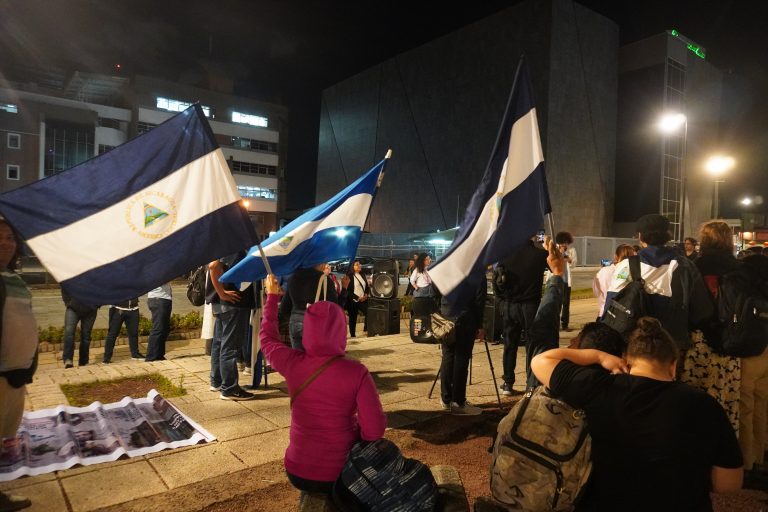
Exiliados nicaragüenses en la plaza de la Democracia en Costa Rica se reunieron para conmemorar la libertad de las personas presas políticas. 9 de febrero 2023. Foto: Katherine Estrada Téllez.
The regime of Daniel Ortega and Rosario Murillo has used “a broad and complex network of surveillance and intelligence” to monitor the activities of Nicaraguans, even “beyond the country’s borders.” This network has allowed them to “harass, discredit, and threaten” Nicaraguans in exile, concluded the Group of Human Rights Experts on Nicaragua (GHREN).
This “extensive and methodical” surveillance system makes substantial use of digital technologies and is primarily aimed at former Sandinista and Contra combatants, ex-military members, journalists, political figures, activists, and human rights defenders, the Group of Experts specified in their report Nicaragua: Persecution Beyond Borders — Exile and Transnational Human Rights Violations.
The document, presented on September 23, 2025, to the United Nations Human Rights Council, reveals that “transnational surveillance” is organized through “a multi-layered intelligence architecture” involving the Army, Police, foreign service, and non-state agents. “At its core is a network coordinated by the Directorate of Information for the Defense of the Army, the military intelligence agency,” it emphasizes.
Regime operatives are tasked with “identifying and monitoring internal and external ‘threats,’” the report warns. “Undercover officials and informants carry out physical and digital surveillance of persons of interest, report on their movements and associations, and in some cases, directly harass and threaten them,” it highlights.
It adds that the National Police intelligence services maintain “close coordination” with the Army, sharing dissident profiles and intercepting communications and mobility data.
The Group of Experts emphasizes that targets are identified by monitoring their social media, public activities, or association with opposition groups. “Once profiled, they are subject to physical surveillance by undercover officials or informants, and digital surveillance through account hacking, spyware, and communication interception,” the report notes.
Some exiled Nicaraguans told the Group they had been photographed, followed, harassed, approached by unknown individuals, and threatened while in Costa Rica and Honduras, but also in Belgium, Guatemala, Spain, and the United States.
“Behind where I live is a police officer who was involved in my kidnapping in 2020. I’ve seen him several times, and when he sees me, he hides. I felt that someone was watching me a lot, until one day I realized it was him.”
Victim interviewed by the Group
These actions “are directed from Nicaragua and carried out by networks of informants, which, according to collected information, include both Nicaraguans and locally recruited individuals,” the report reads.
The document also notes “a sustained pattern of state-sponsored digital espionage against exiled individuals and their families.” This includes the interception of phone calls, hacking of messaging platforms, and installation of spyware on devices such as mobile phones and computers.
“In many cases, victims reported that messages shared privately were later used to threaten or discredit them through anonymous campaigns on social media. This indicates that Nicaragua has systemic monitoring capabilities involving both state operators and private agents aligned with the Government,” it highlights.
According to the Group of Experts, social media platforms have become “a central axis” of this state-sponsored digital surveillance.
They point out that “specialized units” from the Directorate of Information for Defense, the Directorate of Military Intelligence and Counterintelligence, and the National Police “monitor posts, photographs, comments, and digital connections. They use algorithms and keyword tracking to identify content considered critical of the Government.”
People who publicly criticize the regime “are profiled” and “become the target of doxing (the disclosure of personal information online without consent), are threatened, including with death, and subjected to smear campaigns orchestrated by ‘troll farms’ and networks of ‘bots’ linked to the Sandinista Youth, the Unidades de Victoria (Victory Units), and the Nicaraguan Institute of Telecommunications and Postal Services (Telcor),” the document says.
“On social media I’ve received threats, saying I will end up dead in a ditch in Spain, because that is the fate of traitors.”
Victim interviewed by the Group
The smear campaigns often falsely accuse dissidents of crimes or of being connected to drug trafficking and terrorism, aiming to undermine asylum requests and other relocation processes.
Phone communications are also frequently intercepted by the State with the cooperation of telecommunications providers. “Victims reported call drops, interference, echoes, and sudden activation of microphones, signs consistent with surveillance technologies,” the report notes.
In some cases, exiles received calls from unknown numbers in which “private conversations were repeated or they were threatened with descriptions of their recent movements, indicating real-time tracking.”
This digital surveillance has created a climate of fear and isolation among Nicaraguans in exile. The Group notes that “many people no longer feel safe communicating with trusted friends or allies, while others have drastically limited communication with family in Nicaragua for fear of reprisals. In some cases, their own family members have asked them to stop communicating.”
The surveillance, threats, and harassment of exiled Nicaraguans are part of the Ortega-Murillo regime’s transnational repression, which continues to commit a series of transnational human rights violations affecting exiles and their families, both inside and outside Nicaragua.
Among the transnational violations documented by the Group of Experts are: arbitrary deprivation of nationality, prohibition from entering their own country, refusal to issue or renew passports, suppression of civil registry documents, revocation of academic and professional degrees, confiscation of property and pensions, as well as surveillance, threats, and harassment.
Exiled individuals are also exposed to acts of physical violence abroad and to the misuse of international mechanisms, including improper use of Interpol Red Notices, dissemination of false alerts regarding travel documents, and manipulation of financial compliance regulations to block access to the banking system.
These actions are complemented by measures targeting their family members in Nicaragua, who face harassment, arbitrary detentions, dismissals, confiscation of property, and restrictions on their freedom of movement solely due to their familial ties.
All these acts “are part of a coherent and deliberate state policy aimed at silencing dissent, eradicating opposition voices abroad, and ensuring impunity for crimes committed within Nicaragua,” the report states.
“These are serious violations of international human rights law which, in some cases, prima facie constitute crimes against humanity,” the document indicates.
PUBLICIDAD 3M
PUBLICIDAD 3D


