AA
Share

 Las noticias del día en tu correo
Recibe lo más destacado de la cobertura de CONFIDENCIAL todos los días.
Más boletines
The best of our coverage, in English
Sign up for our weekly newsletter. We will send it to you every Friday at 10:00 am (Nicaragua time)
More Newsletters
PUBLICIDAD 4D
PUBLICIDAD 5D
Juan Sebastián Chamorro: the U.S. investigation into CAFTA violations is ongoing, and Nicaragua has been excluded from the investment tour.

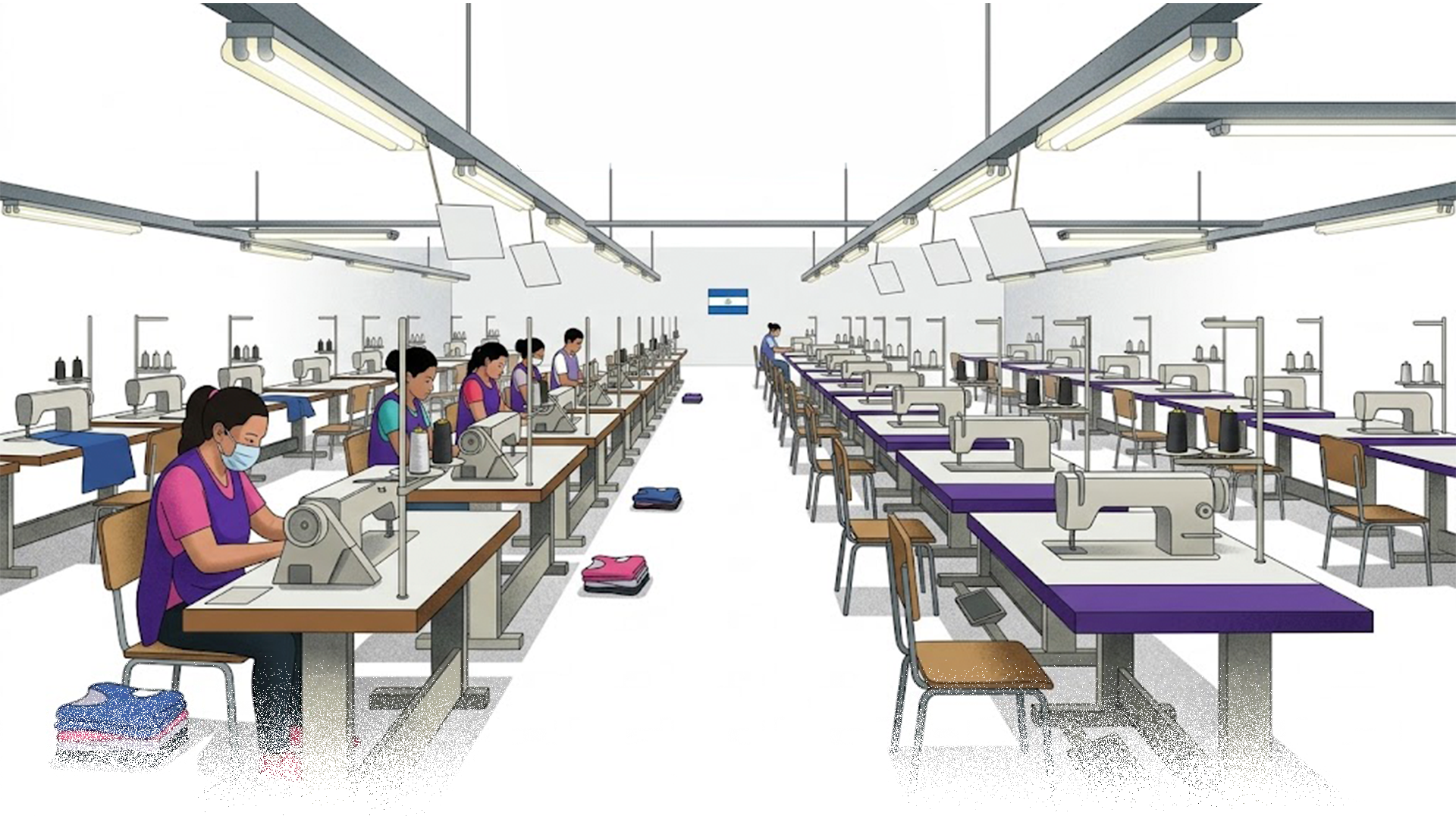
Vista de un grupo de trabajadores en una Zona Franca del sector textil nicaragüense. Foto: Archivo | Confidencial
The 18% tariffs imposed by Donald Trump’s administration on exports from Nicaragua to the United States — set to take effect on Thursday, August 7, 2025 — while tariffs for the rest of the CAFTA countries remain at 10% (with the exception of Costa Rica, which will face 15%), will mainly affect exports of textiles, which amount to $2 billion, and exports of automobile electrical harnesses, around $800 million, according to economist Juan Sebastián Chamorro, former Deputy Minister of Finance.
In an interview on the program Esta Semana, broadcast on CONFIDENCIAL’s YouTube channel due to television censorship in Nicaragua, Chamorro explained that with the eight-point difference in tariffs, Nicaragua will lose competitiveness compared to other countries like Honduras and the Dominican Republic, which export the same textiles to the United States, or automobile harnesses to Mexican plants that export to the U.S. and are subject to higher taxes.
The former political prisoner, exiled in the United States and a researcher at Tulane University in New Orleans, warned that in addition to the 18% tariffs, Nicaragua could face further taxes if the United States decides to adopt other unilateral trade measures due to violations of the CAFTA agreement or because of its clientelist relationship with China, Russia, Iran, and North Korea. Nicaragua has already been excluded from the regional investment summit promoted by the United States, which will take place in October 2025 in Panama.
On Thursday, March 7, 2025, Donald Trump’s tariff policy will take effect for more than 90 countries around the world, ranging from 10% for many of them, up to 50% for Brazil, 35% for Canada, 30% for China, 25% for Mexico, 15% for the European Union, and 18% for Nicaragua. What impact will this trade war have on the global economy?
This is an unprecedented event in global economic history: a commercial and economic superpower imposing tariffs on the entire world. It will revolutionize trade relations. Economists, for well-established reasons, have generally opposed the imposition of tariffs because they involve restrictions or disruptions to trade relations. Therefore, it can be concluded that, overall, this will have a negative impact on the global economy.
In the United States, there is already talk of an inflationary surge once the inventories of imports made before the tariffs run out, which will lead to rising prices. The specific impact on each country will be harder to predict due to the enormous uncertainty surrounding trade policy. That helps explain why President Trump wants to conclude these negotiations quickly, setting deadlines—because the uncertainty is also affecting U.S. markets.
Tariffs are being justified as a way to defend U.S. economic interests, but in some cases, Trump is imposing them as a form of political pressure or retaliation over political disagreements—as with Brazil or Canada, for example, whom he is threatening with additional tariffs for recognizing the Palestinian state.
Yes, and part of the justification is that Canada is one of the main exporters of fentanyl to the United States, something that has not been proven. Using trade policy as a political weapon leads to distortions that further harm trade relations. In Canada and Mexico, whose economies have become highly intertwined with the U.S. since NAFTA was signed decades ago, this situation is a nightmare for exporters and importers. Some auto parts cross the borders two, three, or even four times. All of this will lead to a series of structural changes in a world with tariffs and high taxes due to the distortions involved, creating a situation worse than what would exist under free trade.
Will the reciprocal measures that some countries are adopting against the United States have any impact on price levels or domestic consumption in the U.S.?
Definitely, and it’s not very clear that this will benefit the countries imposing reciprocal tariffs, because they would also be punishing their own consumers and exporters, who are already being affected. So, these countries would be harming their local consumers as well. Economists worldwide have reiterated that this measure can only lead to reduced economic benefits for societies due to these trade wars. Therefore, we hope this doesn’t continue to escalate, especially the tariff war with China, which has the global market very concerned since these are the two main world powers.
In the case of Central America, although some countries tried to negotiate bilaterally with the United States, a 10% tariff was imposed on all, except for Nicaragua (18%) and Costa Rica (15%). Is this because both countries have a trade surplus with the United States?
That is the justification given by the administration—an overtly mercantilist one: “Because I sell you less than what you sell me, I’ll impose this tax on you.”
In reality, Nicaragua’s trade relationship with the United States shows a surplus largely because much of the manufactured goods Nicaragua needs are imported from nearby Central American countries rather than from the U.S. This particular trade dynamic exists because Nicaragua is part of the Central American Common Market, which supplies many products that would not be competitively priced if imported from the United States.
That’s why this differentiated 18% tariff is being applied to Nicaragua. There’s no doubt that this 18% tariff will disproportionately impact Nicaragua compared to other Central American countries that export very similar goods to the U.S.—such as coffee from Costa Rica and Honduras, or meat, where Nicaragua also has a strong position, and sugar, in Guatemala’s case. All of these products will enter with a 10% tariff, while those from Nicaragua will be subject to an 18% tariff. If Nicaragua isn’t competitive enough to make up for that 8-point gap, it will lose its position in the market.
I’m particularly concerned about the textile sector. Nicaragua exports around $2 billion in textiles, and its export structure is very similar to that of Honduras. In fact, when it comes to T-shirts, Nicaragua is the top exporter to the United States, followed very closely by Honduras. That T-shirt exported from Nicaragua will now automatically cost eight percentage points more—and that could knock it out of the market. Many investors might ask themselves: “Why would I keep producing in a country that now carries an 8-point surcharge?”
I’m particularly concerned about the textile sector in a year that hasn’t shown strong growth. In 2025, textile growth was just under 1% in dollar terms.
On top of that, the 18% tariff doesn’t yet factor in the ongoing case involving U.S. investors over property rights violations in the north of the country, which is part of a complaint filed with the U.S. Department of Commerce. The president (Trump) could respond to that rights violation by further raising the tariff above 18%.
How does this loss of competitiveness translate into Nicaragua’s domestic economy? Will companies sell less? Will this impact employment and business operations, or will they be able to absorb the blow?
Logic tells you that these orders will decline in the case of Nicaragua, and that drop will mean layoffs. Over time, some companies may end up pulling out.
We don’t have a crystal ball to predict this, especially because so many things are happening globally. Vietnam, for example, is also facing a tariff similar to what’s being imposed on Nicaragua and is similarly competitive. What’s most concerning is that neighboring countries—particularly Honduras, the Dominican Republic, and El Salvador—which also export textiles, will face a lower tariff. These are extremely sensitive products because they carry very low added value—about $10 per kilo, which is how the added value of these products is typically measured. A tariff nearly twice as high as theirs, even if Nicaragua remains competitive in terms of cheaper labor, will make it very difficult for production to grow.
Another sector that deserves close attention is automobile harnesses, with $800 million in exports. These plants are located in the western part of the country. The impact won’t come so much from the 18% tariff itself, but from the 25% tariff being imposed on Mexico. As a result, assembly plants in Mexico will have to reorganize their orders toward more efficient suppliers of automobile electrical harnesses.
I’m not sure how efficient Nicaragua is in that regard—I assume it is—but Honduras also produces them. In fact, Honduras exports more harnesses to Mexico than Nicaragua does and has the advantage of being around 200 kilometers closer in terms of transportation, and it crosses one less border. These companies, which operate plants in multiple countries, could simply shift their orders and increase production in countries with lower tariffs. Higher prices mean lower demand, so there will be a drop in orders for Nicaragua simply because of those additional eight percentage points.

In addition to the two products you mentioned—textiles and automobile harnesses—Nicaragua also exports gold and agricultural products to the United States, mainly beef, coffee, and tobacco. What could be the impact on these agricultural products?
Nicaragua is by far the most competitive country in the region when it comes to beef. Costa Rica exports very little, and due to issues with the cattle herd in the United States and specific market conditions, beef in the U.S. is currently at one of the highest prices in its history. So, in light of the 18% tariff, the effect needs to be weighed against the fact that prices are extremely high. In the case of beef, as long as prices in the U.S. remain relatively high, there could be some impact, but it may be offset by price levels nearing $7 per pound—levels not seen in a long time.
Gold is a product that, due to global economic uncertainty, is showing a relatively high price in the markets. When there is economic volatility, people turn to gold as a safe investment. Gold stands out strongly in export tables, but it has low added value and limited ripple effects on the economy.
A similar situation is happening with coffee. Coffee prices are also quite high. In fact, between 2024 and 2025, it has been the fastest-growing product in Nicaragua’s export basket, due to these high prices, which are expected to remain relatively strong because of the trade war, given that Brazil is the world’s largest coffee exporter.
This 50% tariff on Brazil may ease some of the economic pressure for Nicaraguan coffee producers, but it’s still unclear, especially considering that Honduran exporters will have an eight-point advantage, and Costa Rican exporters a three-point advantage. In other words, there will be a readjustment in Nicaragua’s exports, but since we’re talking about an increase in U.S. import taxes, this will have a negative effect on producers.
There are also some unresolved issues in the bilateral relationship between Nicaragua and the United States that involve trade matters and the CAFTA agreement. Secretary of State Marco Rubio said that the U.S. would review Nicaragua’s participation in CAFTA, arguing that a dictatorship should not benefit from trade advantages. On the other hand, there is an investigation that was launched by the U.S. Trade Representative’s Office under the Biden administration regarding Nicaragua’s violations of various aspects of the agreement. Is that investigation shelved, or is it still ongoing?
I contacted the Office of the U.S. Trade Representative, and they said the investigation is proceeding through the regular process. When hearings were held in January 2025, it was stated that the Office would take at least half the year—possibly the entire year—before bringing a resolution to the president.
The information I have is that the investigation is still ongoing and has not been shelved. I don’t believe it’s the number one priority, but it’s definitely a process that hasn’t been discarded, so that possibility remains open.
And we must remember that the U.S. president still holds discretion when it comes to determining trade policy on national security grounds—and he will use it. He’s already applying it by mixing foreign policy considerations with tariff issues. Whether that’s the right approach or not is a separate discussion, but it is happening.
If suddenly, in addition to the 18%, there are considerations that in Nicaragua, Daniel Ortega—with his alliances with Russia, Iran, and North Korea—poses a national security threat less than two hours by plane from the United States, the president could invoke the Trade Act and impose additional tariffs. That would effectively amount to an expulsion from CAFTA without going through the legal process of congressional approval, because in practice, a differentiated tariff that much higher would knock the country out of competitiveness. That risk is on the table, and it would translate into lower wages, more unemployment, and reduced investment.
We’re also seeing it in the announcement of a trade summit (promoted by the U.S.) in Panama, where Nicaragua isn’t even mentioned. Representatives from Belize—a very small economy—will attend, along with the rest of the Central American countries, and Panama as the host. But there is absolutely no mention of Nicaragua.
These are the economic consequences of having a regime that violates property rights, infringes on public freedoms, does not encourage investment, does not uphold the rule of law, and simply ignores you. We are in a situation very similar to what Cuba has suffered for so long.
Those are economic costs that are impossible to measure. We won’t be able to know the intentions of an investor who might have been interested in investing in Nicaragua, but simply because they were excluded from the event, that investment never materialized.
PUBLICIDAD 3M
PUBLICIDAD 3D

Alertas en tu celular
Suscribite a las alertas informativas de Confidencial en Telegram.

Boletines
Lo mejor de nuestra cobertura noticiosa en tu correo electrónico.

Anuncios
Obtené una propuesta comercial de acuerdo a tus objetivos y presupuesto.

Test Político
Explorá tus ideas sobre nuestra política, economía y sociedad con nuestro Test Político.