AA
Share

 Las noticias del día en tu correo
Recibe lo más destacado de la cobertura de CONFIDENCIAL todos los días.
Más boletines
The best of our coverage, in English
Sign up for our weekly newsletter. We will send it to you every Friday at 10:00 am (Nicaragua time)
More Newsletters
PUBLICIDAD 4D
PUBLICIDAD 5D
The regime has written off CAFTA and created Special Economic Zones which depend on three key factors to function: market access, a sound business environment, and qualified human talent

Laureano Ortega Murillo habla en la 18ª Cumbre Empresarial China–América Latina y el Caribe, en Zhengzhou, China, el 3 de noviembre de 2025. | Foto: Tomada de El 19 Digital
The regime’s bet to create Special Economic Zones (SEZs) to replace the United States with China as Nicaragua’s main trading partner is ‘bound to fail,’ according to three experts consulted by CONFIDENCIAL. They believe it is highly unlikely that the Ortega Murillo family will succeed in making China the primary destination for Nicaraguan exports.
On October 29, 2025, the Executive submitted a proposal to the National Assembly to create the Belt and Road SEZs. The zones are designed as a special regime with full tax, customs, port, border, and administrative incentives for companies that invest in the country. On October 30, the Assembly approved it, enacting Law 1264.
The law does not specify that it is intended solely to benefit Chinese companies. In fact, Article 6 states that companies “may be national or foreign,” but the “Belt and Road” name confirms, at the very least, a nod to the Chinese economy. Laureano Ortega Murillo, appointed advisor to his parents for Investment Promotion, Trade, and International Cooperation, confirmed this four days after the law was passed.
“All companies, especially Chinese companies that establish themselves under this regime in Nicaragua, will be exempt from all taxes for the entire time they operate in our country, and will have facilitation mechanisms for the establishment and operation of their businesses in Nicaragua,” he said at the 18th China–Latin America and Caribbean Business Summit held in the Chinese city of Zhengzhou.
The ruling party fast-tracked the Special Economic Zones (SEZ) law as a political lifeline in the face of potential sanctions based on the investigation carried out by the Office of the United States Trade Representative, says Félix Maradiaga, president of the Fundación Libertad.
He adds that Law 1264 is not a development policy, but “an attempt to sell a shift toward China as a replacement for our main market, while concentrating more economic power in a special commission under the control of the Executive.”
For economist Juan Sebastián Chamorro, the approval of this law “shows that Ortega has already cut ties with the export route to the United States and has decided to sail to another port: the Chinese port.”
The goal is to try to grow business volume with China enough to replace CAFTA, as has been stated repeatedly. “But, as we have said, that is not going to happen,” he emphasizes.
Ronaldo, a businessman in the food sector, observes how domestic companies are increasingly being strangled while multiple benefits are offered to foreign firms. From this perspective, he sees the approval of the SEZs as “a flirtation with the Chinese. It’s an SOS, saying ‘come save us. I am your ally, and I’m willing to give you everything you need if you offer me an alternative,’ in the face of the probable closure of the U.S. market,” he explained.
Chamorro also points out the difference in treatment between existing entrepreneurs and those the law is trying to attract. He believes this new law creates a Nicaragua of privileged business owners, while “entrepreneurs not covered under this regime will continue to be subjected to violations of their rights as investors, fiscal audits, disputes over DGA valuations, and excessive tax charges and extortion.”
The economist explains that the offer to exempt all these taxes is an attempt to convince certain companies to stay in Nicaragua, specifically those that are evaluating whether they can continue exporting to the United States under 100% tariffs.
“The government projects these SEZs to attract investors who will inject enough resources into the country to replace what has historically been our main market,” adds Ronaldo.
He also notes that “they are betting on Chinese companies coming to invest,” knowing it will be increasingly difficult to attract Western firms because “those companies require legal certainty; assurance that if they have a dispute with the state, they can win in court.” Looking at the broader reality of Nicaragua, the businessman emphasizes his skepticism about the regime’s ability to achieve its objectives.
In addition to the rule-of-law factor, which in theory should not concern Chinese companies since they have the backing of their government and the regime’s favorable disposition, there are other challenges that seem insurmountable. The first is the possibility of new tariffs being imposed on the products and services Nicaragua wants to export to the United States.
One of the main benefits of having a trade agreement with the United States is that it allows our country, like the other signatories, to serve as an export platform to that market. That benefit disappears—or is diluted—
“If Washington suspends CAFTA‑DR benefits, the rules of origin and preferential access are lost,” confirms Maradiaga.
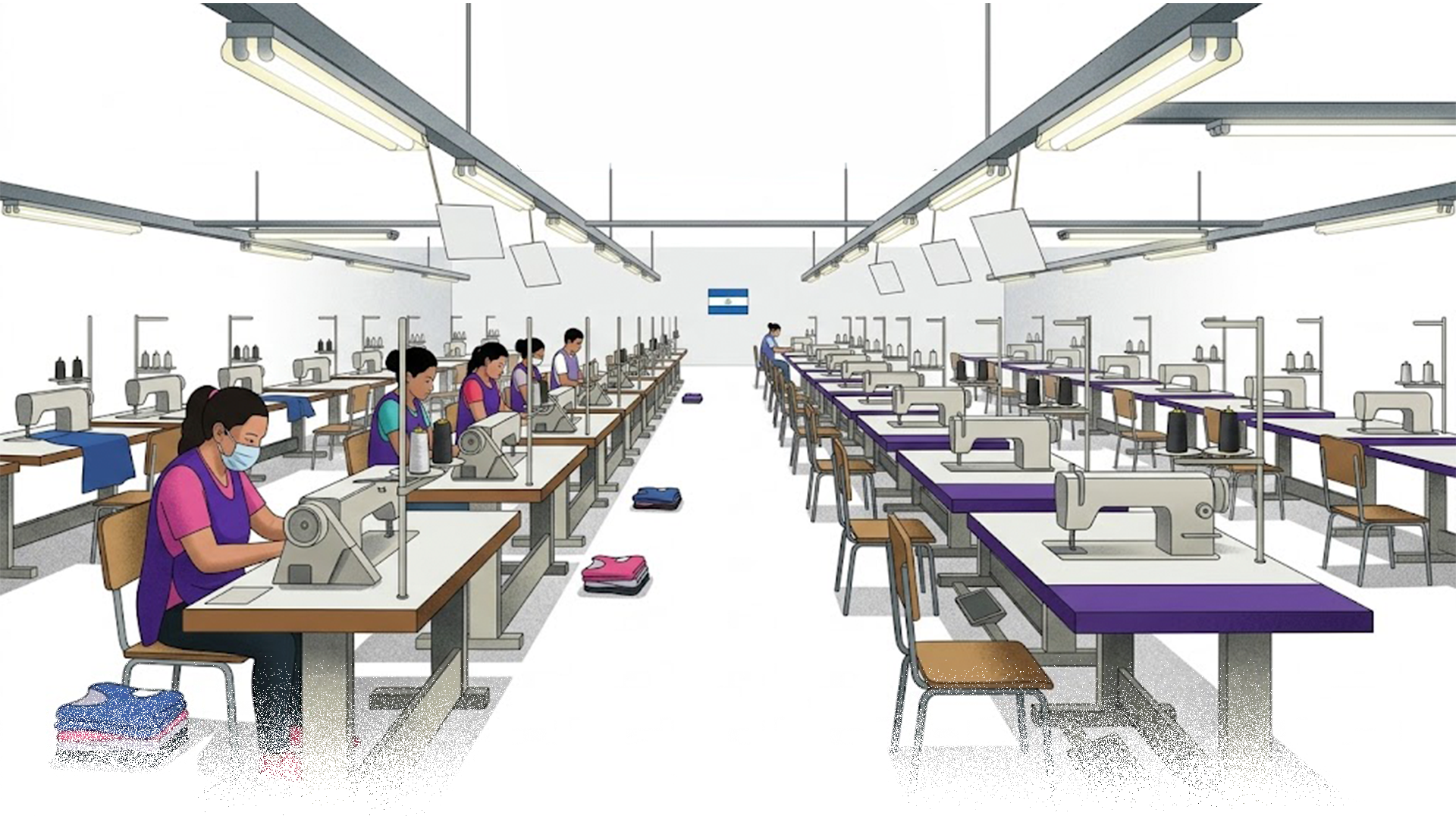
Another option would be for Chinese companies to produce in Nicaragua and export back to their home country, but once again, reality does not support this strategy. First, labor is cheaper in China as well as in some neighboring countries. Second, it is also cheaper to transport goods from Cambodia or Vietnam to China than from Nicaragua.
“Are you going to export clothes to the Chinese, who are the world’s largest exporters?” the businessman asks ironically.
Then there is the issue of brain drain. Rolando points out that the regime could not create an army of engineers in five or ten years, even if it tried, because “the human talent has already left us!” Additionally, he notes that “our education system is simply not prepared for that—especially after the best universities in the country were eliminated, or when the region’s top business school, INCAE, was shut down.”
From an economic standpoint, Special Economic Zones are not necessarily a bad idea. It is true, however, that they have not been very successful in the Central American countries that tried to implement them, even though they did work in places like South Korea, Taiwan, and Singapore.
Ronaldo recalls that South Korea and Taiwan were poor nations emerging from war when they embraced the idea of creating something like an SEZ. In doing so, the leaders of those countries established a strategy that began with investing in education and guaranteeing stability for investors. The next step was to set ambitious goals.
As a result, South Korea today is home to globally competitive brands such as Samsung, Hyundai, and Kia, while Taiwan has become a key player in microchip manufacturing. China itself competes in many sectors and holds the unofficial title of the world’s second-largest economy.
The businessman notes that those countries once produced rice, cotton, and similar goods because, at the time, “they were third-world economies, like those in Central America.” Most started with textile free-trade zones because these factories and types of machinery are comparatively simpler to establish in the initial stage. Proof of that is the fact that Nicaragua’s own free-trade zones are dedicated to similar activities.
Neither China, South Korea, nor Taiwan settled for that. They “designed a strategy to diversify into more complex, higher-value economic sectors that would generate greater contributions to the economy,” he explains. That approach helped create more skilled jobs with better pay—benefiting both the national economy and the citizens of those countries.
Maradiaga acknowledges that SEZs have worked in other countries, but clarifies that it was “in very different institutional contexts.” He cites examples such as Shenzhen in China and several parks in Vietnam, which succeeded because there were stable rules, competition, infrastructure, and macroeconomic discipline.
He notes that, globally, there are more than 5,400 SEZs across 147 economies, yet many show “modest or negative results when opacity and clientelism prevail. Without judicial independence, competition, or clear time limits on tax exemptions, SEZs tend to fail or benefit only a few.”
None of the three experts interviewed describe Nicaragua as a country with “stable rules, competition, infrastructure, and macroeconomic discipline.” Instead, they all see it as a place “where opacity and clientelism prevail, with no judicial independence and no real competition.”
PUBLICIDAD 3M
PUBLICIDAD 3D