AA
Share

 Las noticias del día en tu correo
Recibe lo más destacado de la cobertura de CONFIDENCIAL todos los días.
Más boletines
The best of our coverage, in English
Sign up for our weekly newsletter. We will send it to you every Friday at 10:00 am (Nicaragua time)
More Newsletters
PUBLICIDAD 4D
PUBLICIDAD 5D
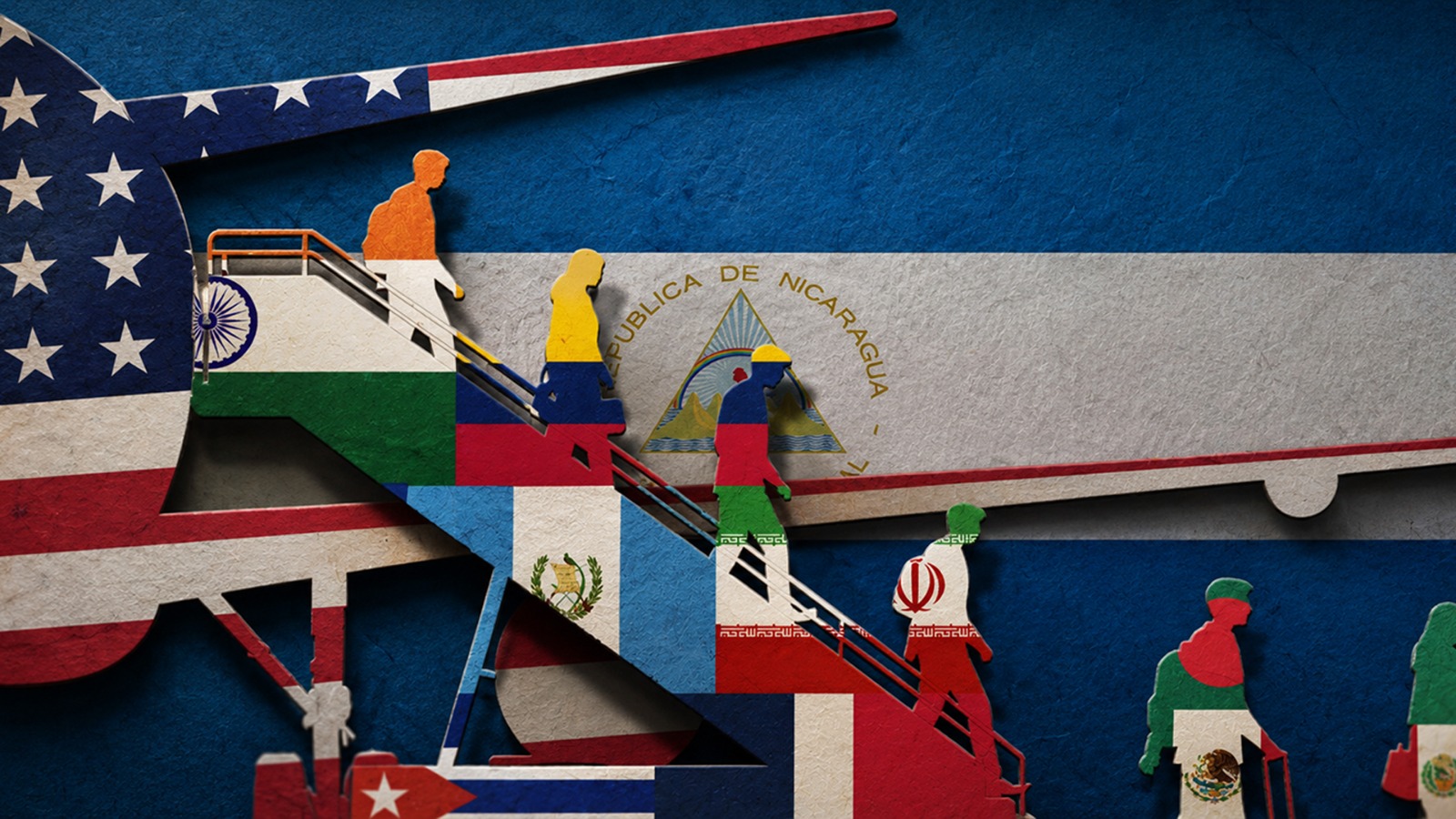
Manuel Orozco: The suspension could lead to the loss of 10,000 jobs in free-trade zones and a 15% drop in exports to the U.S.

Fotoarte: CONFIDENCIAL
More than 2,000 citizens, companies, and civil society organizations shared their views in the U.S. Trade Representative’s consultation on whether to recommend that President Donald Trump suspend the trade benefits Nicaragua currently enjoys for exporting to the United States under the DR-CAFTA agreement, due to serious violations of labor rights, human rights, and the rule of law.
In an interview on Esta Semana, which airs on CONFIDENCIAL’s YouTube channel on Sundays due to television censorship in Nicaragua, political scientist Manuel Orozco—researcher at the Inter-American Dialogue specializing in migration, remittances, and development—believes that “the highest likelihood is that some type of suspension of benefits will be imposed on the textile sector, the auto-parts (automotive) sector,” and on tobacco, before affecting the food or mining sectors.
According to Orozco, depending on the final decision, which Trump could announce within a month, this could result in the loss of 10,000 jobs in the textile sector and “a 10–15% drop in the value of exports” to the United States.
Orozco criticized the latest International Monetary Fund report on Nicaragua, which recommends that the government “strengthen transparency and the rule of law” but says nothing about property confiscations or the imposition of a police state that for seven years has dismantled the rule of law.
On November 19, the public consultation by the U.S. Trade Representative (USTR) concluded regarding the recommendations submitted to President Trump to suspend the trade benefits that Nicaragua has enjoyed for exporting to the United States under the CAFTA agreement, due to violations of the rule of law, human rights, and labor rights. What can be concluded from the dominant opinion among the more than 1,500 submissions—such as those from business leaders opposing sanctions, and others arguing that these trade advantages should indeed be suspended?
More than 2,000 comments were submitted to the Trade Office, and the dominant response was to support the findings of the U.S. International Trade Commission. In most cases, there was no consensus on what the most appropriate measure would be, but more than 60% of the comments aligned with those findings. The remaining 40% came mainly from companies—most of them in the tobacco sector, which accounted for one-third of the comments; second was the coffee sector, and third the textile industry.
Another group provided arguments aligned with what the Trade Office had asked for—namely, which measures would have the most direct impact on the harm caused by the dictatorial regime while minimizing the impact on U.S. businesses. Some business owners were honest and said that selective suspensions should be applied, but that they should also be accompanied by some form of diplomacy and foreign policy measures. Those are the three main trends that emerged.
Will the Trade Office present President Trump with a new version of its recommendations, or will it simply uphold the initial document that details all the evidence of labor and human rights violations?
The Commission’s proposal will include a recommendation on one of the four components—or a combination of them. The most likely outcome is the option of selectively suspending benefits by imposing tariffs on certain sectors. But it is also possible that it will include other recommendations that fall under the jurisdiction of the State Department. It’s important to remember that the Trade Office does not have the authority to conduct foreign policy or diplomacy. Therefore, it will defer that type of recommendation to the State Department, and from there the White House would formulate its final decision.
President Trump has no legal deadline to issue a decision. Does he have a political timeline? How relevant is the Nicaragua–CAFTA issue on the president’s agenda?
Nicaragua is not a priority as a country in U.S. foreign policy; what is a priority is what Nicaragua is doing. A dictatorial regime has
Although there is no defined deadline, the probability that a decision will be made in the coming months is very high—in other words, that starting December 19, a measure will be adopted and made public early next year. What the Administration is doing is being consistent: on one hand, it is accusing Venezuela of using its regime as a dictatorial system to profit through drug trafficking exports; on the other, it is accusing Nicaragua of using migration and free trade as strategies to benefit itself against the interests of the United States.
What impact would these selective taxes—or an additional 10% tariff on top of the 18% Nicaragua’s exports already face—have on export sectors? Those are the options, since imposing a 100% tariff now seems to be off the table.
The decision revolves around the political context in the United States, where the focus is on reducing the impact that tariffs might have on food. That includes coffee, bananas, and meat. It does not include tobacco, because it is considered a luxury product. Paradoxically, those who commented against raising the price of tobacco said, “This is the only indulgence I allow myself.” As if to say: go ahead and keep exploiting people, protect the dictatorship, but don’t raise cigarette prices.
Practically speaking, the immediate effect would be a decrease in demand for Nicaragua’s exported products. How large would it be? That depends on the specific measure. The highest likelihood is that some type of suspension of benefits will be imposed on the textile sector, and secondly on the auto-parts sector (for automobiles), which also has a higher probability of being relocated within Central America. This is more likely than measures affecting the food or mining sectors, which are quite protected. Such a measure could result in a 10%–15% drop in demand for exported goods.
The sectors you’re mentioning are highly labor-intensive—at least in the case of the textile factories. What impact could this have on employment and on Nicaragua’s economy, especially on next year’s growth projections?
Exports to the United States are split between the manufacturing sector in the free-trade zones and the agricultural export sector across different regions of the country. In the case of the Free-Trade Zone, there are 45 industrial parks, and more than 70% of exports are destined for the United States. These are primarily textiles, and they function as enclave economies.
The value chains in textile production have very limited impact on the local economy because the inputs are imported; what they leverage is the local labor force. There would be an impact in terms of reduced employment—potentially a loss of around 10,000 Free-Trade Zone workers. The presence of companies had already been shrinking since 2018, as had employment. This would accelerate a process that was already underway for several reasons, primarily Nicaragua’s lack of legal certainty. In this context, you will see an impact on certain labor sectors and on profitability, because the profits generated by companies in the Free-Trade Zone are extremely high compared to what they contribute to the local economy. Essentially, what remains in the country is wages—less than 20% of the exported value stays in Nicaragua in the form of salaries.
The International Monetary Fund’s report warns of the uncertainty surrounding the national economy if broader and stricter sanctions are imposed, but it only projects a slight decrease in growth forecasts for 2026. Is the IMF taking into account the potential impact of suspending Nicaragua’s export advantages?
I believe that the International Monetary Fund, and economist Alina Carare, have chosen to shield the Nicaraguan regime by suggesting that this is an economy with relatively stable fiscal and monetary indicators and policies. The statement they released to the press is quite generous toward the dictatorship, in a context that is completely unrealistic. First, this year—something they themselves acknowledge—the economy will grow because of remittances: 33% of the GDP comes from remittances, which adds almost three percentage points of growth. Second, there has been an increase in exports, which had already been occurring within the global economy, mainly driven by the United States.
Next year, what will likely happen is an economic contraction due to a slowdown in remittance growth, which will probably hover around zero to 2%. A 3% increase in remittances boosts GDP by 1%; if the rate is 0%, the country’s economy will not achieve growth higher than last year’s rate.
Secondly, a decline in foreign trade will also affect overall economic activity—though not domestic activity, which is already fragile. For example, credit supply has not been growing; it has been falling, and what does grow is private consumption through debt, which in the future many will likely be unable to repay. The IMF’s indicators and the comments they make are embarrassing. One can understand them to some degree, but they’re shameful.
The IMF also recommends that the Government strengthen transparency, the rule of law, and the business climate. But it says nothing about the causes of the opacity and lack of transparency. It does not mention property confiscations, nor does it say that the police state must be lifted—even though that is what has destroyed the rule of law. It’s as if they were talking about another country. Why so much complacency toward the Nicaraguan regime?
You’d have to ask the IMF economist, because I’ve asked her, and she knows Nicaragua is a dictatorship and that even traveling to the country requires caution. There are two reasons why they’re not saying things as they are: first, because they don’t want to backtrack and be forced to explain why they defended the Government in earlier reports as well. And second, because issuing a negative assessment—one proportional to what is actually happening in Nicaragua—would have very serious implications for the country’s economy, and they don’t want to be held responsible for that.
One of the IMF’s mandates in overseeing a country’s economic stability involves four indicators: the independence of the Central Bank, the independence of the financial sector, the regulatory structure of the market, and the fulfillment of the rule of law in Nicaragua. If you apply that checklist rigorously to Nicaragua, you’ll see that independence does not exist. In December of last year, Nicaragua merged the Superintendency of Banks with the Central Bank—eliminating independence altogether. They also introduced a mechanism that penalizes financial institutions that refuse to maintain economic relationships with sanctioned individuals and accuses them of being “traitors to the homeland.” Legally speaking, what Nicaragua is doing is protecting criminals, and that in itself represents an extremely high financial risk—yet the IMF remains silent. And we haven’t even touched on the rule-of-law issue: there is no legal certainty, the justice system has disappeared, and it has been subordinated to the Prosecutor’s Office. That inconsistency makes no sense at all.
What is clear is that the suspension of the trade benefits Nicaragua had for exporting to the United States is imminent, although it is not an “atomic bomb,” nor will it cause the economy to collapse. The economy will continue functioning, but at a slower pace, with certain impacts on export-oriented zones. But does it affect the country or not? Because the government seems unaware—or pretends to be—and its only response so far has been to grant more concessions to Chinese mining companies and promote the Special Economic Zones, tax-free for Chinese investors, as some kind of miracle solution. Can this compensate for the loss of preferential access to the U.S. market?
Those advising Rosario (Murillo) are telling her: “Stay quiet, because as long as you let them keep deporting people (back to Nicaragua) and you don’t say anything, and you don’t get involved in any drug-trafficking activities, the United States will leave you alone.” But that’s not the reality, because the current U.S. foreign policy is unilateral—there are no bilateral concessions.
There was a specific decision regarding CAFTA: since May, the CAFTA member countries began negotiating bilaterally with the United States, with the exception of Nicaragua. All of this was imminent, but the regime has this mindset that as long as their inner circle keeps accumulating wealth, and they can bet on China, everything will be fine.
The reality is very different. From a commercial standpoint, China offers products that Nicaragua itself produces. So you cannot continue importing products in volumes that prevent you from being competitive domestically. They are displacing Nicaraguan domestic commerce, which is why Nicaraguans are furious with the Chinese and with the dictatorship.
China’s investments in Nicaragua are long-term, closer to a ten-year horizon, especially in mining, assuming they can eventually displace the gold companies that are currently exporting abroad. That can only happen if the Ortega-Murillo regime weakens the productive capacity of companies like Calibre Mining and Hemco, among others. And that is exactly what they are doing: continuing to shrink the options for sustaining themselves in a durable way.
PUBLICIDAD 3M
PUBLICIDAD 3D