AA
Share

 Las noticias del día en tu correo
Recibe lo más destacado de la cobertura de CONFIDENCIAL todos los días.
Más boletines
The best of our coverage, in English
Sign up for our weekly newsletter. We will send it to you every Friday at 10:00 am (Nicaragua time)
More Newsletters
PUBLICIDAD 4D
PUBLICIDAD 5D
An undercurrent is sweeping across the country. Thousands of citizens are viewed with suspicion by those in power. That is what drives tyrants to despair

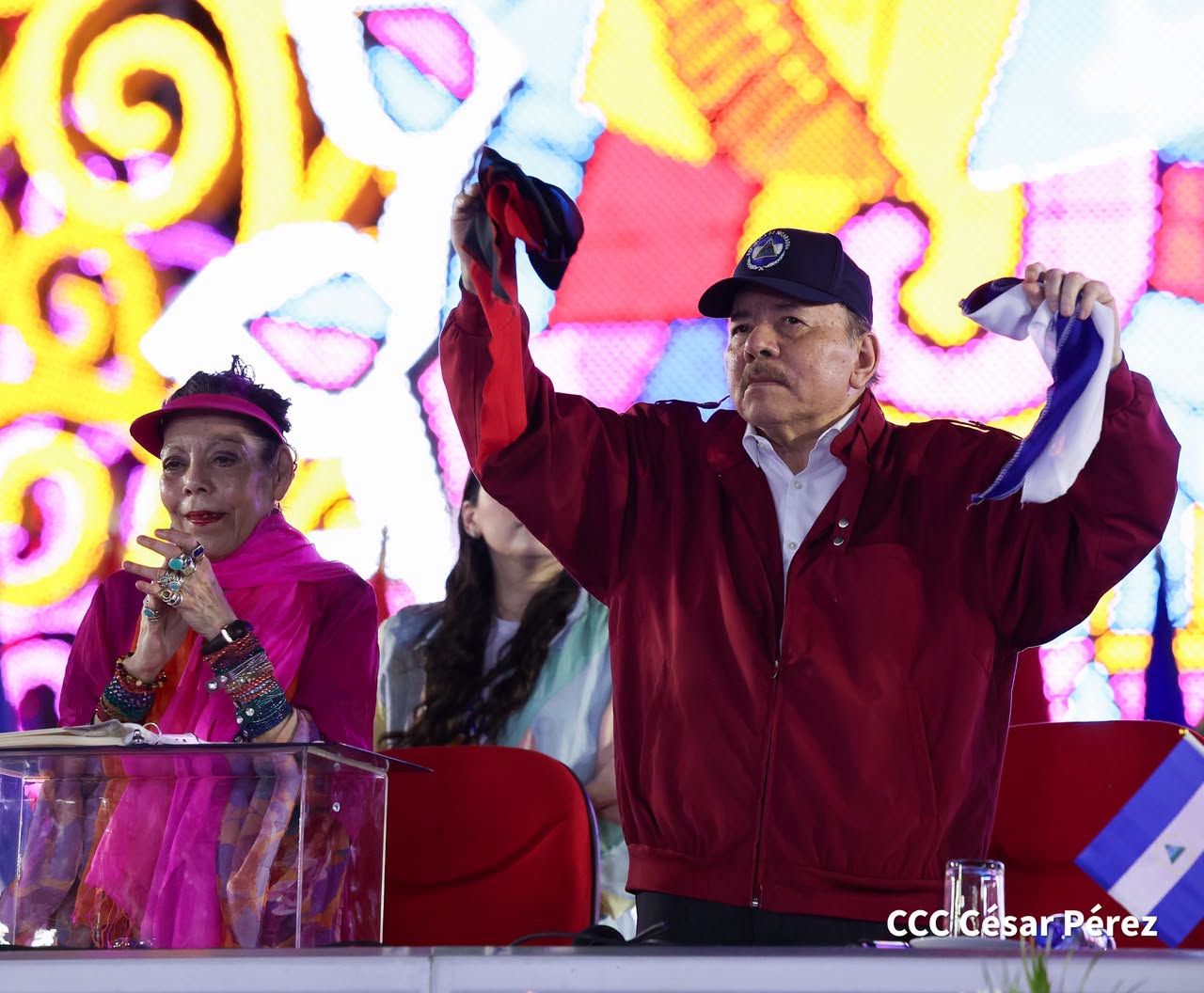
Los dictadores Daniel Ortega (der.) y Rosario Murillo junto al sancionado diputado Gustavo Porras, participan en un acto oficial el 4 de mayo de 2026. | Foto: CCC
Historically, the term “fifth column” is attributed to a Spanish general during the Spanish Civil War. He was preparing to attack Madrid—then under Republican control—with four armed columns. The general surprised everyone by stating that the most important and decisive force would be the “fifth column” – secret forces that would operate from within the city.
In today’s Nicaragua, there is neither a “Republic” nor a civil war. Nor are there armed columns—military or civilian—inside or outside the country. No one is preparing, for now, to take [the presidential bunker of] El Carmen. And no one desires the deployment of armed forces, much less the Trump fantasies with which some irresponsibly speculate. However, it is indeed essential that an internal force be promoted and made visible to contribute “from within” to the progressive undermining of the pillars that sustain the dictatorship and stimulate its eventual collapse.
In this brief article, we will limit ourselves to giving substance to what we will call the conduct and behavior “from within”: its inclusive character; its possible components; and its forms of action. I start from a basic premise: the dictatorship will not fall like a ripe mango, as in the case of Maduro, nor is there a set date for its fall. Rather, it is a matter of impelling and channeling a complex and protracted process. For the sake of brevity, I will omit here a detailed analysis of the mechanisms through which the regime has captured and subjugated the Nicaraguan state and society.
I’m talking about citizens who initially operate without any organic connection to one another. Thousands of lone wolves, convinced, however, that others are doing—or will do—the same. That lack of visible coordination, which might seem like a weakness, ultimately becomes a significant force in the current context. It is the sign of a silent insurrection of conscience, an underground current sweeping across the country and casting a shadow of suspicion over countless citizens in the eyes of those in power.
Such a current can drive the insecure conscience of tyrants to desperation and destabilize them. The intuition that threats are everywhere; that it is becoming increasingly difficult for them to leave El Carmen and reach the nearest plaza in peace; that the hour of reckoning is approaching. It is precisely this constant suspicion that fuels, day after day, their exaggerated policies of fear and terror.
These forces “from within” are gradually emerging as a silent democratic resistance of isolated individuals and small, trusted groups within public institutions, the military and police apparatuses, and also among citizens in neighborhoods, schools, universities, factories, and rural communities. There are grassroots priests and committed parishioners; unemployed journalists; environmentalists; feminists; activists from numerous, now-outlawed, organizations; resentful citizens who’ve been mistreated by the regime; silent dissenters, and even some former regime operatives who were purged by that same dictatorship.
There are also thousands of non-Ortega Sandinistas who reject the regime and their affiliation with Chavismo [authoritarian political legacy of Hugo Chavez in Venezuela]. And, of course, there are those who, even while working for the government or the ruling party, quietly lean toward dissent.
It is this discreet action, still without visible leaders, that could gradually transform into increasingly organized networks and groups. A fabric of resistance capable of sustaining a permanent siege and, eventually, producing an organizational leap that might ultimately bring about the collapse of the dictatorship.
Today, these individual dissident consciences comprise an enemy difficult for the state repressor to detect. A conscience that seeks ways to act without exposing itself unnecessarily. That asks which government activities can be discreetly delayed or boycotted; which rumors can be circulated to deepen internal divisions; which satires and jokes can ridicule those in power; which information can be leaked to independent media; which acts of corruption and immoral conduct by the regime should be made public.
They are the ones who know that there are names that must be kept only in memory: neighbors or coworkers who inspire trust for discreet political exchange and the eventual formation of small circles of trust. They are the ones who use secure platforms to communicate and wonder which tech-savvy young people might be able to help strengthen communications while protecting them from surveillance.
They are the ones who identify, within their communities, the numerous citizens mistreated by the regime or victims of its policies who could be drawn into the democratic resistance sooner rather than later. They are the ones who consider how to approach active-duty or retired army or police officers who do not believe in the dictatorship’s course of action.
They are the ones who attend Mass not only out of faith, but because it’s still possible to meet like-minded others there. Those who practice solidarity without fanfare and support community causes without drawing attention to themselves. Those who comment every day about the unaffordable cost of basic necessities; the corruption that impoverishes the country; the repression that is no longer bearable; the arbitrary fines; the violence against women; the lack of medicines in hospitals; the annihilation of democracy; the humiliating dependence on remittances; the absence of a future for their children.
They are the teachers who, through small gestures, note the failure of an education system subjugated to propaganda. The educators who identify young people with talent and critical awareness to guide them discreetly. Those who teach that we must unite, leaving behind the old ideologies and sectarianisms.
They are the ones who keep nothing in their phones that could compromise them or their friends. Those who listen quietly to independent journalists. Those who take advantage of birthdays and family gatherings to talk and plot discreetly. Those who don’t fall for provocations in taxis or buses. Those who are wary of the surveillance in their neighborhood and informants in the workplace.
They are the ones who do not forget the torturers or the repressors. Those who pay attention to what’s happening in the indigenous communities. The rural people who preserve the memory of their struggles and share it only with trusted individuals. Those who do not forget the political prisoners. Those who observe how the Chinese businesses are displacing and bankrupting small and medium Nicaraguan merchants, while taking over entire sectors of the national economy.
They are those who understand that the regime is also sustained by undesirable international alliances yet finds itself increasingly isolated. Those who know that, when the time comes, they’ll need the support of those police and military personnel who still have clean hands.
They are also those who are not obsessed with taking sides in the disputes and leadership struggles of the distant exile community, because they understand that preparing the struggle within the country remains the strategic priority today. They know that external factors will have an important role to play later on, but that this struggle will not be one of “knockout blows,” nor can it be reduced to just waiting for the dictatorship to collapse on its own. They understand that dialogue, unity and negotiations will also be necessary to administer an eventual transition with its inevitable tensions.
Within these sectors, there are no partisan orthodoxies or would-be strongmen. They work in silence to spark a great patriotic uprising against tyranny, in a process that welcomes all who aspire to a free Nicaragua.
These individual and small-group initiatives could gradually evolve into networks of growing interconnection, coordination, and political organization, both within and outside the country. And then the blue-and-white Nicaraguan flag will once again fly freely, without fear, over this land that still belongs to everyone.
PUBLICIDAD 3M
PUBLICIDAD 3D

Alertas en tu celular
Suscribite a las alertas informativas de Confidencial en Telegram.

Boletines
Lo mejor de nuestra cobertura noticiosa en tu correo electrónico.

Anuncios
Obtené una propuesta comercial de acuerdo a tus objetivos y presupuesto.

Test Político
Explorá tus ideas sobre nuestra política, economía y sociedad con nuestro Test Político.