AA
Share

 Las noticias del día en tu correo
Recibe lo más destacado de la cobertura de CONFIDENCIAL todos los días.
Más boletines
The best of our coverage, in English
Sign up for our weekly newsletter. We will send it to you every Friday at 10:00 am (Nicaragua time)
More Newsletters
PUBLICIDAD 4D
PUBLICIDAD 5D
All the magistrates are “decorative” figures. “Rosario Murillo appoints and removes judges in Nicaragua,” denounce Judicial Branch workers

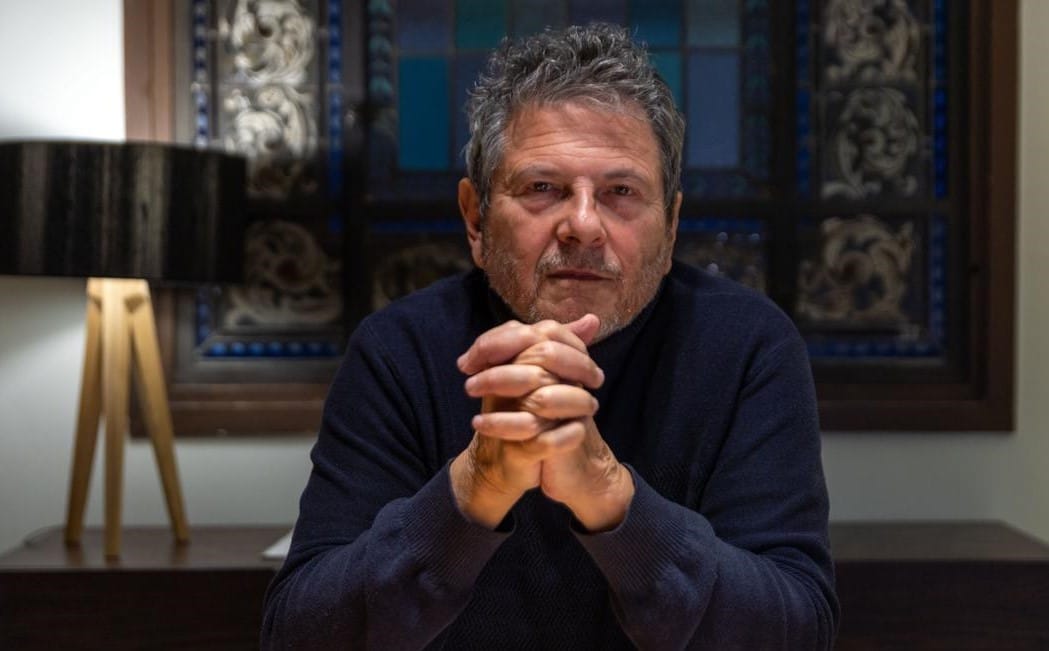
Imágenes de izq. a der.: Róger Martínez Domínguez, Arlen Reyes López, Rosario Murillo y Fidel Moreno. | Fotoarte: CONFIDENCIAL
As she does every Monday, Gladys arrived punctually at her office, located in one of Managua’s judicial complexes. “I’ve gotten used to arriving as early as possible, especially on Mondays and Fridays, which tend to be the days when people get fired—although you never really know,” she says. That day, October 27, 2025, she was surprised when a large group of public employees were blocked from entering their workplace.
“That’s how they were notified that they were being fired, without any explanation,” she explains. For
That Monday, it became known that some workers had been fired over the phone during the weekend. “They didn’t even wait for them to show up to work. It’s completely rude and disrespectful to the workers they dismiss without any justification,” she adds.
But the unstoppable, silent wave of dismissals is not limited to Managua. It has reached courts in municipalities such as La Paz in Carazo; Nagarote in León; El Rama on the Northern Caribbean Coast; and El Almendro in Río San Juan.
The purge in Nicaragua’s Judicial Branch, ordered by “co-president” Rosario Murillo and initiated in late October 2023, has not stopped and now totals more than 1,600 people dismissed nationwide, sources linked to that branch of government confirmed to CONFIDENCIAL. But who are the ones carrying out Murillo’s orders?
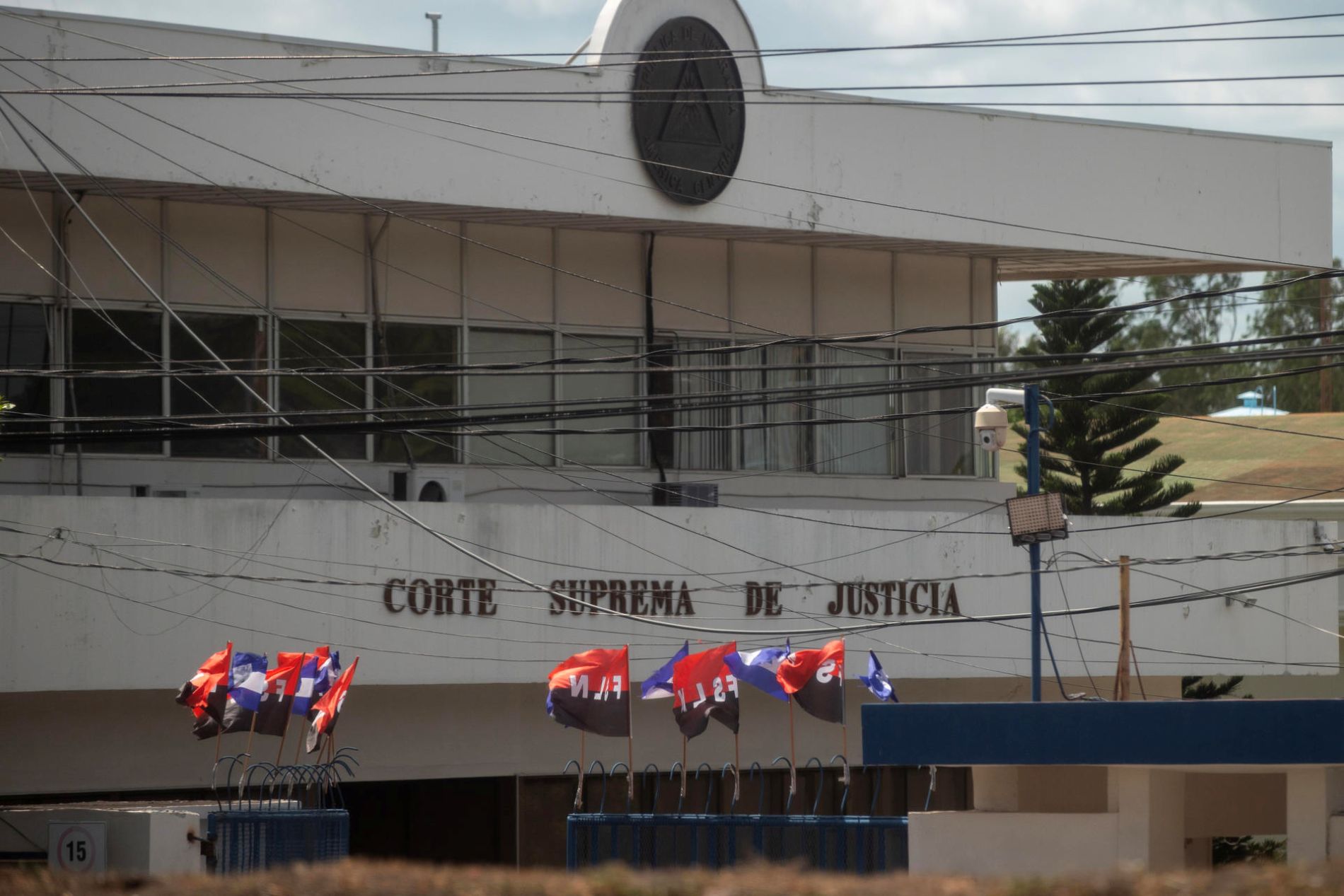
Since the intervention in the Judicial Branch, a “restructuring” process has continued, carried out outside the authority of the Supreme Court magistrates, who have become merely “decorative” figures.
The vice president of the Supreme Court, Marvin Aguilar, was initially identified as the “acting president,” which appeared to be a promotion. However, he is now “just a decorative figure, with no role beyond appearing at public events and—like the other magistrates—signing any document or resolution sent to him from El Carmen,” sources linked to the Judicial Branch confirmed.
This so-called “restructuring” is being directed by Fidel Moreno, the organizational secretary of the Sandinista National Liberation Front (FSLN) and one of Murillo’s “trusted men.”
But Moreno has positioned two key operatives who are in charge of “managing the day-to-day” operations of the Judicial Branch: Róger Martínez Domínguez and Arlen Idalia Reyes López.
Róger Martínez Domínguez was appointed as the administrative secretary-general of the Supreme Court, replacing Berman Martínez, who was dismissed, imprisoned, and convicted in a secret trial.
Before joining the Judicial Branch, Martínez Domínguez was an auditor at the Office of the Comptroller General of the Republic (CGR).
As for Arlen Idalia Reyes López, she is a business administrator from Matagalpa who served as the human resources director at the Managua Mayor’s Office.
Reyes López had previously worked as the administrative and financial director of the Ministry of Women (MINIM). In 2017, she was cleared after filing a review appeal against a CGR resolution that held her administratively responsible for failing to comply with probity declaration requirements.
“Both are Fidel Moreno’s eyes and are above even the entire Full Court, which is currently made up of eight magistrates,” said a source linked to the Judicial Branch.
According to the source, at this point Daniel Ortega’s influence is minimal. “Here, the one who appoints and removes judges in Nicaragua is Rosario Murillo,” the source insisted.
For former Judicial Branch official Yader Morazán, these two new officials, who have no experience in judicial matters, “came to boss everyone around, including the magistrates.”
“These people are currently the most powerful, above people who have been working in the Judicial Branch for decades, and although they supposedly came to reorganize, they ended up just giving orders,” he explains.
Morazán notes that these officials have been responsible for “displacing” interlocutors who had significant influence with judges and magistrates, such as Néstor Moncada Lau and Lenin Cerna, both fallen out of favor in the “great political purge” ordered by Rosario Murillo.
“They’ve come to sweep away the strongholds that existed in the Judicial Branch at all levels, including those protected by magistrates,” Morazán asserts.
The former judicial official details that the “purges” within the Judicial Branch have even affected lawyers “who boasted about rubbing elbows with the powerful and selling judgments and favors.” One of them is lawyer Francisco Reyes, uncle of the now-powerful judicial official, Arlen Idalia Reyes López.
“That lawyer is in prison, which shows that no one is untouchable anywhere (…) I know many lawyers who were given free rein and now are sleeping in safe houses out of fear,” Morazán asserts.
Sources connected to the Supreme Court told CONFIDENCIAL that among those dismissed in October 2025 were officials “at all levels,” particularly judges and staff in municipalities of León, Matagalpa, Carazo, Chontales, Managua, and the North Caribbean Coast.
In the first days of November 2025, the purge reached about 15 CSJ employees in Managua, as well as two judges in the capital and one in León.
“What’s happening is uncontrollable, and it paralyzes many of the pending justice cases in the country,” comments William, a municipal judicial official.
Among those dismissed are officials who have been loyal to the Ortega-Murillo regime, such as Judge Félix Salmerón, who headed Managua’s Fifth Criminal Trial Court.
“It’s unclear what criteria are used to fire people; only the top leaders of the dictatorship know that,” William observes.
This official, with more than fifteen years of judicial experience, believes the saddest part is that “no one knows what direction the Judicial Branch will take.” “There are judges who get dismissed and then reinstated weeks later; I even know some who are currently appealing their dismissals,” he adds.
To fill the vacancies left by the mass dismissals, the regime has ordered the hiring of personnel “with zero experience,” Morazán says.
This has caused “many pending cases to start over because those handling the cases are no longer there,” he notes.
He points out that the new officials are appointed “without knowing what criteria were used” and arrive stating that “their positions are political.”
Morazán emphasizes that this has created “discord,” because while positions remain vacant, some officials take on the duties of their former superiors, and when someone new is appointed, “they are demoted again.”
“Many take on these duties hoping to be appointed to the vacant positions, but suddenly ‘people from the street’ arrive and they are sent back to their old posts,” he explains.
These are not isolated cases, Morazán adds. It’s happening across the country, and the result is that “the old officials don’t want to help the new ones learn.”
A CONFIDENCIAL report published at the end of October 2025, marking two years since the CSJ has been intervened and paralyzed by the regime—two years after the “humiliating” removal of its president Alba Luz Ramos and the start of the massive purge—reveals that many departments remain inoperative and cannot act without the authorization of the “co-presidency.”
“There is a total paralysis of the CSJ (…) The magistrates barely come to their offices, and they are not allowed to sign rulings without the approval of El Carmen,” detailed a source linked to the Court.
Alberto, a judicial worker with over ten years of experience, notes that the fear is “enormous” because they have dismissed “people who were appointed by magistrates and judges who considered themselves powerful.”
“They used to strut through the offices boasting about being backed by people who are no longer there, or who, if still around, are hiding in a corner trying not to be seen,” he explains.
The indiscriminate purge has also left hundreds of officials without severance pay. “They don’t want to pay them, and that’s why the newly fired don’t report it—they fear the same thing will happen to them,” says Alberto.
On a panel aired on November 2, 2025, on the program Esta Semana, Azahálea Solís, a denationalized Nicaraguan and lawyer specializing in Constitutional Law, noted that currently, loyalty to Rosario Murillo is the only thing valued in the Judicial Branch.
Solís pointed out that in the current Court structure, “none of them have any power, not even administrative, not even enough to fix a sewing machine.”
PUBLICIDAD 3M
PUBLICIDAD 3D

Alertas en tu celular
Suscribite a las alertas informativas de Confidencial en Telegram.

Boletines
Lo mejor de nuestra cobertura noticiosa en tu correo electrónico.

Anuncios
Obtené una propuesta comercial de acuerdo a tus objetivos y presupuesto.

Test Político
Explorá tus ideas sobre nuestra política, economía y sociedad con nuestro Test Político.