AA
Share

 Las noticias del día en tu correo
Recibe lo más destacado de la cobertura de CONFIDENCIAL todos los días.
Más boletines
The best of our coverage, in English
Sign up for our weekly newsletter. We will send it to you every Friday at 10:00 am (Nicaragua time)
More Newsletters
PUBLICIDAD 4D
PUBLICIDAD 5D
There is an 82% chance that an El Niño event will occur in 2026, and it could become historically strong—an unusual “Godzilla Niño”
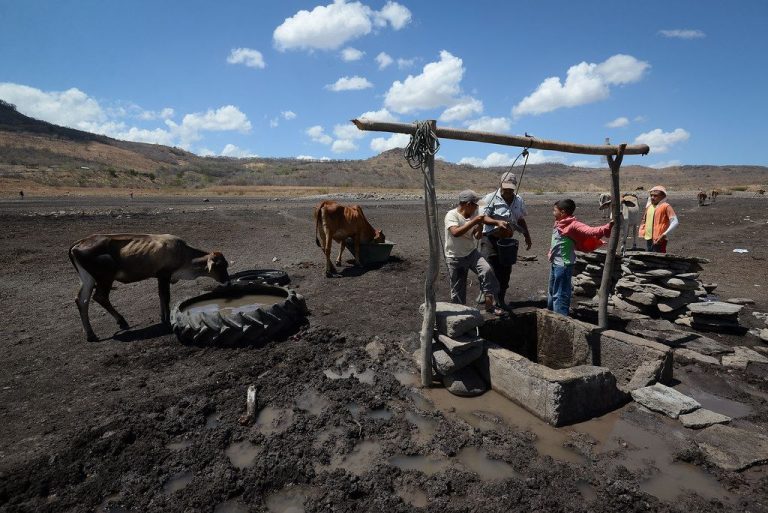
Una imagen de archivo muestra los estragos causados en el ganado por una sequía en 2016. Foto: Confidencial
The climate phenomenon known as El Niño is emerging forcefully in the Pacific Ocean, and the chances are increasing that it could become historically intense — an unusual “Super El Niño” — by mid-2026 and early 2027.
The latest update from the Climate Prediction Center of the National Oceanic and Atmospheric Administration (NOAA), published on May 14, 2026, indicates an 82% probability that El Niño will emerge between May and July 2026, and a 96% probability that it will persist through February 2027. But why does this phenomenon worry the planet?
NOAA is maintaining an alert over the possibility that El Niño could become especially intense, capable of disrupting global climate patterns for months. They estimate a two-in-three chance that its maximum intensity will be strong or very strong.
El Niño is a natural climate phenomenon that occurs when Pacific Ocean waters experience abnormal warming. This warming alters wind patterns and atmospheric pressure, triggering drastic climate disruptions worldwide: intense rainfall in some regions and severe droughts in others.
When scientists speak of a “Super El Niño”, they are referring to a particularly intense version of this phenomenon.
On average, El Niño occurs every two to seven years and usually lasts between nine and twelve months. Its intensity is measured by how much ocean water temperatures rise above average in a specific region of the Pacific Ocean.
El Niño develops when water temperatures remain more than 0.5 degrees Celsius above average over an extended period. For the phenomenon to be considered very strong or a “Super El Niño,” temperatures must be two degrees above average.
According to NOAA, ocean temperatures are still below the 0.5-degree threshold, but they are expected to surpass it in the coming weeks. Furthermore, they warn that El Niño is likely to strengthen during the second half of 2026.
What concerns experts is not only the arrival of El Niño, but also its magnitude. Some climate models point to an event comparable to the “Super El Niño” episodes of 1982, 1997, or 2015, which were linked to heat waves, massive wildfires, and historic tropical cyclone seasons. Even if this year’s El Niño does not reach “super” status, it is likely to be very strong.
Regardless of whether El Niño becomes strong or super this year, a major global impact is expected. An article published by BBC Mundo warns that several Latin American countries, particularly Mexico and Central America, have historically experienced the “most evident impacts” because of their proximity to the unusually warm Pacific waters.
They note that when El Niño is strong, it tends to generate droughts and conditions favorable for hurricane formation in the Pacific across Latin America. Meanwhile, the Atlantic usually experiences a calmer storm season.
In South America, countries such as Peru and Ecuador may experience much wetter conditions, leading to heavy rains and flooding. Meanwhile, northern South American regions bordering the Caribbean and Atlantic often face drought conditions.
CONFIDENCIAL reported that Nicaragua’s farm sector — which sustains exports and guarantees most of the country’s food security — faces a horizon of climate uncertainty because of this phenomenon.
Phenomena reaching the “Super El Niño” category are rare. The most recent high-intensity period took place between 2015 and 2016, although several months of a strong El Niño were also recorded at the end of 2023.
The severity of the last “Super El Niño” (2015–2016) was enormous, contributing to 2016 becoming the hottest year ever recorded at that time, while sea levels continued rising and the Arctic sea ice extention fell far below average.
The United Nations Food and Agriculture Organization (FAO), the International Fund for Agricultural Development (IFAD), and the World Food Program (WFP) warned about increasing food insecurity in Latin America and the Caribbean due to El Niño, which threatens millions of vulnerable people amid the climate crisis.
According to these organizations, more than 33 million people suffer from hunger, 167 million face moderate or severe food insecurity, and more than 181 million cannot afford a healthy diet in the Americas. They also note that the region accounts for 22% of global agricultural disaster losses, valued at 713 billion dollars.
The El Niño phenomenon could push more families into “a situation of vulnerability by causing arid conditions in Central America’s Dry Corridor (an arid region affected by poverty and vulnerable to the climate crisis) and altering rainfall and temperature patterns across the region,” the organizations warned in a statement.
*With information from EFE.
PUBLICIDAD 3M
PUBLICIDAD 3D

Alertas en tu celular
Suscribite a las alertas informativas de Confidencial en Telegram.

Boletines
Lo mejor de nuestra cobertura noticiosa en tu correo electrónico.

Anuncios
Obtené una propuesta comercial de acuerdo a tus objetivos y presupuesto.

Test Político
Explorá tus ideas sobre nuestra política, economía y sociedad con nuestro Test Político.