AA
Share

 Las noticias del día en tu correo
Recibe lo más destacado de la cobertura de CONFIDENCIAL todos los días.
Más boletines
The best of our coverage, in English
Sign up for our weekly newsletter. We will send it to you every Friday at 10:00 am (Nicaragua time)
More Newsletters
PUBLICIDAD 4D
PUBLICIDAD 5D
Human Rights experts consider that Ortega and Murillo are attempting to evade international justice in the event of a regime change in Nicaragua

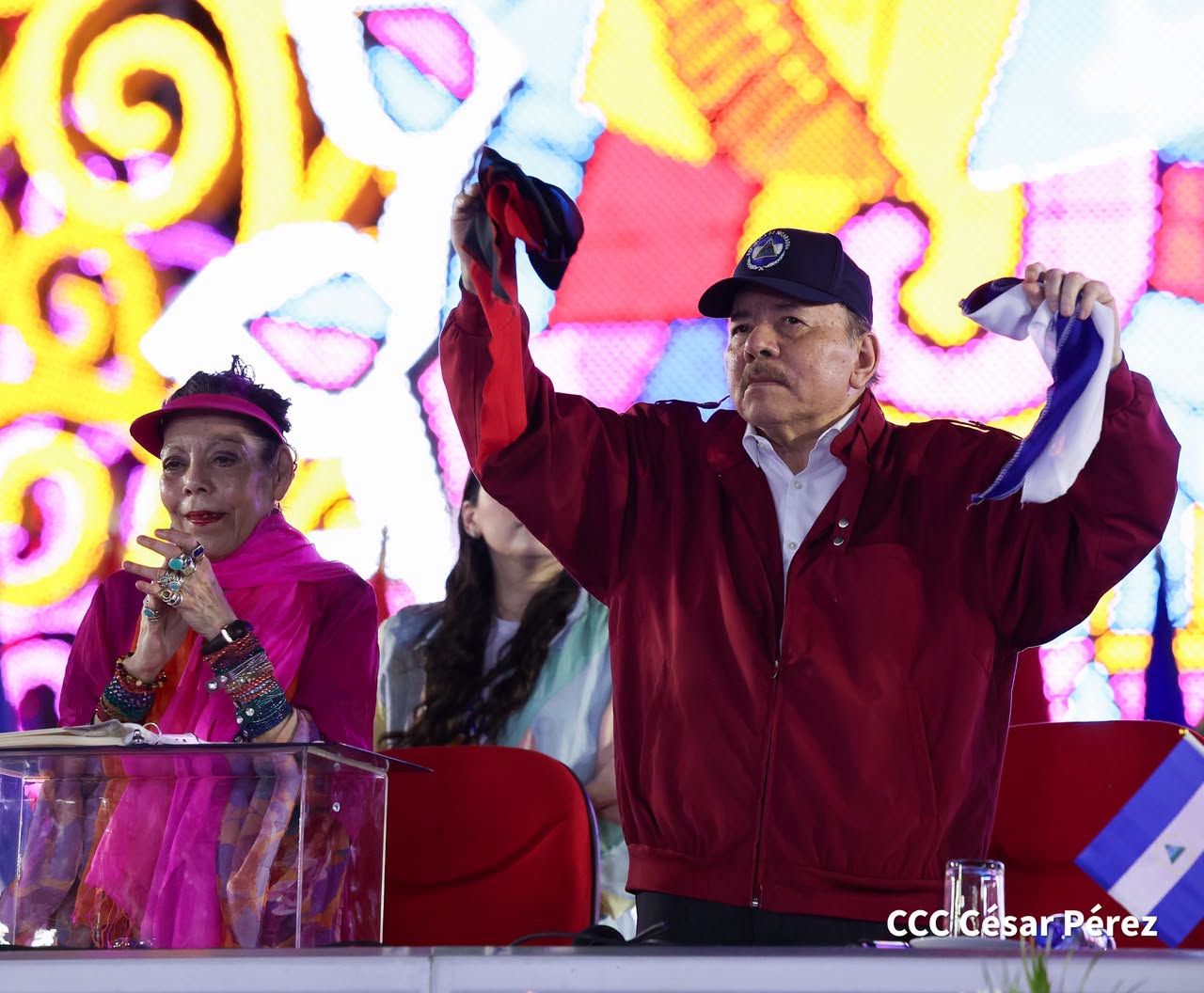
Los dictadores Daniel Ortega (der.) y Rosario Murillo llegan a un acto de la Policía Nacional, el 23 de junio de 2025. // Foto: CCC
The Nicaraguan dictatorship ratified an agreement of “mutual protection” with the Russian Federation, a move aimed at blocking the authority of the International Criminal Court and guaranteeing impunity for them and their inner circle, according to experts in the field. “This could be Daniel Ortega and Rosario Murillo’s Plan B,” in case of a change of government in Nicaragua.
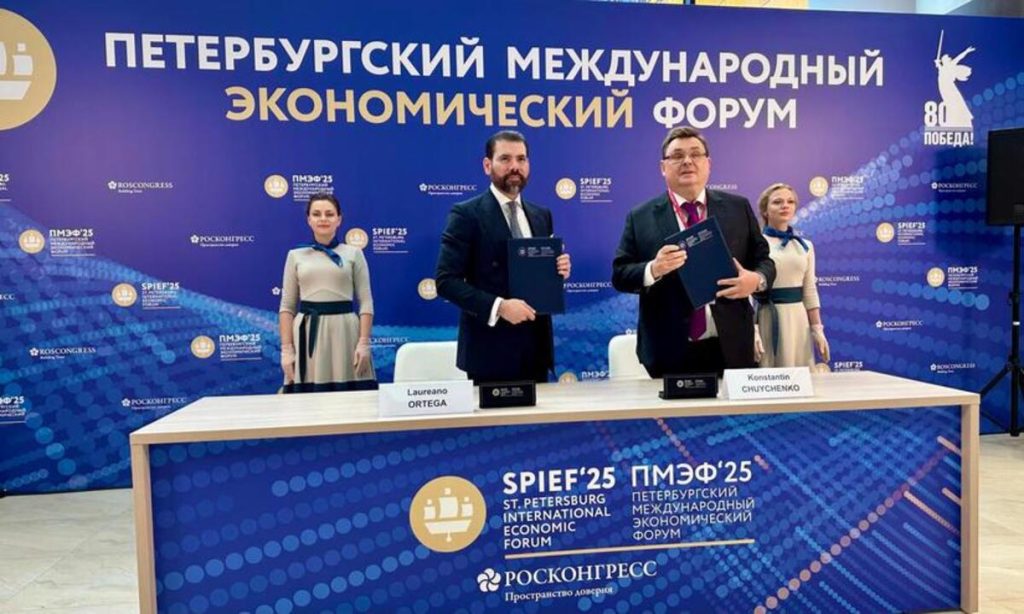
The binational accord was signed in St. Petersburg, Russia, on June 20, 2025, by Russian Justice Minister Konstantin Chuychenko and Laureano Ortega, son of Nicaragua’s dictatorial couple. The text of the agreement was approved by Nicaragua’s compliant National Assembly on July 10, with 91 votes in favor and no objections.
According to Ortega and Murillo: “International Justice has large gaps and contradictions,” is “an object of manipulation,” and “an instrument for interference and political intervention.” In addition, they have called the principles enshrined in the Statute of Rome, “totally askew and biased.”
With this agreement, Nicaragua and Russia seek to prevent their citizens from becoming ‘victims’ of the ‘deviations of international justice’ and pledge to ‘mutually grant immunities and privileges to citizens who may fall victim to this phenomenon, to keep sensitive information strictly confidential, and to prevent forced expulsions,’ according to the statement of purpose in the document sent to the National Assembly.
This “reciprocal protection” agreement between Nicaragua and Russia grants “absolute immunity” to Nicaragua’s co-presidents and the foreign minister of Nicaragua. Likewise, it offers guarantees to the Russian Federation President, the President of the Russian Government, and the Minister of Foreign Affairs.
It also grants “functional immunity” for any officials – active or retired – who have held the positions of co-president, plus mayors, assistant mayors, or anyone appointed by the Nicaraguan Executive branch or the National Assembly.
As long as these functionaries and members of their government cabinet remain on Russian territory, they will enjoy “personal inviolability;” “will not be subject to the jurisdiction of the courts” of that country; “may not be detained;” and “will not be obliged to appear before a court,” according to Article 7 of the agreement.
In Article 10 of the agreement, Russia and Nicaragua also agreed to not extradite any acting or former official of either country if demanded by an international court, or to extradite such officials to another country which could then transfer them to the international court.
Requests for extradition will be denied when, among other things, they seek a change of Constitutional order, a violation of the territorial integrity of either of the parties, facilitation of terrorist activities, or the criminal trial of an individual.
Nicaraguan attorney and independent human rights consultant Uriel Pineda views this agreement as a combination of legal and political concerns. Legally, he explains, it’s “a blockade” of the International Criminal Court and the UN Security Council. But, in political terms, it’s also a “Plan B” for the Nicaraguan dictators.
This agreement “serves Nicaragua more than Russia,” Pineda foresees. Vladimir Putin “doesn’t need a potential refuge in Nicaragua… the ones who may need to take refuge in Russia are Daniel Ortega, Rosario Murillo and their regime. It seems to me like they’re tracing a Plan B, an escape plan,” he commented.
To him, the fact that Article 7 of the agreement, regarding functional immunity expressly mentions the co-presidents, “suggests that they are trying to have an escape plan”.
In addition, the fact that Article 11 specifies no extradition in the case of “any Constitutional change” reinforces the idea. That is, “in addition to being their Plan B, they foresee that their departure could be in an abrupt or violent form.”
Attorney Salvador Marenco of the Nicaragua Nunca Mas Human Rights Collective agrees that this accord represents a future contingency plan for the Nicaraguan dictators. “They want to try to assure their future in case the regime falls – as, in fact, it will in the end – and that way they can have a place where they can be safe from the arrest warrants that are already out on them now,” he stressed.
The agreement also “undermines the possibility of the International Criminal Court prosecuting Daniel Ortega, Rosario Murillo and a series of people close to them,” warned Pineda. In other words, given the eventual fall of the regime and the possibility of the dictators reaching Russia, the scope of international justice would be limited, since this treaty would take precedence.
“What they are seeking is impunity for themselves in the first place, because they are expressly mentioned, and secondly for those close to them. As long as they decide to make Russia their home,” Uriel Pineda emphasized.
For Marenco, this agreement demonstrates that the Nicaraguan dictators “are not indifferent” to the processes of international justice. Despite this, “they want to maintain the impunity” with which they operate and try to avoid extradition.
“Unfortunately for them [the dictators], crimes against humanity are not susceptible to any type of such agreements – they are not considered subject to any type of legal obstacle. Evidently, there is no way to force compliance either, but at a legal level, this (pact) does not have any kind of real foundation,” remarked Marenco.
The attorneys also pointed out that this agreement reflects a certain fear on the part of the dictatorship of eventual criminal prosecution and of a change of government in Nicaragua.
The Group of Human Rights Experts on Nicaragua, created by the UN, has stated that they’re seeking to have one or more governments file a demand with the International Criminal Court for the crimes of torture and forced statelessness, considered crimes against humanity.
On April 3, 2025, the group of experts published a list of 54 people responsible for violations and crimes in Nicaragua since 2018, headed by Ortega and Murillo, and including authorities such as Julio Cesar Aviles, head of the Nicaraguan Army; Marvin Aguilar, acting president of the Supreme Court; Francisco Diaz, director general of the Police, and National Assembly President Gustavo Porras.
The 54 people cited, according to the group of experts, have played key roles in arbitrary detentions, torture, extrajudicial executions, persecution of civil society and the media, as well as other crimes that in some cases could be considered crimes against humanity.
The list was published weeks after the group of experts presented another report to the UN Human Rights Council on February 28, denouncing multiple abuses by the Nicaraguan regime.
Nicaragua withdrew from the Human Rights Council on February 27, the same month in which it also announced its withdrawal from other major international agencies, such as the International Labor Organization, the International Migration Organization, the UN Organization for Food and Agriculture, and others.
*With information from EFE.
PUBLICIDAD 3M
PUBLICIDAD 3D

Alertas en tu celular
Suscribite a las alertas informativas de Confidencial en Telegram.

Boletines
Lo mejor de nuestra cobertura noticiosa en tu correo electrónico.

Anuncios
Obtené una propuesta comercial de acuerdo a tus objetivos y presupuesto.

Test Político
Explorá tus ideas sobre nuestra política, economía y sociedad con nuestro Test Político.