AA
Share

 Las noticias del día en tu correo
Recibe lo más destacado de la cobertura de CONFIDENCIAL todos los días.
Más boletines
The best of our coverage, in English
Sign up for our weekly newsletter. We will send it to you every Friday at 10:00 am (Nicaragua time)
More Newsletters
PUBLICIDAD 4D
PUBLICIDAD 5D
Costa Rican authorities received a 25-page anonymous document that is in the investigation file, “but has no correlation” with the case, they say
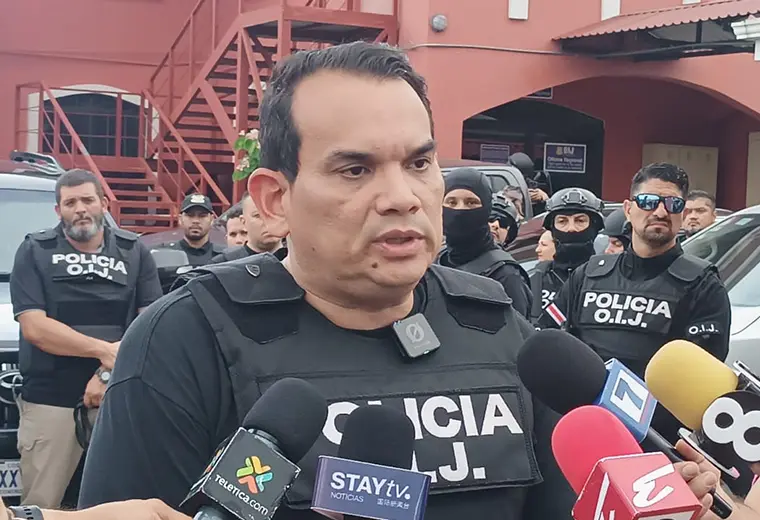
Randall Zúñiga, director del Organismo de Investigación Judicial de Costa Rica. //Foto: Teletica
Randall Zúñiga, director of Costa Rica’s Judicial Investigation Agency (OIJ), stated that “an intelligence agency” attempted to manipulate the investigation into the murder of Nicaraguan Roberto Samcam, sending the agency highly detailed anonymous information intended to give the case “a political tint” or to change the “direction of the investigation.”
Zúñiga, however, did not clarify what he meant by “political tint” or how the anonymous information—which suggested possible coordination by intelligence agencies of the Nicaraguan regime in the murder of retired Major Roberto Samcam—might have altered the course of the investigation.
“I couldn’t say right now whether the intelligence agency was from Costa Rica, Nicaragua, or another neighboring country with an interest in the Samcam case. But curiously, very, very detailed information arrived, which is being investigated, but it has no real correlation with the facts we are examining,” Zúñiga explained in an interview with the program Nuestra Voz, hosted by journalist Amelia Rueda.
Costa Rican authorities did investigate the anonymously submitted information, but it does not constitute a central focus of the OIJ investigation.
Zúñiga noted that the anonymous information came in the form of a 25-page “very well-prepared” document linking Samcam to the 2018 protests in Nicaragua. He added that the level of “coordination” and “precision” in the information received by the OIJ Confidential Information Center “never happens.”
“When someone provides confidential information, it is usually very brief and to the point. But in this case, almost 25 pages were sent, which raised suspicions that some intelligence agency likely wanted to manipulate or directly influence the investigation,” he said.
The OIJ director explained that the anonymously submitted information “was recorded in the judicial file,” which is why some media outlets published parts of the document.
“Obviously, when that information arrives, it is noted in the file, and that’s when you see media reports saying ‘according to the file,’” Zúñiga warned. “But it doesn’t necessarily correspond to the reality we are investigating, and its purpose is to generate some benefit for a group with an interest in this homicide,” he emphasized.
The anonymous information, received by the OIJ and reported by La Nación and CR Hoy, claims that a source provided names, phone numbers, and detailed physical descriptions of the alleged hitmen. It also identifies Pablo Robles Murillo as the “mastermind” behind these men.
The information indicates that Robles Murillo received intelligence and assassination training in Cuba and Russia. He is also linked to the Nicaraguan Irregular Warfare Battalion “Socrates Sandino,” a military unit from the 1980s, and to General Julio César Avilés, current head of the Nicaraguan Army.
Zúñiga stressed that if he could say whether the Nicaraguan government was involved in the crime, he would do so “without any problem.” However, he emphasized that he cannot make that claim at this time. “I need to have objective evidence to say whether it was a political homicide,” he noted.
He added that in this case, “I see, and it seems to me, that some government agency was interested in giving it a political tint.”
Nevertheless, both Samcam’s widow and human rights organizations have stated that he was killed for being a critical voice against the Daniel Ortega and Rosario Murillo regime.
Samcam, 67, was a strong critic of the Nicaraguan Army due to the institution’s involvement in repression and the killing of unarmed citizens during the 2018 protests.
Costa Rican authorities have not confirmed a motive for the crime. However, Attorney General Carlo Díaz did not rule out the possibility that it was politically motivated.
“One line of investigation suggests that this was apparently an order from the Nicaraguan Army. We will not be satisfied with merely arresting those who carried out the execution; we will pursue every possible avenue to determine who ordered this homicide,” Díaz said during the capture of the four suspects.
Samcam’s murder has been reported as the fourth “violent attack against an exile in recent years,” according to a report presented in Geneva by the Human Rights Experts Group on Nicaragua (GHREN), which concludes that the Ortega-Murillo regime’s repression extends beyond Nicaragua’s borders.
The dictatorship has employed “a broad and complex network of surveillance and intelligence” to monitor Nicaraguans’ activities even “beyond the country’s borders.” This network has allowed it to “harass, discredit, and threaten” Nicaraguans living in exile, the report states.
The document, presented on September 23, 2025, to the United Nations Human Rights Council, reveals that this “transnational surveillance” is organized through “a multi-layered intelligence architecture” involving the Army, the Police, the foreign service, and non-state agents.
“At its core is a network coordinated by the Army’s Directorate of Information for Defense, the military intelligence agency,” the report emphasizes.
Costa Rica’s OIJ arrested four of the five suspects in the murder of Roberto Samcam on September 12, 2025. He was shot dead on June 19, 2025, in his apartment in San José, Costa Rica, where he had lived in exile since 2018.
Three of the four suspects detained for Samcam’s murder were placed in six-month preventive detention by a criminal court.
Stephanie Chacón Guillen, 30, arrested on a public street. Identified as the intermediary’s wife, who allegedly paid 50,000 colones (about $100) for the transport of the perpetrators. She was released following a hearing on September 13–14, 2025.
The OIJ is still searching for Luis Carvajal Fernández, 20, who is believed to be the shooter.
The judicial file also notes that a photo of the “co-president,” Rosario Murillo, was found on one of the suspects arrested on September 12, Luis Orozco González. “That is true,” Zúñiga commented, but he added that it “doesn’t really mean much.”
The anonymous document included in the judicial file for the investigation into Samcam’s murder, leaked by Costa Rican media outlets La Nación and CR Hoy, points to possible coordination by military intelligence agencies of the Nicaraguan regime in the crime. The document highlights the name of Pablo Robles Murillo, identified as the “mastermind” behind the hitmen.
Robles Murillo, 55, served in the Sandinista Popular Army in the late 1980s and was part of the Irregular Warfare Battalion “Socrates Sandino.” A former soldier who knew Robles Murillo at the time recalled that he “survived a terrible ambush on the Mulukukú stretch. He was a truck driver, and a relative of his died in that same ambush.”
According to the confidential information received by the Judicial Investigation Agency (OIJ), the ex-soldier received military training in intelligence and assassination operations in Cuba and Russia, though the dates are unspecified. Robles Murillo is of Nicaraguan origin, holds Costa Rican nationality, and is currently in Nicaragua.
PUBLICIDAD 3M
PUBLICIDAD 3D