AA
Share

 Las noticias del día en tu correo
Recibe lo más destacado de la cobertura de CONFIDENCIAL todos los días.
Más boletines
The best of our coverage, in English
Sign up for our weekly newsletter. We will send it to you every Friday at 10:00 am (Nicaragua time)
More Newsletters
PUBLICIDAD 4D
PUBLICIDAD 5D
Nicaraguan naturalized Costa Rican is identified in judicial file as the organizer of the crime. He is linked to the Nicaraguan Army

Ficha de Pablo Robles Murillo en el expediente judicial. Foto: Tomada de CR Hoy
The judicial file investigating the murder of retired Major Roberto Samcam, leaked by Costa Rican media outlets La Nación and CR Hoy, reveals that Costa Rican authorities are probing the possible involvement of Nicaraguan regime military intelligence in the crime. One name, however, stands out in the document: Pablo Robles Murillo. But who is this man identified as the “mastermind” behind the hitmen?
Robles Murillo, 55, served in the Sandinista Popular Army in the late 1980s and was part of the “Sócrates Sandino” Irregular Warfare Battalion. A former soldier who knew Robles Murillo at the time recalled that he “survived a terrible ambush on the Mulukukú straight. He was a truck driver, and a relative of his died in that same ambush.”
According to confidential information received by the Judicial Investigation Agency (OIJ), the ex-soldier received military training in Cuba and Russia in intelligence and attack operations, though the exact dates are unspecified. Robles Murillo is originally Nicaraguan, holds Costa Rican nationality, and is currently in Nicaragua.
Costa Rican press reports indicate that the file—identified as 87-SH/RCI-2025—documents that Robles Murillo traveled 59 times between Nicaragua and Costa Rica from 2005 to February 2025.
Migration records show that the man accused of planning the attack on retired Major Roberto Samcam traveled to Nicaragua on June 10, 2025, nine days before the murder, and returned to Costa Rica on July 23.
His last trip to Nicaragua was on August 7, 2025, about a month and a half after Samcam’s murder, which occurred on June 19 at his home in Moravia, San José, Costa Rica.
According to CR Hoy, Robles Murillo has been in Nicaragua since August which was confirmed by calling him on the phone. “He is in Nicaragua… I’ll let him know,” replied a woman identified as Sara, his sister-in-law, who answered the call.
Records from the General Directorate of Migration and Foreigners (DGME) confirm that Robles Murillo has not returned to Costa Rica, at least not through an official border checkpoint.
According to the judicial file, it was an anonymous person who reported Robles Murillo as the mastermind behind the hitmen who killed Samcam.
The file states that the informant claimed members of the Military Intelligence and Counterintelligence Directorate (DICIM) and Cuba’s Intelligence Directorate (G2) allegedly planned the assassination while operating in Costa Rica.
The document leaked by Costa Rican media indicates that Robles Murillo reportedly maintained direct communication with Danilo Chaves Medina, arrested in Cañas on Thursday, September 11, 2025, who was identified as the intermediary between the masterminds and the individuals who carried out the murder.
It also indicates that Robles Murillo allegedly had “meetings with the top command of the Nicaraguan Army about a month ago, possibly coordinating the assassination of retired General Samcam.”
The judicial file includes a photo of Robles Murillo with the Army chief, General Julio César Avilés, taken on an unspecified date. According to the file, Robles Murillo and General Avilés have maintained a long-standing relationship.
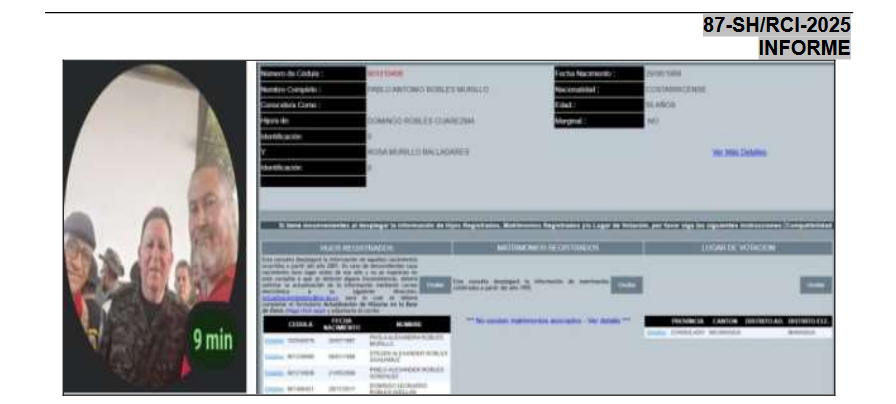
The informant also identified the alleged perpetrators of the crime as individuals from León XIII, in Tibás, providing names, phone numbers, and detailed physical descriptions of the suspected hitmen. In the case of Robles Murillo, the informant provided information about his travels, meetings, and his Facebook account.
The Judicial Investigation Agency (OIJ) and the Prosecutor’s Office arrested four suspects in the crime on September 12, 2025. However, Luis Carvajal Fernández, 20, reportedly the gunman, remains at large, as does Robles Murillo.
According to confidential testimony, the suspects met on June 18, 2025—one day before Samcam’s murder—at the Delta gas station located at the entrance to León XIII, in front of the company Metalco, around 6 p.m.
During that meeting, they coordinated Samcam’s assassination and brought the vehicles and the weapon they would use “to inspect them, ensure everything worked properly, and fine-tune the planning details,” the file published by La Nación details.
According to the case file, the informant stated that they did not want “their information to appear in the proceedings, as they consider the information accurate and fear that the people it refers to could kill them.”
The judicial file also shows that Pablo Robles Murillo owns a 282-square-meter plot in Upala, Alajuela, registered in the Property Registry on May 20, 2025. The property is located near the border between the two countries.
The report clarifies that Robles Murillo has no criminal record in the Unique Criminal File and does not appear in reports from the Public Force, seizure records, or the Ministry of Justice and Peace, according to CR Hoy.
Costa Rican authorities have not confirmed the motive for the crime, nor have they officially charged Robles Murillo in the case, as he only appears in the judicial file. However, Attorney General Carlo Díaz did not rule out the possibility that the crime had a political motivation.
“One line of investigation points to this being an apparent order from the Nicaraguan Army. We will not be satisfied with merely arresting those who carried out the execution; we will go to the utmost lengths to determine who ordered this homicide,” Díaz said during the arrest of the four suspects.
The Costa Rican official emphasized that the investigation remains open to fully identify the intellectual authors of the crime.
The murder of retired Major Samcam has been reported as the fourth “violent attack against an exile in recent years,” in a report presented in Geneva by the Human Rights Experts Group on Nicaragua (GHREN), which concludes that the Ortega-Murillo regime’s repression extends beyond national borders.
The dictatorship has used “a broad and complex network of surveillance and intelligence” to monitor the activities of Nicaraguans, even “beyond the country’s borders.” This network has allowed it to “harass, discredit, and threaten” Nicaraguans in exile, the report indicates.
The document, presented on September 23, 2025, to the United Nations Human Rights Council, reveals that the “transnational surveillance” is organized through “a multi-layered intelligence architecture” involving the Army, the Police, the foreign service, and non-state agents.
“At its core is a network coordinated by the Army’s Defense Information Directorate, the military intelligence agency,” the report emphasizes.
PUBLICIDAD 3M
PUBLICIDAD 3D

Alertas en tu celular
Suscribite a las alertas informativas de Confidencial en Telegram.

Boletines
Lo mejor de nuestra cobertura noticiosa en tu correo electrónico.

Anuncios
Obtené una propuesta comercial de acuerdo a tus objetivos y presupuesto.

Test Político
Explorá tus ideas sobre nuestra política, economía y sociedad con nuestro Test Político.