AA
Share

 Las noticias del día en tu correo
Recibe lo más destacado de la cobertura de CONFIDENCIAL todos los días.
Más boletines
The best of our coverage, in English
Sign up for our weekly newsletter. We will send it to you every Friday at 10:00 am (Nicaragua time)
More Newsletters
PUBLICIDAD 4D
PUBLICIDAD 5D
“There are 386,000 Nicaraguan refugee claimants. We are concerned about refugees,” says Andrés Celis, representative of the UN agency in Costa Rica.

Andrés Celis Neira, representante de la oficina del Alto Comisionado de las Naciones Unidas para los Refugiados (Acnur) en Costa Rica. //Foto: Elmer Rivas
On June 12, 2025, the dictatorship of Daniel Ortega and Rosario Murillo announced its withdrawal from the United Nations High Commissioner for Refugees (UNHCR). The regime accused the UN agency of being “an instrument of manipulation and interference in the internal affairs of states” — on the same day that UNHCR revealed that the number of Nicaraguans seeking international protection had quintupled, rising from 70,786 to 386,221 between 2020 and 2024.
In an interview with the program Esta Semana and CONFIDENCIAL, Andrés Celis Neira, the UNHCR representative in Costa Rica, responded to the accusations: “UNHCR is apolitical. It is a protection agency. We don’t care who governs or doesn’t govern. What matters to us is the people. The data [in our reports] comes from the authorities in charge of asylum in each country. These are not UNHCR’s own figures.”
This is the first time a UNHCR official has spoken publicly about Nicaragua’s withdrawal from the UN agency. Celis warns: “The withdrawal affects those who will go to that country and knock on the door seeking protection.” He also clarified that the activities UNHCR carries out in Costa Rica — one of the main host countries for Nicaraguan refugees — are not affected by the Nicaraguan regime’s decision. However, UNHCR’s assistance capacity in Costa Rica has been reduced due to funding cuts from the United States government, which began under Donald Trump’s administration.
UNHCR is the sixth UN agency the Ortega regime has withdrawn from in 2025, following exits from the UN Human Rights Council, FAO, IOM, ILO, and UNESCO.
In this interview, the UNHCR representative in Costa Rica also discusses how the agency is handling hundreds of thousands of asylum applications and the threat of transnational repression facing political dissidents.
On June 12, 2025, the Nicaraguan government announced its withdrawal from UNHCR. What are the consequences of this decision, and who does it affect?
The withdrawal of any country is something that affects the entire world. The problem with a country pulling out is that it ends up impacting those who might turn to that country, knock on its door, and say: I need your protection. People in different parts of the world who need protection in other territories end up trapped in their own countries—like a pressure cooker. And in this particular case, UNHCR will always be open to dialogue with the Nicaraguan authorities to find a way to resolve situations like this, and to allow the country to rejoin the office of the High Commissioner and the refugee protection system.
Historically, UNHCR has always been present in Nicaragua. In 1979, we were talking about 100,000 to 150,000 Nicaraguan refugees in different countries. By 1989, that number had reached 150,000. Since 2018, 386,000 Nicaraguans have fled to various countries, asking others to open their doors to them. Our relationship with any country cannot depend on political circumstances, party affiliation, ideology, or anything like that. What matters to us are people. UNHCR is apolitical; it is a protection agency. We don’t look at who governs or doesn’t govern, who the opposition is. No. What matters is that if someone is seeking protection in a country, they will have the chance to find a door open somewhere else.
“It’s a problem for everyone—it’s a problem for the refugee system. With 123 million forcibly displaced people worldwide, this is a challenge for humanity. We expect solidarity, coherence, and awareness from states in the face of this reality.”
Does this decision have any implications for Nicaraguan migrants and exiles living in Costa Rica or other countries?
The protection mechanisms are provided by other countries. In theory, what generates a claim for refugee status is the breakdown in the relationship between a citizen and their home country—when a person believes they can no longer be protected by their own state and thus turns to the international protection system. Other countries are the ones offering protection to these individuals. The activities we carry out in a country like Costa Rica are not affected by Nicaragua’s decision to withdraw from the Refugee Convention.
Nicaragua is not typically a destination country for refugees, but it is a country of transit for migrants and also for exiles. Were there people receiving support from UNHCR in Nicaragua?
Nicaragua has also been a host country. It offered asylum to Salvadorans and Guatemalans during the wars of the 1980s. Until 1990, we were talking about some 35,000 people who were refugees in Nicaragua. I don’t have current data. We do not cover Nicaragua from the Costa Rica office. I don’t know if there was anyone currently under some sort of protection scheme—I don’t believe so. I also don’t know whether all the case files for people who at one point sought protection or naturalization have been closed. I don’t have that information. Another office is responsible for Nicaragua.
You mention that the agency is apolitical, but the Nicaraguan regime has accused you of being a tool of manipulation, of having double standards, and of interfering in internal affairs. What is UNHCR’s position on these accusations?
These are matters addressed bilaterally with permanent missions, through foreign ministries and at our headquarters—that’s one channel. All I can say is that the High Commissioner is always willing to engage in dialogue, to understand concerns, to clarify misunderstandings, and to find ways to continue working together in pursuit of the well-being of all people who need it—those who have been forcibly displaced from their countries.
The Government of Nicaragua described the UNHCR reports as “biased, partial and full of deceit”. What is the procedure and sources used by UNHCR for these annual reports?
The data of these 386,000 people, who from 2020 to 2024, have sought protection in other countries, are data that come from the authorities in charge of refuge in each country. They are not UNHCR data. What UNHCR does is to group the information it periodically requests from each country in terms of how many asylum applications there are, how the cases have been processed and how many people have been recognized as refugees in a period of time, but also in their accumulated number. That is shared with us by all the countries and with that information the reports are made. And that is what we share with the international community.
The assassination of retired Nicaraguan Army Major and opposition refugee, Roberto Samcam, has shocked the entire Nicaraguan exile community in Costa Rica. Are Nicaraguan refugees suffering transnational repression in Costa Rica?
The situation of any refugee is important to us. We have been concerned about it and have been sensitive to the reality of what is happening. Seventy percent of the people who have sought international protection are living in the neighboring country. And in all these circumstances there are situations of risk. But we do not have, in front of these cases, elements that can tell us: indeed, this fact of (transnational repression) came. We have to wait for the decisions of the judicial authorities. We have also been in coordination with the judicial authorities, seeking, promoting that the investigation allows us to identify the causes, those responsible, the way.
We cannot say that one of these cases has or has not corresponded to a situation of cross-border persecution. But the fact that there are circumstances of persecution against some people, particularly in the territory of a country, is something that concerns us and that we are in permanent dialogue, both with people within the diaspora of the country concerned, in this case, Nicaraguans in the country, as well as with the authorities.
Apart from that case, have you identified cases that may be related to transnational repression? Any pattern?
The point is the qualification of the origin, the cause, the authorship. We have no elements on that. What we do permanently is to follow up on the situation that occurs. Each case worries us, each case in which a person from Venezuela, from Nicaragua, who suffers an aggression in Costa Rican territory appears, we follow it up. But in following up, what we can do is simply to inform the authorities: look, someone who appears in the registry of refugees, appears with a type of aggression, and we share this with the authorities.
What kind of aggressions have you documented? Are there threats, surveillance?
What I am talking about are types of events in which there is a situation that can endanger a person’s life.
Does ACNUR play a role in the protection of asylum seekers or refugees in Costa Rica or is this the sole responsibility of the host country?
We have a responsibility to protect, but the responsibility fundamentally lies with the States. The primary duty-bearer is the State, which is a signatory to the Convention. As persons who are on the territory of a country, the protection of their lives is under the responsibility of the authorities of the country concerned.
When it comes to refugees, our responsibilities are simply to follow up on the realities, how to be in dialogue with the authorities to show, to demonstrate with them, to find mechanisms. We have close coordination. Every time we have known any circumstance, we have shared the information we have with the corresponding authority in the Executive, in the judicial apparatus of the country. And we have always found on the part of the authorities an open and willing channel to talk about the situation.
What we do not have is any concrete mechanism, in terms of a risk situation, that requires physical protection, in order to provide some kind of physical protection mechanism. Our protection is linked to legal protection and, in some cases, to finding another country to open the door if the risk is very high, which are the resettlement programs.
The 386,000 refugee claimants you mentioned, between 2020 and 2024, are they in all countries?
This is the record given to us by the countries at a global level.
What is the trend of refugee applications in Costa Rica?
In 2017 we were talking about 4,000 people. From 2019 onwards, an increase of asylum applications in this country began, with the highest growth years being 2021 and 2022. That of 2022 even reached a level close to 130 000 people, which at that time placed Costa Rica as the third country globally with the highest number of new asylum applications. The number has been decreasing. What is very difficult to establish is how the number of people entering the country has varied from year to year. Because the system of registration of the population comes by the moment in which the acceptance of the asylum application is registered. But it is possible that some of these applications correspond to entries into the country prior to the moment at which they are registered in the system.
So, the 386 000 was global, but -from 2018 to date- 380 000 people have applied for asylum in this country (Costa Rica), not only Nicaraguans. Of those who are only Nicaraguans, at this moment we have a little more than 15 000 people who have already been recognized as refugees and there are about 195 000 cases pending resolution, within what is called the backlog of the asylum system.
We are working on this backlog. That is why I was raising the 380 000 since 2018, because it is not that cases have not been resolved, the problem is that every week there are, per month, between 1500 and 2000 requests that are coming in.
Why is the approval rate so low, and is it an issue of eligibility requirements or capacity to care for and respond to cases?
I don’t think there is a low recognition rate. It has been traditionally high. What there is in the number is that due to the accumulation of applications, there are applications that are no longer active. So, that is also decreasing in some of the data. There is a problem of congestion in the appointment request. In the processing once the appointment is recognized for decision making. So, what you have in front of you is 195,000 pending requests.
In a recent interview, the Vice Minister of the Interior, Mr. Omar Badilla, said that of those pending, 150,000 are complex cases and require a case-by-case review. It takes time to deal with the case, take it seriously, analyze the conditions and make a decision on the asylum request. And that is what causes the backlog to accumulate.
But the pressure continues because cases continue to accumulate. That is what the Government is trying today, with our support and with our willingness, to solve how to maintain a number of people who are attending the cases, which is not always ideal, but important. It took us more than a year, together with the Government, to organize files that did not allow the search for an agile solution of the cases in order to improve the rate, the time in the resolution and in the review of the cases, grouping them by profiles, that allow solutions by groups, to solve problems. But I would not say that there is a low rate of recognition, it is a low rate of processing.
In 2018 the first refugee claimants to arrive in Costa Rica, were people who participated in marches, barricades and fled repression. What is the profile of Nicaraguan refugee claimants in recent years?
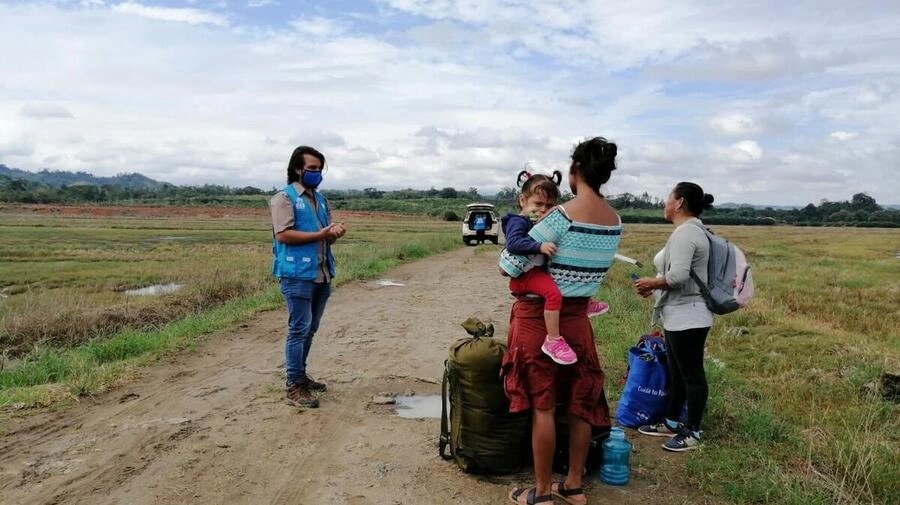
The first, clearly linked to the situations derived from the tensions and disturbances that occurred in the country, in which students and people from the medical sector appeared. Subsequently, we identified some problems that concern us, such as the situation of the Miskito indigenous peoples. They arrive in Costa Rica where there is no indigenous Miskito nation and this generates a problem of integration. And there is a serious problem in terms of how to respond to them.
There were cases of deprivation of nationality of some people. So, obviously these profiles generate a different political profile in terms of who we are talking about. Peasant communities that require a different type of response. How to support peasant communities that remain grouped within Costa Rican territory. All these realities concern us, but we are also concerned about those that are not so visible as a profile, because we do not know the cause, we cannot say: it is not a high political profile, but it may be something linked to what is happening with his family, with someone close to him, we do not know.
In any case, all cases warrant a review of the profile and that is what makes the processing of situations so slow. People may think that the number of cases in arrears is a static figure. No, cases have been resolved, but they continue to arrive. This year 10,880 new asylum applications have been processed by the Refugee Unit (until April 2025). The problem is that we cannot yet be sure that they correspond to people who arrived this year or last year. They may be applications that have been stuck in the procedure.
Does this low application processing rate have any impact on the refugees’ ability to integrate into Costa Rican society?
I believe that this is the reason for the concern, obviously, because as long as the asylum application has not been formalized, there is a situation that may be, perhaps, that they have another migratory status in the country, that they still have an irregular presence in the country. And that affects, of course, the possibilities of socioeconomic integration.
There are Nicaraguan refugees who in previous years were resettled in the United States, Spain and Canada under the Secure Mobility program. What have been the main motivations?
There is everything. What a resettlement system offers is whether there are elements linked to risks in a given country. Two, that there are mechanisms that complement other forms of family reunification, that there are objective integration difficulties that facilitate this. The programs have been, firstly, derived from agreements between States. There is an element there which is the shared responsibility between the States.
Costa Rica is a country with the highest percentage of foreign inhabitants in Latin America. About 10% of the inhabitants of this country are foreigners. Eighty percent of them are Nicaraguan. The fact that 200,000, 230,000 people have sought international protection of Nicaraguan nationality, generates the need to address that. It is 5% of the population. If we were to look at it in the reading of another country, we are assuming a burden. The country is assuming the need for protection of a very significant number as a total proportion of the population. So, what the resettlement programs do is also contribute to alleviate that situation.
In fact, we have encountered particular situations of a need for a humanitarian solution due to the concerns, the vision, and what the affected person is also finding. And I think it has been very useful to have those doors open. These are programs that do not constitute rights. It is not that the person has a right per se to resettlement. It is an opportunity.
The United States suspended the admission of refugees through the safe mobility program. Are there other resettlement programs to which refugees can apply?
We are working with the Government of Spain in the management of a quota that never reaches the magnitude of what the quota was when we had the safe mobility program.
Are you still receiving applications?
Yes, some cases. Whenever there is a situation of risk, a humanitarian situation that warrants it, UNHCR will knock on the door of the States to see if it is feasible to open that and move forward with a resettlement program.
How has the cut in U.S. funding affected UNHCR’s programs in Costa Rica?
The cuts are affecting a reality at the worst moment. The worst moment is: there have never been as many conflicts as the ones that are happening today on the planet. We are talking about 123 million people.
It impacts those people who are suffering from the unacceptable things they are experiencing. It impacts the societies they are leaving and it impacts the societies they are coming from. They generate instability. The cuts that organizations like UNHCR are suffering affect those people, much more than it affects UNHCR.
There was a humanitarian model of response, orderly, concerted, which is crumbling. As it crumbles, it affects the principle of humanity. The problem is not that there is less funding, but that this impacts the sustainability of the programs. UNHCR continues with its door open to attend to a person who arrives with a need for international protection. It continues to evaluate situations of risk and need, looking for integration mechanisms. What things have affected us? The mobility and resettlement programs were affected, and we have no opinion to express on that, because the States say: we have to evaluate the design of this program. We do not agree. We cannot. There is no right, there is no obligation. So, it is being diminished and that affects the speed, the processing of the cases.
Second, humanitarian assistance has a difficulty and that is that in this massive movement of people it was seen as an incentive for movement, and that has never been the case. According to IOM statistics, more than 65 000 people have died since 2014 in transit through the different regions of the world when they turn to irregular routes. What one finds at the borders is the arrival of people in a state of inadmissibility. It is not possible not to attend with a glass of water, it is not possible not to provide assistance. Now, this is not our main burden, but the humanitarian assistance we used to provide is covered by this, so there is a reduction in assistance and this affects us.
Do the programs continue, but have they reduced their capacity?
Humanitarian assistance is something that has affected us more, because of (lack of) funding sources. But we continue to support the country’s refugee protection system. We continue working hand in hand with the institutions for the recognition of refugee status. We continue working on social integration, we continue with fewer quotas, but with the program that we managed with the Costa Rican Social Security Fund for extreme cases in which people had a complex health situation and did not have a source of funding, they were not working; with reduced numbers, but we continue to work on it. We continue in coordination with the National Women’s Institute, with PANI, looking for answers.
We continue working with programs that some of the months were affected by economic integration. We maintain a network called Vivir la Inclusión (Living Inclusion), with about 70 private sector companies that are contributing, but we also have government agencies, with programs that are very positive, such as Brete, which seeks, within the Ministry of Labor, to open opportunities for people who have been arriving. The same with the INA, in training programs, in soft skills to be able to have enterprises.
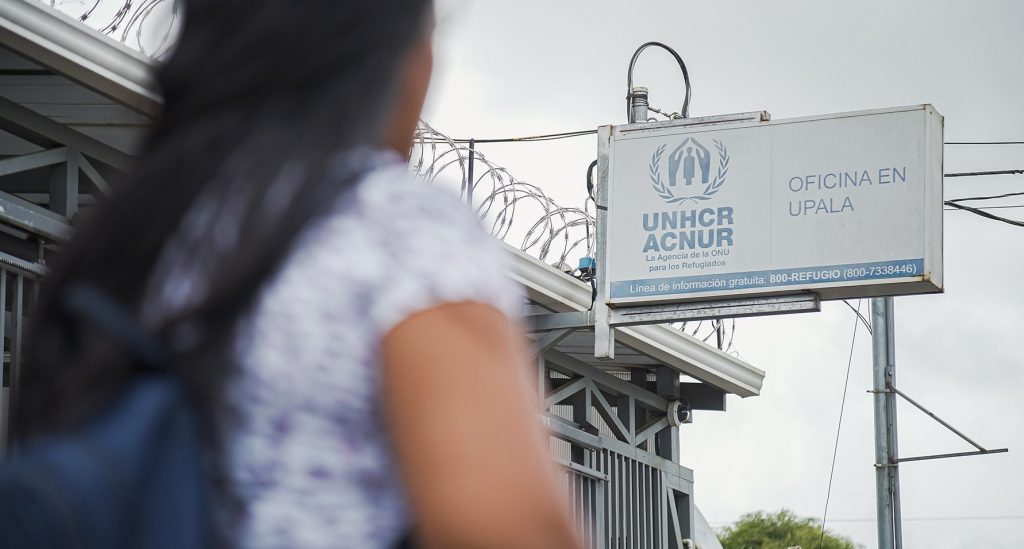
We maintain our presence in Upala. Upala is a critical location. The final level of impact on this new financing scenario is not yet known because we are still in the process of making adjustments. But we continue to provide protection. We continue with the door open, we continue with excellent coordination with the authorities, with local and international NGOs that continue to provide support, and with the rest of the agencies of the United Nations system, which we are all linked to this response.
Refugees or people seeking protection in Costa Rica who want to seek assistance from UNHCR, what should they do? Which method should they use?
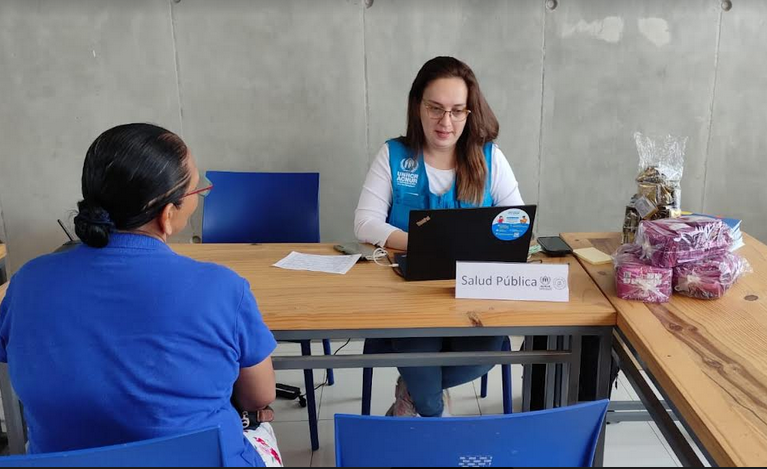
Of course, people are always welcome. That’s what we are here for. There is a support page . There are our facilities here, in San José and in Upala, where all people are welcome. I also invite you to go to the Government Shelter offices. I think it can also expedite. There we are also in contact with them.
Is the phone line no longer available?
The telephone line, sadly, no. It was something we were also affected by the funding (cutback) process.
PUBLICIDAD 3M
PUBLICIDAD 3D

Alertas en tu celular
Suscribite a las alertas informativas de Confidencial en Telegram.

Boletines
Lo mejor de nuestra cobertura noticiosa en tu correo electrónico.

Anuncios
Obtené una propuesta comercial de acuerdo a tus objetivos y presupuesto.

Test Político
Explorá tus ideas sobre nuestra política, economía y sociedad con nuestro Test Político.