AA
Share

 Las noticias del día en tu correo
Recibe lo más destacado de la cobertura de CONFIDENCIAL todos los días.
Más boletines
The best of our coverage, in English
Sign up for our weekly newsletter. We will send it to you every Friday at 10:00 am (Nicaragua time)
More Newsletters
PUBLICIDAD 4D
PUBLICIDAD 5D
Ortega-Murillo regime demands “respect for Venezuela’s sovereignty” and calls for the release of Maduro and his wife, Cilia Flores
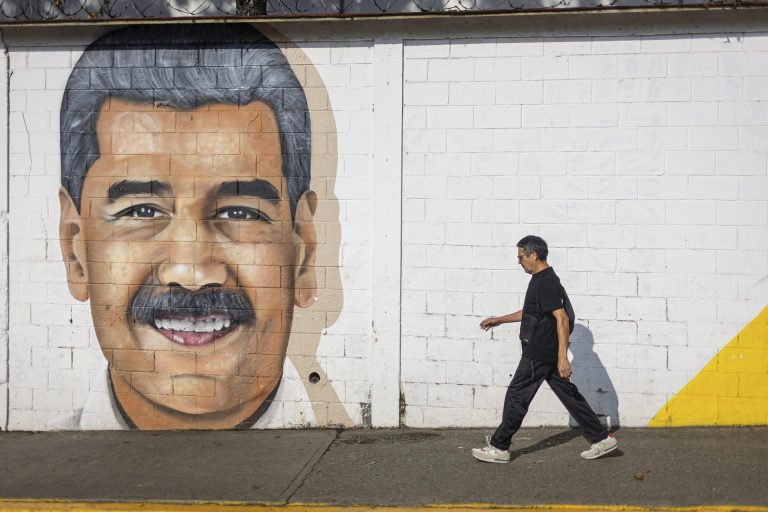
Una persona pasa frente a una pared con un dibujo alusivo a Nicolás Maduro en Caracas (Venezuela). EFE/ Miguel Gutiérrez
The capture of Venezuelan president Nicolás Maduro and his wife, Cilia Flores, in the early hours of January 3, 2026, by the United States—during an operation called Absolute Resolution, which included several airstrikes on the country—has divided the American continent between those who celebrate the end of the Chavista leader’s rule and those who denounce the U.S. actions as illegal.
One of the first leaders to react was Colombian president Gustavo Petro, who said on his X (formerly Twitter) account that he was watching the events “with deep concern.” The Colombian president stated that the Organization of American States (OAS) and the United Nations (UN) “must meet immediately.”
Amid growing uncertainty, dozens of Venezuelans began crossing the Simón Bolívar International Bridge, the main land route connecting Colombia and Venezuela, prompting Petro to order the deployment of military forces along the border.
Washington had offered a $50 million reward for Maduro, whom it identifies as the leader of the so-called Cartel of the Suns and the criminal gang Tren de Aragua.
Maduro and his wife were transported by helicopter to the U.S. military vessel USS Iwo Jima, stationed in the Caribbean, from where they departed for the United States.
The government of Claudia Sheinbaum in Mexico strongly condemned the “unilaterally executed military actions” carried out by the United States armed forces on Venezuelan territory and called on the United Nations to “contribute to the de-escalation of tensions, facilitate dialogue, and help create conditions for a peaceful, sustainable solution in accordance with international law.”
In a statement, Mexico’s Ministry of Foreign Affairs said the attack violates Article 2 of the UN Charter, warning that “any military action poses a serious risk to regional stability.”
Spanish Prime Minister Pedro Sánchez also urged de-escalation following the U.S. military attack on Venezuela and offered to “lend his good offices” to help achieve a peaceful and negotiated solution to the crisis.

In response to calls for action at the United Nations, Secretary-General António Guterres expressed his “deep alarm” over the “escalation of tensions in Venezuela” and said the attack does not comply with international law, warning that it could set a “dangerous precedent,” though without pointing to specific responsibilities or outlining possible actions to be taken.
The regime of Daniel Ortega and Rosario Murillo waited more than 12 hours after the capture of Maduro—its main political ally on the American continent—before issuing a brief statement demanding “respect for the sovereignty of the Venezuelan people.”
“As brothers in this brave and noble Our America–Caribbean region, we join the outcry of the entire world, affirming from a position of deep rejection that we will continue to fight for the rule of international law and respect for sovereignty,” the Nicaraguan dictatorship’s statement said.
The statement concludes by expressing support for a call by Venezuelan Vice President Delcy Rodríguez to “defend truth, justice, and life, and to demand the immediate release of President Nicolás Maduro, our comrade, and our comrade Cilia Flores.”
The Russian government described the military action as an “act of armed aggression” by the United States.
“In the current situation, it is important (…) to avoid further escalation and to focus on finding a way out of the situation through dialogue,” Russia’s Ministry of Foreign Affairs said in a statement.
The president of Cuba, Miguel Díaz-Canel, described the attack as “criminal” and also called for an “urgent” response from the international community, aligning himself with the denunciations made by Caracas, its long-standing ally in the region.
Iran, another ally of Maduro, said through its Ministry of Foreign Affairs that the U.S. intervention “constitutes a blatant violation of the fundamental principles of the United Nations Charter and of the basic norms of international law.”
On the opposite end of the political spectrum, Argentina’s far-right president Javier Milei said that Maduro’s capture “is excellent news for the free world,” welcomed the U.S. intervention, and stated that Edmundo González Urrutia, the opposition candidate who ran against Maduro in the 2024 presidential election, should assume power.

Peru acknowledged that Maduro’s “illegitimate” government violated the human rights of thousands of Venezuelans and subjected them to “torture, arbitrary and illegal detentions.” Interim president José Jerí, however, spoke in favor of the principles of International Law and the United Nations Charter regarding the maintenance of peace, the preservation of security, and the peaceful settlement of international disputes.
Chile’s president-elect José Antonio Kast said that the detention of the Venezuelan leader by the United States “is great news for the region.”
“Maduro is not the legitimate president of Venezuela, and from that country operate criminal and terrorist structures that seriously threaten regional peace and security,” said the far-right Kast, who will take office on March 11, 2026, and considers himself an ally of Trump.
In Central America, Costa Rican president Rodrigo Chaves Robles said that Maduro “was never a legitimate president and must now answer for his crimes in Venezuela and abroad.”
Maduro assumed the presidency of Venezuela in 2013 following the death of Hugo Chávez, becoming the political heir to the Chavista project. Since then, he remained in power amid allegations of electoral fraud, authoritarianism, and serious human rights violations.
Following the capture of Nicolás Maduro, President Trump announced that the United States will govern Venezuela until there is a “safe and appropriate” transition, and during a press conference avoided offering direct support to opposition leader María Corina Machado.
The U.S. president said it would be “difficult” for Machado to lead Venezuela, arguing that she lacks the necessary “support and respect.”
Machado, however, urged Venezuelans to remain attentive to developments. The 2025 Nobel Peace Prize laureate spoke of a “transition” and said that Edmundo González Urrutia “must assume power immediately” in Venezuela.
Following the military actions and the capture of Nicolás Maduro, the Venezuelan diaspora reacted with celebrations in different parts of the world. In cities with a strong presence of exiles, such as Madrid and other locations in Spain, hundreds of Venezuelans took to the streets waving flags and singing the national anthem.
*With information from Efe.
PUBLICIDAD 3M
PUBLICIDAD 3D

Alertas en tu celular
Suscribite a las alertas informativas de Confidencial en Telegram.

Boletines
Lo mejor de nuestra cobertura noticiosa en tu correo electrónico.

Anuncios
Obtené una propuesta comercial de acuerdo a tus objetivos y presupuesto.

Test Político
Explorá tus ideas sobre nuestra política, economía y sociedad con nuestro Test Político.