AA
Share

 Las noticias del día en tu correo
Recibe lo más destacado de la cobertura de CONFIDENCIAL todos los días.
Más boletines
The best of our coverage, in English
Sign up for our weekly newsletter. We will send it to you every Friday at 10:00 am (Nicaragua time)
More Newsletters
PUBLICIDAD 4D
PUBLICIDAD 5D
The sanctioned Deputy Interior Minister is a central figure in the repression led by Rosario Murillo, including entry bans and political surveillance.

Luis Cañas Novoa, viceministro del Interior. //Ilustración: Confidencial
Deputy Interior Minister Luis Cañas Novoa is a key figure within the repressive apparatus of Daniel Ortega and Rosario Murillo. He was sanctioned by the United States government on April 18, 2026, and is described by those who know him as someone capable of doing “anything” to achieve his objectives. As Murillo’s operator within the Interior Ministry, those objectives are to repress the Nicaraguan population and carry out the orders of the all-powerful “co-president.”
Cañas has gained prominence as a central figure in the regime’s exile machinery and as part of Murillo’s inner circle. He is also involved in a system of permanent surveillance across the country and is responsible for relaying Murillo’s orders, effectively wielding real power within the Interior Ministry.
His record includes a dismissal for corruption in 2007. His later promotion to the rank of commissioner general positioned him as a key figure in implementing the regime’s most repressive policies.
The right-hand man to Rosario Murillo in the regime’s exile machinery—the system that decides who is allowed to enter Nicaragua—is Deputy Interior Minister Luis Cañas Novoa. He has been identified as one of 54 officials responsible for crimes against humanity committed by the dictatorship, according to the United Nations Group of Human Rights Experts on Nicaragua.
The group of experts reports that, to deny entry to Nicaraguans, the vice minister requests information from the Sandinista Front’s organization secretary, Fidel Moreno, who oversees a domestic surveillance network with support from the Police Intelligence Directorate and the Telecommunications and Postal Institute (Telcor). Moreno compiles a profile of the individual, and based on that information, the vice minister decides whether the person is allowed to enter Nicaragua.
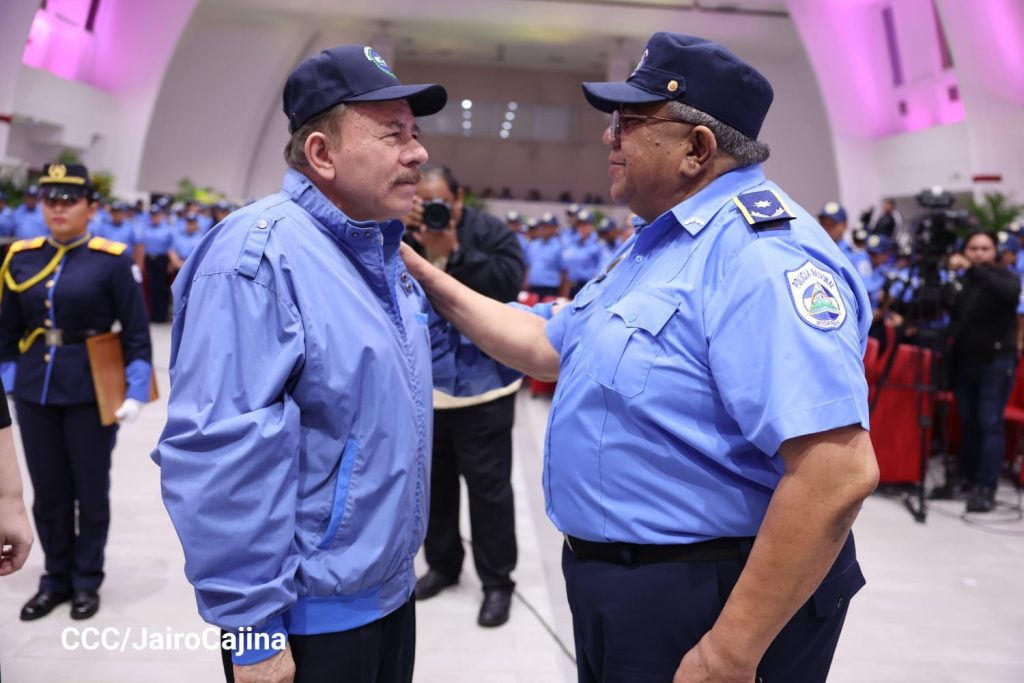
Cañas also took part in the exile of the 222 political prisoners sent to the United States in 2023, as well as the 135 sent to Guatemala in 2024. He ordered the issuance of their passports without their request, and the documents were personally delivered by the vice minister.
Within the new inner rings of power built by Rosario Murillo to secure a dynastic succession, Cañas ranks among the closest figures. He is the one who effectively exercises real authority within the Interior Ministry, above Minister María Amelia Coronel.
Since late 2024, Cañas has also regularly occupied a seat at the main table alongside the country’s rulers and has become one of the most visible operators, despite having initially maintained a lower profile.
According to the UN experts, the vice minister plays “an important role” in the regime’s repressive infrastructure.
According to a report by Divergentes, before becoming vice minister, Cañas organized a group of former Sandinista combatants, securing medical and financial support for them. The group later backed the 2018 crackdown, when the dictatorship armed paramilitary forces to attack and carry out massacres against citizens participating in that year’s civic protests.
Cañas’s role within the Interior Ministry also includes political surveillance and permanent control throughout the country.
According to United Nations experts, this surveillance system allows the regime to control the flow of information within Nicaragua and to decide who should be monitored, detained, expelled from the country, barred from returning, or stripped of their Nicaraguan nationality.
Cañas has served as the link between the Interior Ministry, the Police, and the orders coming from El Carmen, the residence, party headquarters, and office of co-rulers Daniel Ortega and Rosario Murillo.
Until mid-2025, he carried out that role through former presidential security adviser Néstor Moncada Lau, who was “purged” by Murillo in August 2025. After Moncada Lau’s fall, the vice minister has taken on a more visible role within the regime’s surveillance structure.
Cañas is the one who receives direct orders from Ortega and Murillo and passes them on to the police surveillance apparatus. According to UN experts, in April 2023 Murillo instructed the Police that “not even a fly should be moving without her knowing.”
Cañas comes from a poor family in El Sauce, León. He joined the ranks of the Sandinista Front in the 1970s as a combatant. He was a founding member of the National Police in the 1980s and, a decade later, in the 1990s, established himself in anti-drug investigations.
He also headed the police intelligence unit in the early 2000s, but then–Police Chief Aminta Granera removed him from the force in 2007 after he was linked to corruption cases.
After leaving the Police, Cañas spent eight years as a civilian. In 2015, Moncada Lau recommended him for the position of vice minister, replacing Carlos Nájar. During his first year in office, Cañas kept a low profile, but he gained prominence after the removal of Ana Isabel Morales in 2016 as head of the Ministry of the Interior, which Ortega renamed in 2023 as the “Ministry of the Interior (MINT),” reviving its 1980s name.
Alongside the reestablishment of the Interior Ministry (MINT), the dictatorship imposed its direct subordination to the Police, establishing police rank structures within its general directorates. The new law stipulated that the position of vice minister is equivalent to the rank of commissioner general. Days later, Cañas was promoted.
The vice minister’s repressive framework also extends to the National Penitentiary System (SPN). According to the United Nations experts, Cañas ordered “a systematic policy of discriminatory treatment against political prisoners.”
He also instructed prison directors to “obstruct access for defense attorneys and to ignore court orders for release and habeas corpus.”
These instructions also include defying judicial orders authorizing forensic medical evaluations and access to information about detention conditions, reinforcing a systematic pattern of impunity within the prison system. This obstructs accountability and allows abuses against detainees to continue, including dozens who remain in conditions of enforced disappearance.
In May 2019, following the killing in prison of political prisoner Eddy Montes, Cañas claimed that Montes was shot while struggling with a guard during an attempted riot at La Modelo prison. However, political prisoners who witnessed the killing dispute the official version and say it was a direct shooting.
Cañas also carried out direct orders from co-president Rosario Murillo to revoke the legal status of NGOs and other nonprofit organizations. In addition, the Group of Experts points to him as someone who seeks Murillo’s authorization to cancel the legal status of organizations he himself selects.
In an interview on October 9, 2024, Cañas justified the closures by claiming that funds sent to NGOs were being used to undermine public order in the country.
“A large percentage of these nonprofit organizations had been inactive, in some cases for decades. They had never submitted any of the required reports, especially financial statements. There were organizations that received significant amounts of money and never accounted for it. And donors of questionable origin or even existence didn’t care. They knew that money was being used to undermine order and security in the country. And that had to be prevented,” Cañas said.
Cañas is also identified as the main figure, alongside the Ministry of Foreign Affairs, behind the state policy of denying the issuance or renewal of passports to opponents both inside and outside Nicaragua.
Other measures include the annulment or deletion of official records, including birth certificates. According to the United Nations Group of Experts, this leads to the arbitrary deprivation of nationality on political grounds.
Nicaraguans who are denied these rights are individuals identified by the regime’s intelligence network, which coordinates the collection of personal, family, professional, and other types of information on people considered a threat to national sovereignty and society.
Within this structure, Fidel Moreno works with the Civil Registry and municipal civil registry offices to order the deletion of official records. Based on that information, and in consultation with Rosario Murillo, Vice Minister Cañas decides who will be stripped of their nationality.
Archivado como:
PUBLICIDAD 3M
PUBLICIDAD 3D