AA
Share

 Las noticias del día en tu correo
Recibe lo más destacado de la cobertura de CONFIDENCIAL todos los días.
Más boletines
The best of our coverage, in English
Sign up for our weekly newsletter. We will send it to you every Friday at 10:00 am (Nicaragua time)
More Newsletters
PUBLICIDAD 4D
PUBLICIDAD 5D
The alliance of 21st-century dictatorships is cracking after Maduro’s removal by the United States, but a democratic transition is nowhere in sight
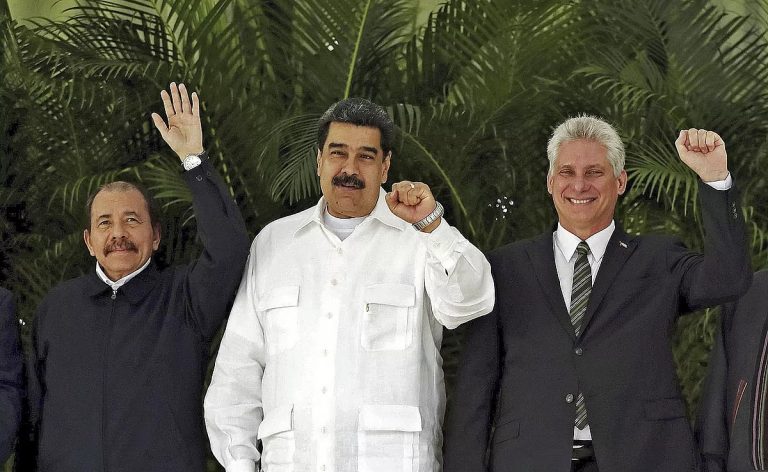
De izq. a der.: Los dictadores Daniel Ortega, de Nicaragua; Nicolás Maduro, de Venezuela; y Miguel Díaz-Canel, de Cuba, en una cumbre en diciembre de 2018. Foto: EFE
The so-called “troika of tyranny” in Latin America — the dictatorships of Cuba, Venezuela, and Nicaragua — a term coined by John Bolton, National Security Advisor during Donald Trump’s first presidency, was always a misleading simplification.
Despite sharing some common elements due to their authoritarian resilience, the 21st-century dictatorships were never a homogeneous bloc, and beyond their strengths and weaknesses, their particularities require the design of differentiated policies toward each country, as is indeed happening in Trump’s second presidency, although always under the exclusive imprint of MAGA interests. Three months after Nicolas Maduro was forcibly removed by the United States, the mirror of Venezuela reveals that the paths of the improvised “Donroe doctrine” do not necessarily lead to a transition to democracy.
Cuba has been a single-party authoritarian regime for more than 60 years — a Communist Party-Army-State system — whose inefficient model of centralized state economy, worsened by the US embargo, depends on massive external economic subsidies, first from the USSR and later from Chávez’s Venezuela. Before reaching the stage of collapse the country has been in for several years, the Cuban regime rejected or was unable to carry out deep economic and political reforms when they were inevitable: after the “Special Period” in the 1990s, during Barack Obama’s opening in 2014, and after the 2021 protests. This now represents its greatest vulnerability in the face of Donald Trump’s “maximum pressure.”
Venezuela, under Hugo Chavez’s populist regime, became the main economic support of Cuba and, to a lesser extent, Nicaragua until 2017. Under Maduro, as heir and coordinator of an authoritarian corporation, economic failure and political repression continued, provoking a massive exodus, crowned by the monumental theft of the 2024 elections. The US military intervention removed Maduro from power but left the chavista regime intact under Delcy Rodríguez, to control oil and natural resources in an authoritarian “innovation” that Luz Mely Reyes describes as “a kind of 21st-century colonialism.”
Nicaragua is a dynastic dictatorship, turned into a marital “co-dictatorship.” Ironically, its fragility lies in the extreme centralization of power in a personalist regime that, like the Somoza regime in the last century, depends on a single family. According to the latest Varieties of Democracy (V-Dem 2025) report, Nicaragua is the least democratic country in Latin America — even below Venezuela and Cuba — and ranks fifth among the worst autocracies in the world after Eritrea (179), North Korea (178), Myanmar (177), Afghanistan (176), and Nicaragua (175). However, Nicaragua enjoys greater economic autonomy than Cuba and Venezuela: it has no oil resources that attract the voracity of Trump’s policies, but it also does not suffer blackouts, its economy is not collapsing but rather stable, and its dynamism depends on private sector exports to the US market which, combined with family remittances from migrants in that country, account for more than 50% of the national economy.
With the drop in oil prices between 2018 and 2020, the three Latin American dictatorships survived the decline of the Bolivarian Alliance (ALBA) as a club of autocracies aligned with Russia, China, Iran, and North Korea, immune to diplomatic pressure from the OAS and the European Union.
Since 2025, US policy of force has attempted to fill the political vacuum left by the impunity of dictatorships and the failure of the democratic agenda. The capture of Maduro after the US military intervention resulted in a regime tutored by Donald Trump, which shut off Venezuela’s economic cooperation with Cuba and is cutting military and security ties. Under the US oil blockade, Cuba has no economic way out, but it still retains reserves of state repression to try to contain a new social uprising, while negotiations begin between Secretary of State Marco Rubio and the GAESA business consortium — the fusion of Army-party-business — which projects itself as the core of the stability Trump demands in a transition, whatever its outcome.
Maduro’s fall in Venezuela has had no economic impact on Nicaragua, but the political blow has been devastating for Daniel Ortega and Rosario Murillo. The message is loud and clear: in the face of the determined use of force, even outside international law, the co-dictators are expendable and no international ally can guarantee their protection. On the other hand, it warns the Nicaraguan opposition that the end of the co-dictators does not necessarily lead to the restoration of freedom and democracy but may instead generate perverse incentives among those aspiring to inherit power within the regime’s elite, placing the country in a holding pattern. Political scientist Manuel Orozco, a researcher at the Inter-American Dialogue, summarizes it this way: “there is no domino effect — after Venezuela and Cuba — but Nicaragua remains on the United States’ agenda.”
The example of Venezuela has triggered paranoia in co-dictator Rosario Murillo, who has ordered greater control, surveillance, and repression against potential opponents, including more than 10,000 deportees who have been received in secrecy as part of her collaboration with Trump’s anti-immigration policies. And although there are no signs of any official negotiation with the United States, within the political and civic opposition in exile, frenetic activity has been unleashed under an irrefutable line of reasoning: if in the Venezuelan deal Trump is excluding the opposition led by María Corina Machado — after Edmundo Gonzalez overwhelmingly won the 2024 election — and prevents them from returning to the country in order to maintain authoritarian control with Delcy Rodríguez, what could be expected in Nicaragua, where opposition leadership is not only fragmented but, despite widespread rejection of the regime, has failed to validate its legitimacy and cannot express itself freely under a police state?
For this reason, among the five opposition platforms — Democratic Concertation Monteverde (CxL, Unamos, UNAB), Dialogue Space, Nicaraguan University Alliance, PUDE-Route for Change, and the Grand Opposition Confederation — urgent calls have emerged to create a “Transition Commission,” agree on a roadmap for democratic transition, and take on pressing demands for unity in action to exit the dictatorship.
As political scientist and former political prisoner Félix Maradiaga, founder of Route for Change, points out, Nicaragua has an opportunity it cannot waste: “waiting for the Trump administration to do the work for us in the opposition would be a mistake. Washington can exert pressure, but the legitimacy of the opposition and minimal cohesion are tasks that only Nicaraguans can resolve. Externalizing those responsibilities is political abdication.”
After Venezuela decreed an amnesty that has freed 503 political prisoners, and Cuba announced a pardon for 2,000 prisoners, demands have increased for the release of all political prisoners in Nicaragua, an end to religious persecution, and the dismantling of a repressive system that has stripped more than 450 citizens of their nationality, keeps hundreds as de facto stateless persons, and promotes transnational repression.
The million-dollar question is: how can the power of a police state be broken from exile so as to restore democratic freedoms, or how can an authoritarian power that has maintained total control be fractured from within, despite the wounds and fractures caused by internal purges tied to Rosario Murillo’s dynastic succession?
Without a doubt, Donald Trump’s actions have started the countdown for the dictators — but not for the dismantling of the dictatorships. A democratic transition will only be possible if, in addition to external pressure, a legitimate opposition leadership emerges capable of organizing and mobilizing civic resistance under conditions of repression; if political incentives are created to build a national alliance that includes dissidents and former regime allies around a minimum transition program; and if an international environment — in Latin America and Europe — places democracy with justice and without impunity at the forefront, as a counterweight to Donald Trump’s transactional doctrine.
*A version of this article was originally published in El País
PUBLICIDAD 3M
PUBLICIDAD 3D

Alertas en tu celular
Suscribite a las alertas informativas de Confidencial en Telegram.

Boletines
Lo mejor de nuestra cobertura noticiosa en tu correo electrónico.

Anuncios
Obtené una propuesta comercial de acuerdo a tus objetivos y presupuesto.

Test Político
Explorá tus ideas sobre nuestra política, economía y sociedad con nuestro Test Político.