AA
Share

 Las noticias del día en tu correo
Recibe lo más destacado de la cobertura de CONFIDENCIAL todos los días.
Más boletines
The best of our coverage, in English
Sign up for our weekly newsletter. We will send it to you every Friday at 10:00 am (Nicaragua time)
More Newsletters
PUBLICIDAD 4D
PUBLICIDAD 5D
Official figures show that 11,000 workers were laid off during the first three months of 2026 alone.

Ilustración: Confidencial
Adolfo used to walk into a free-trade zone factory every day at six in the morning. For the past seven years, he had worked assembling T-shirts in a vast warehouse where the noise of the machines never stopped. He knew the routine by heart: clock in, put on his blue work apron, check the production line, and wait for the signal announcing the start of the shift. “It was my routine, but it was also part of my life,” he says.
He often complained that the job was not easy, but it provided stability. His wages paid the rent on a small house, put food on the table for his family, covered school expenses for his two children, and helped make the monthly payments on the motorcycle he used to get to work every day.
Everything changed on a Monday in January 2026. Supervisors gathered dozens of employees together, and the manager spoke for only a few minutes: the company was scaling back operations, and many workers would be laid off. “Losing my job from one moment to the next was hard,” he says.
Adolfo remembers the silence that followed. “It felt like the ground shifted beneath me,” he recalls. He barely heard the full explanation for his dismissal. That day, he returned home much earlier than usual. His wife thought he was sick, and it took him several minutes to tell her he had lost his job.
The first days of unemployment were filled with uncertainty. “I would wake up early out of habit, but I had nowhere to go,” he says. Although he looked for work, finding a new job proved difficult.
“You don’t just lose your paycheck,” Adolfo explains. “You also lose your routine, your sense of security, even the peace of mind that lets you sleep at night.”
As the days passed, financial worries began to mount. His severance pay barely covered household expenses.
Even so, he insists he will not give up. He now takes occasional jobs at a small tailoring shop and sells clothing alongside his wife. He earns less than before, but says he continues to look for a stable opportunity.
“The hardest part is realizing that after so many years, you can be replaced from one day to the next,” Adolfo laments.
The 44-year-old still hopes he will be called back. “In the free-trade zones there are times when production slows and fewer workers are needed. Maybe things will improve later on,” he says.
María Elena had worked for nearly 12 years at a manufacturing company located in a free-trade zone in Managua. Every morning, she woke up before sunrise to prepare food, get her son ready, and catch the bus that took her to the industrial park.
She says the company had been making cuts for more than a year. “But they were small cuts, maybe a dozen people at a time,” she explains. Still, she began noticing that orders were steadily declining.
“They started sending people on vacation, and there were already rumors that a major round of layoffs was coming,” she recalls. She tried to focus on her work, convinced that her experience and dedication would be enough to keep her job. She was wrong. In September 2025, she was laid off.
The explanation she received was that the company was moving part of its production to another country and would therefore eliminate dozens of positions. María Elena was devastated, but she tried to stay positive. She had previously worked for two other free-trade zone companies. One of them shut down several years ago, and the other also went through layoffs.
“Free-trade zone jobs are often unstable, so I’m somewhat used to it by now. But this time things seem more difficult,” she admits.
“There’s a lot of fear because of the constant layoffs in the free-trade zones. The atmosphere is uncertain, you never know when people will be let go or when a company might shut down,” she adds.
Today, María Elena makes a living selling food, and she says business is “going very well.” The company that laid her off told workers they would be rehired immediately “if orders increase again.” “There’s a promise that we’ll be brought back, but we don’t know when,” says María Elena, who for now prefers to focus on growing her own business.
Since 2023, employment in Nicaragua’s free-trade zones has declined sharply. The sector now employs fewer than 100,000 workers, bringing job creation levels close to where they were in 2011.
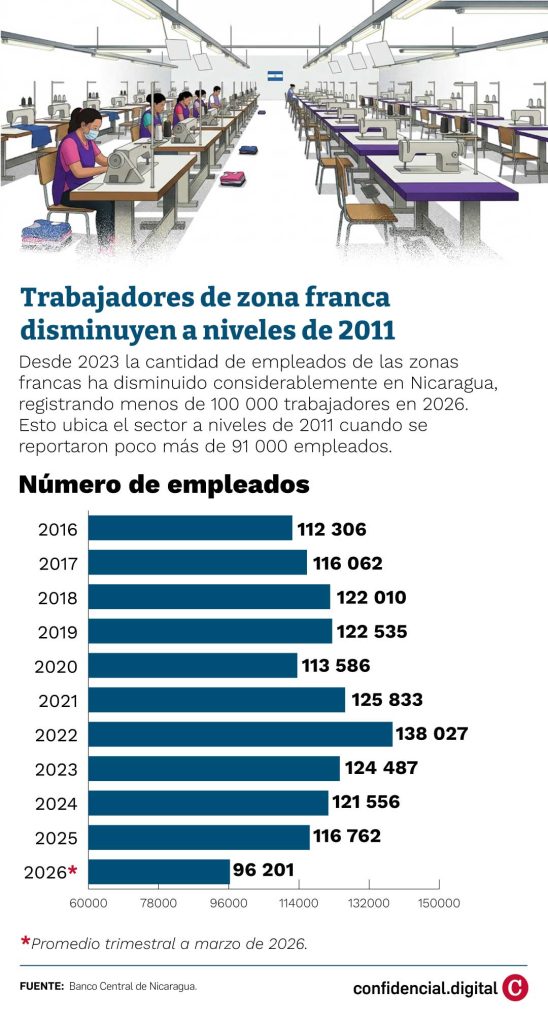
The annual average number of free-trade zone workers in 2025 was 116,762. By the first quarter of 2026, that average had fallen to 96,201 workers—a loss of more than 20,000 jobs on average.
However, a closer look at figures from the Central Bank of Nicaragua (BCN) shows that the actual number of layoffs is even higher. In December 2024, the sector employed 121,858 workers. By March 2026, the reported workforce had dropped to 94,861. In other words, nearly 27,000 jobs were lost between 2025 and 2026.
In the first quarter of 2026 alone, 10,954 jobs disappeared across the country’s 168 registered free-trade zone companies.
At the current pace, layoffs in 2026 are on track to approach—or even surpass—the 16,043 jobs lost during all of 2025.
The decline comes amid a broader contraction in the sector. According to official data, more than 43,000 free-trade zone jobs have been lost since 2023.
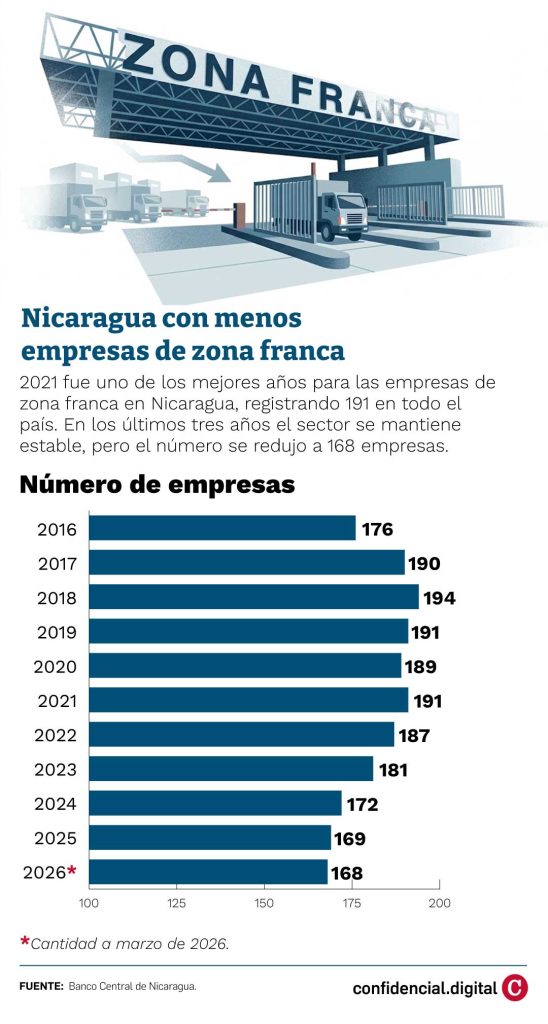
The number of active free-trade zone companies has remained relatively stable over the past three years. As of March 2026, there were 168 companies operating in the country—one fewer than at the end of 2025. Even so, that figure remains well below the 191 companies that were operating in 2021.
Fernando Sánchez, executive director of the Free Trade Zone Corporation (CZF), acknowledged the sector’s difficulties in April 2026. He attributed the losses to the “reciprocal” tariffs imposed by the United States in 2025, declining orders, and the dependence of many companies on a single client.
“By the end of 2025, during the last quarter, many companies experienced a shortage of orders as a result of the reciprocal tariffs imposed by the U.S. government (…) around 20 companies were left without work, which led to a reduction in employment of approximately 15%,” the official said.
Sánchez noted that the maquila industry, which accounts for roughly 50% to 60% of the free-trade zone sector, “was affected by a decline in orders.” He added that many companies had shifted some of their operations to El Salvador, Guatemala, and Honduras.
Despite the downturn, the official insisted that the sector’s goal is to reach 120,000 jobs by the end of 2026, even as unemployment has continued to rise during the first half of the year.
“Brands that had stopped placing orders are gradually beginning to do so again. Many companies were reducing their footprint in industrial parks at the beginning of the year,” Sánchez said.
On March 7, 2026, the regime of Daniel Ortega and Rosario Murillo amended the Export Free Trade Zone Law (Law 917), which had been in force since 2015. The reform allows companies already operating under the free-trade zone regime to receive benefits similar to—or even more generous than—those granted to businesses operating under Law 1264, the Special Economic Zones of the Belt and Road Law, which took effect on December 19, 2025.
Under the Special Economic Zones (SEZ) regime, companies receive tax exemptions for ten years, with the possibility of renewal. Export Free Trade Zones (FTZs), meanwhile, offered a one-time 15-year tax exemption. The recent reform makes that 15-year exemption renewable indefinitely.
According to the executive director of the Free Trade Zone Corporation (CZF), the reform “expands the benefits” available to companies and is intended to “encourage investors, existing businesses, and new companies to operate in Nicaragua.”
When Amelia heard the announcement, she thought conditions might improve for free-trade zone workers. “They said investors would have more incentives because they wouldn’t have to pay taxes, and that those incentives would help keep companies in Nicaragua. They talked about job growth, but so far none of that has happened,” she says.
Amelia, who works as a supervisor at a free-trade zone company in southern Nicaragua, says that “production continues to decline” and that the company where she works “keeps laying people off.”
“Many coworkers who had been there for years were called into Human Resources and came out with a termination letter. Some were single mothers, others were supporting entire families, and nobody is doing anything for those people,” she laments.
A “widespread sense of fear” is how Douglas describes the atmosphere that has prevailed in free-trade zones in recent months. He has spent more than a decade working at various manufacturing plants.
“People who had only been there a short time have been laid off, but so have workers who spent years in the free-trade zones, and that’s painful to see. We all know we could be next. There is no guarantee of job stability,” he says.
“Companies can continue enjoying tax exemptions for years, while workers are still dealing with temporary contracts, uncertainty, and the constant risk of being laid off,” Douglas adds.
One of the main changes affecting workers who have managed to keep their jobs is the introduction of new overnight shifts at some free-trade zone companies.
“They’ve kept fewer workers, but those of us who remain are expected to produce more, even if that means longer, more exhausting shifts with poor pay,” says Josué, a factory worker at a free-trade zone company in Masatepe.
PUBLICIDAD 3M
PUBLICIDAD 3D