AA
Share

 Las noticias del día en tu correo
Recibe lo más destacado de la cobertura de CONFIDENCIAL todos los días.
Más boletines
The best of our coverage, in English
Sign up for our weekly newsletter. We will send it to you every Friday at 10:00 am (Nicaragua time)
More Newsletters
PUBLICIDAD 4D
PUBLICIDAD 5D
Friends and relatives are demanding proof that the businessman is alive after being denied any contact with him since July 2024 under orders from the Ortega-Murillo regime

Imagen de Santos Ariel Rodríguez Lagos, empresario y preso político de la dictadura de Nicaragua. //Foto: Cortesía
Political prisoner Santos Ariel Rodríguez Lagos, 46, has not been seen by anyone since July 2024, according to friends of the Nicaraguan businessman. The Ortega-Murillo regime has barred all relatives and other close associates from visiting him at La Modelo prison in Tipitapa.
Rodríguez’s friends, who requested anonymity for fear of reprisals, said they decided to speak out because they fear he could suffer a fate similar to that of Indigenous leader Brooklyn Rivera, another political prisoner who was only shown publicly in photographs after he appeared bedridden and gravely ill in a Managua hospital.
“We demand that Daniel Ortega and Rosario Murillo provide proof that Santos Ariel is alive,” one of his friends said.
“In February or March 2026, someone close to the family who had been imprisoned told them that Santos was in poor health,” the friend explained. “He said there had been an attempt on his life and that he was at risk of losing a foot because an open wound had become infected.”
He added that, “because we have not been allowed to see him, and after everything that happened to Brooklyn Rivera, we’re increasingly afraid that what this person told us may be true. We’ve already seen the condition Brooklyn was in when the authorities finally showed him.”
Santos Rodríguez was arrested on June 2, 2024, in the municipality of Jalapa, in Nicaragua’s northern department of Nueva Segovia. One month later, he was convicted in what critics describe as a sham trial conducted by video conference. He remains imprisoned at La Modelo prison.
Another friend said that since his arrest, the businessman has been seen only once, “for five minutes” during the virtual hearing. According to the source, Rodríguez was denied the right to private legal counsel, and neither he nor his representatives were granted access to his court file through Nicaragua’s Nicarao judicial system.
The source said that, in a desperate attempt to secure his release, Rodríguez’s family paid individuals described as “regime authorities” who claimed they could arrange his release. However, the purported intermediaries took advantage of the family’s situation.
“These people started taking amounts of money you can’t even imagine, extraordinarily large sums, promising to help them, but they did nothing,” the family friend said.
Until February 2026, when they learned about Rodríguez’s deteriorating health, his relatives still hoped he would be released. Those hopes have since faded, prompting them to demand proof that he is alive.
The Group for Reflection by Released Political Prisoners (GREX) joined calls for Rodríguez’s release. It warned that “the persecution of businesspeople, even those who are not well known, is inevitable and ultimately aimed at stripping them of their assets.”
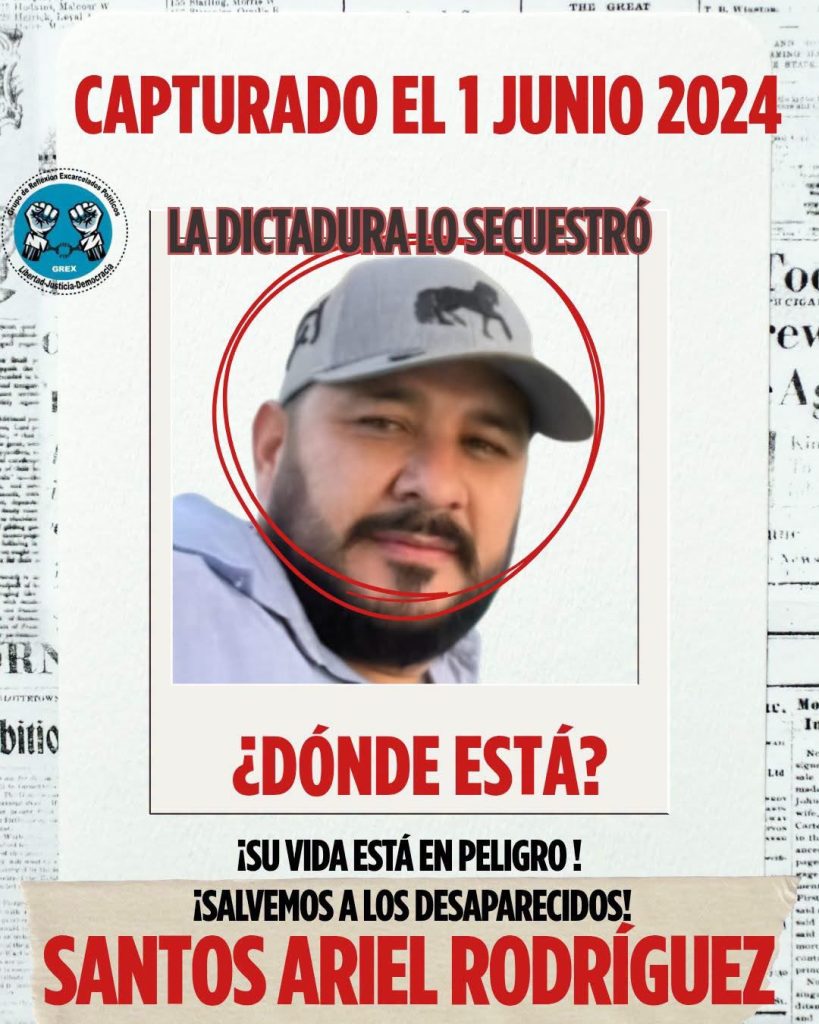
Rodríguez is among the 46 political prisoners identified by the Mechanism for the Recognition of Political Prisoners as of May 31, 2026. Of those prisoners of conscience, thirteen are older adults and nine remain victims of enforced disappearance.
The organization highlighted the continued lack of transparency surrounding the whereabouts, physical condition, and detention conditions of a significant number of those documented.
According to the mechanism, 26% of the 46 political prisoners are members or leaders of Indigenous communities, 21% are farmers, and 15% are individuals previously linked to the state apparatus or the ruling party.
“This distribution reflects a pattern of repression with differentiated impacts. On the one hand, the high proportion of Indigenous and rural detainees is associated with efforts to control territory and weaken community structures. On the other, the presence of individuals previously connected to the state apparatus or the ruling party confirms that political imprisonment now extends beyond the traditional opposition, demonstrating a broader and more cross-cutting reach,” the organization stated.
*With information from EFE.
PUBLICIDAD 3M
PUBLICIDAD 3D