16 de March 2026
AA
Share

 Las noticias del día en tu correo
Recibe lo más destacado de la cobertura de CONFIDENCIAL todos los días.
Más boletines
The best of our coverage, in English
Sign up for our weekly newsletter. We will send it to you every Friday at 10:00 am (Nicaragua time)
More Newsletters
PUBLICIDAD 1M
PUBLICIDAD 4D
PUBLICIDAD 5D

The country exported more than 39 600 kilos of shark fins between 2018 and 2024, but the government alleges “bycatch” and blames the “artisanal fleet”
16 de March 2026
“We buy shark fins,” reads a sign painted on the gable of a house on a busy street in Bluefields, on Nicaragua’s Southern Caribbean coast. It is an exception. Fishing businesses along Nicaragua’s Pacific coast have no signs, but everyone knows who buys shark fins. Along both the Pacific and Caribbean coasts, what is officially classified as “bycatch” is, in reality, a multimillion-dollar business.
Under the umbrella of the term “bycatch,” Nicaragua has exported tens of thousands of kilograms of dried shark fins in recent years to the Asian market, where they sell for more than $400 per kilo. The trade continues to grow, even as already endangered shark populations decline without any real scientific oversight, according to an investigation by CONFIDENCIAL, carried out with support from Fundación del Río—an NGO that was outlawed and confiscated by the dictatorship of Daniel Ortega and Rosario Murillo, but continues to operate from exile.
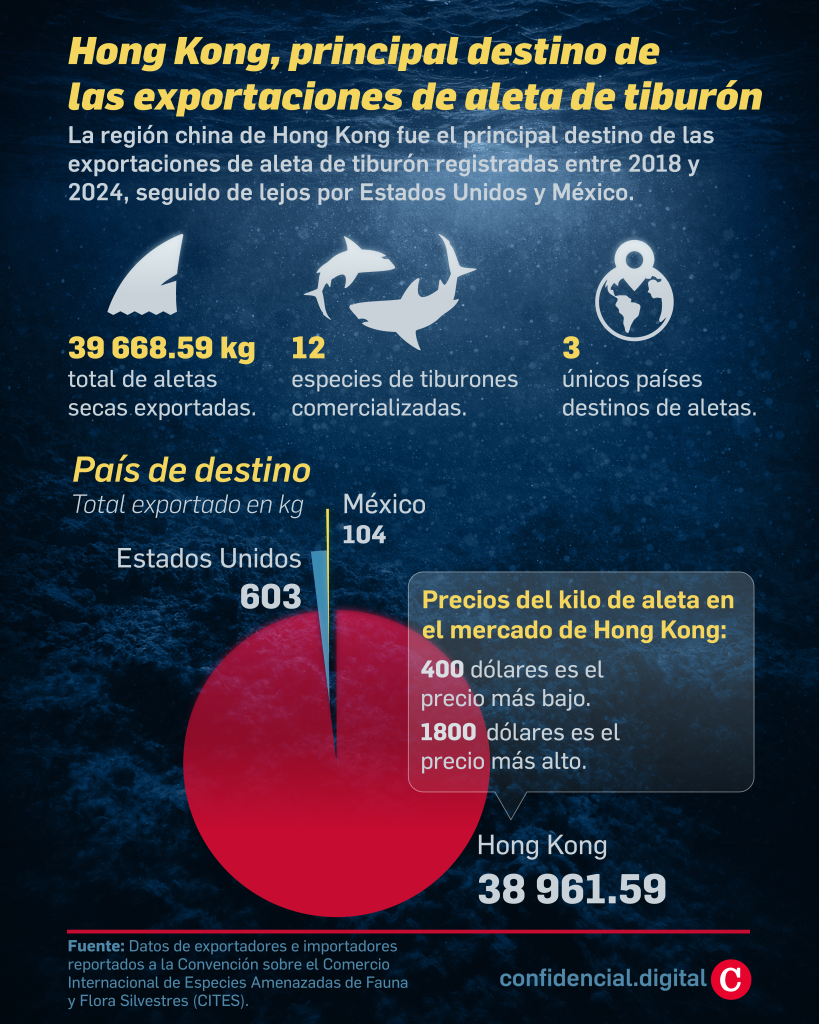
Between 2018 and 2024, Nicaragua exported about 39,668.59 kilograms (roughly 39.66 tons) of dried shark fins, according to data from exporters and importers reported to the Convention on International Trade in Endangered Species of Wild Fauna and Flora (CITES), which regulates international trade in endangered species.

The main export destination is Hong Kong, China, the nerve center of the shark fin trade in the world. Nicaragua exported some 38,961.59 kg of shark fins to that region, followed at a great distance by the United States (603 kg) and Mexico (104 kg).
The price per kilo varies depending on quality, species, and size. According to international media reports, dried shark fins sell for:
Based on the lowest price ($400), the 38,961 kg exported to Hong Kong generated approximately $15.5 million.
In Asian countries such as China, Singapore, Vietnam, and Thailand, shark fin soup is considered a symbol of status, luxury, and wealth. Its prestige stems from its historical role as a delicacy reserved for Chinese royalty and emperors.
A single bowl of high-quality soup—made with whole fins from prized species such as hammerhead sharks—can cost between $100 and $250. Meanwhile, in more modest establishments, a bowl that uses only a few grams of fin may sell for around $40.
Shark fin consists mainly of cartilage, collagen, and elastin, which have little nutritional value. Because it has no distinct flavor, it is typically combined with other meats in commercial dishes.
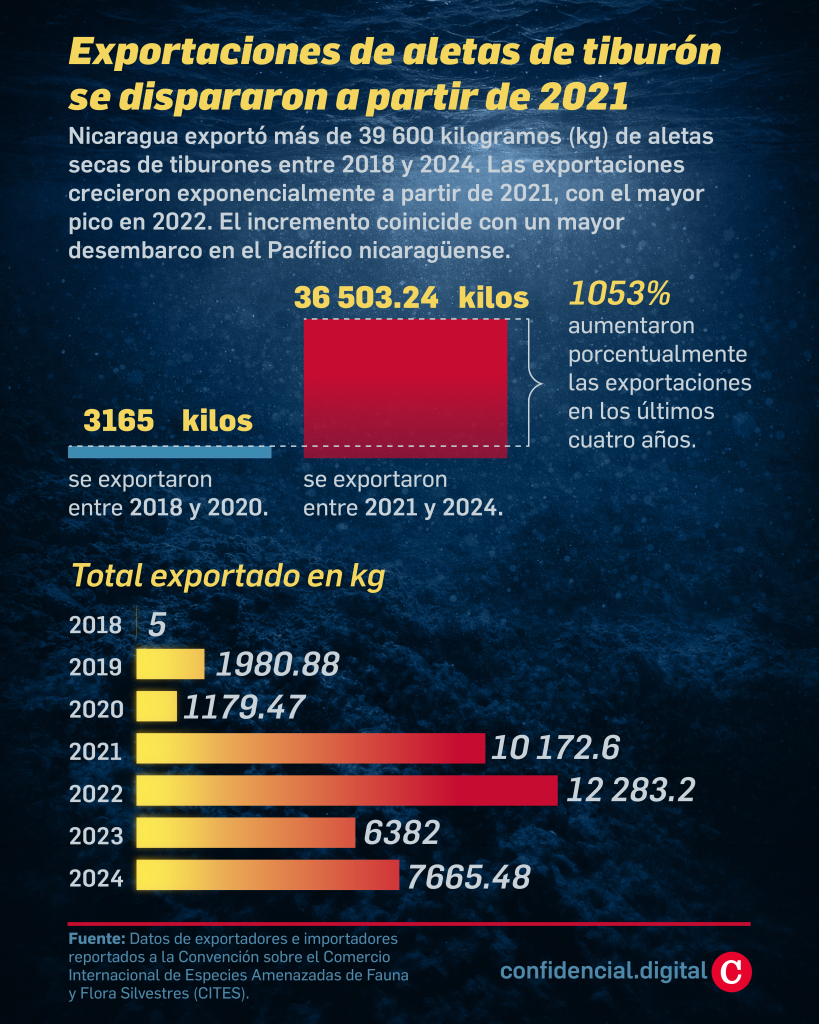
Exports of shark fins surged sharply in 2021, rising from 1,179.47 kg in 2020 to 10,172.56 kg the following year. The peak came in 2022, with 12,283.20 kg exported. According to CITES data, the most affected species are:
Also on the list are the scalloped hammerhead (Sphyrna lewini) and the common thresher shark (Alopias vulpinus).
To understand the scale of the killing behind these figures, Costa Rican biologist Randall Arauz Vargas offers a rough estimate: a large shark—around 50 kg when alive—yields approximately one kilogram of dried fins.
“One ton of hammerhead shark fins represents roughly 1,000 large sharks, or between 1,500 and 2,000 if they are smaller,” explains the biologist, who was awarded the Goldman Environmental Prize in 2010—often referred to as the “Nobel Prize for the environment”—for his efforts to protect sharks and ban the shark finning industry.
Based on Arauz’s estimate, the export of silky shark fins alone required the killing of more than 14,000 sharks.
According to CITES data, Nicaragua has exported fins from twelve shark species, most of which are listed as threatened on the International Union for Conservation of Nature (IUCN) Red List. Four are classified as endangered, and five are considered vulnerable to extinction.

“In Nicaragua, there is no targeted fishing for sharks; they are caught incidentally by the artisanal fleet,” the Nicaraguan government stated in a 2023 document prepared to justify the capture of hammerhead sharks.
According to the regime, the artisanal fleet operates in coastal waters—up to 40 miles offshore—and “its products are mainly landed at the port of San Juan del Sur and the beaches of Masachapa, Corinto, and Jiquilillo,” on Nicaragua’s Pacific coast.
“All fins from hammerhead sharks caught incidentally and landed in Nicaragua are destined for export, as there is no evidence of domestic consumption of this product,” the government asserted.
“All of the meat,” it continued, “is destined for domestic consumption. The small-scale or artisanal fleet also catches hammerhead sharks, mostly in juvenile stages, which are likewise consumed locally.”
However, official figures from the Nicaraguan Institute of Fisheries and Aquaculture (Inpesca) contradict the government’s narrative of “bycatch.”
Between 2013 and 2023, more than 2.8 million kilograms of shark (about 2,819.28 tons) were landed at Nicaraguan ports, according to the 2023 Fisheries and Aquaculture Statistical Yearbook—the most recent published by Inpesca.
The data show fluctuations in shark catches over the decade, although since 2020 there has been a clear upward trend, peaking in 2022 at 479,313.84 kg (about 479.3 tons)—the same year that recorded the highest shark fin exports.
Overall, landings on the Caribbean coast exceed those on the Pacific: 1.6 million kg versus 1.2 million kg, respectively. However, since 2021, shark catches along the Pacific coast have surged, reaching levels four times higher than those of the Caribbean by 2023, according to Inpesca statistics.
Nicaraguan ecologist Fabio Buitrago Vannini explains that shark fishing would be considered incidental “if landings are below 10,000 kg, are not increasing, and are not sustained year after year.” None of these conditions apply in Nicaragua’s case.
Fabio Buitrago Vannini
Nicaraguan ecologist
“It can never be considered incidental fishing. By all indications, this is a targeted fishery. The fact that it is increasing so rapidly suggests greater fishing effort or more advanced (fishing) technologies.”
Environmentalists point out that the techniques used are inherent to directed fishing. Buitrago details that the industrial boats use longlines that can extend up to 80 kilometers. “In those 80 km of line, for every kilometer there can be about 200 baited hooks,” he stresses. This means that a single boat can deploy thousands of hooks specifically designed to attract predators.
“An industrial vessel can easily catch more than 1,000 sharks in one or two nights of fishing,” the ecologist adds.
Arauz distinguishes between “accidental” and “incidental”: “An accident is something random; incidental catch is something inevitable and predictable, linked to the activity.”
“If you set that line there, you knew they would get hooked. It wasn’t an accident. They catch large numbers of sharks, bring them in, sell them, and then claim it’s incidental,” says the Costa Rican biologist.
“Shark fishing is allowed in Nicaragua, which is why it is carried out as a completely normal activity,” says Daniel, a fisherman from Huehuete, a coastal area in the municipality of Jinotepe, in Carazo.
In Pacific coastal communities – such as Casares, Huehuete, Masachapa, Poneloya and San Juan del Sur – and the Nicaraguan Caribbean – mainly Bluefields – shark fishing has become normalized as a lucrative economic alternative, since a pound of “fresh fin” sells for between 10 and 20 dollars.
In the case of dried fins, the price per pound is between $40 and $60. The sun-drying process takes between one week and ten days.
Based on these prices, a kilo of fresh fin is priced at a maximum of US$44, while dry fin is priced at US$132.
CONFIDENCIAL spoke via telephone and WhatsApp with Nicaraguan Pacific and Caribbean fishermen, who commented that the most “coveted” fins are the dorsal and pectoral fins.
Most sharks have eight fins:
The excessive interest in shark fins generates the so-called “finning” or “finning”, which consists of cutting off the fins and discarding the body. This practice has a “perverse” economic basis, according to Buitrago, since the fins of a medium-sized shark can be worth between 300 and 400 dollars, while its meat barely reaches 20 dollars.
“Since the fins weigh less than 2% of the total weight of the animal and are worth five or six times as much, vessels with limited capacity prefer to load only with fins and discard the meat,” the Nicaraguan ecologist explains.
Article 75 of Nicaragua’s Fisheries and Aquaculture Law 489“prohibits the capture of sharks in continental and marine waters for the sole purpose of cutting off any of their fins, including the tail, discarding the rest of the body of the species in the high seas, coastal areas or other places”.
The same article also prohibits “the landing, transport, storage and commercialization of fresh, frozen, dried or salted shark fins”. This order is not enforced in Nicaragua.
In practice, this legislation has encouraged the capture of the animal to take advantage of the whole body, although the real incentive is the fin.
Shark meat, known on Nicaraguan beaches as “bolillo”, is in low demand. It is sold to middlemen at prices ranging between 20 and 35 córdobas per pound (whole) and up to 50 córdobas per fillet. In Managua markets, shark fillets are priced between 100 and 110 córdobas per pound.
Miguel, an artisanal fisherman from the community of Casares, in Carazo, comments that, in order to “facilitate sales”, the stores and businesses mix shark meat with other fish species, mainly for the preparation of ceviches.
CITES data show that, between 2018 and 2024, there was only one export of shark meat. In 2022, 10 791 kg (10.7 tons) were sold to the United States. The meat was from the same species: the common thresher shark.

Fishermen and experts agree that “artisanal fishing” is not responsible for the shark catch, as the government claims, because the landing and export volumes are above their capacity.
“Our fishing is aimed at snapper, grouper, mackerel, dorado, jack mackerel, mackerel, scorpionfish, tuna, among others, but if a shark falls, we take advantage of it because it is not prohibited,” says Josué, a fisherman from Poneloya, in León.
He argues that shark catching “is mostly carried out by vessels over 15 meters in length”, which fall into the category of industrial fishing.
“They (industrial fishermen) use longlines, with multiple hooks, which extends into the deep sea for several kilometers and facilitates the capture of large sharks in the open sea,” he details.
“In artisanal fishing, more juvenile (sharks) are extracted, measuring between 60 and 110 centimeters long,” says the fisherman.
Inpesca classifies as “artisanal or small-scale fishing” the fishing carried out by Nicaraguans “with vessels less than 15 meters in length and for commercial purposes, among which are: cayucos, pangas, canoes, boats, pontoons and duritara”.
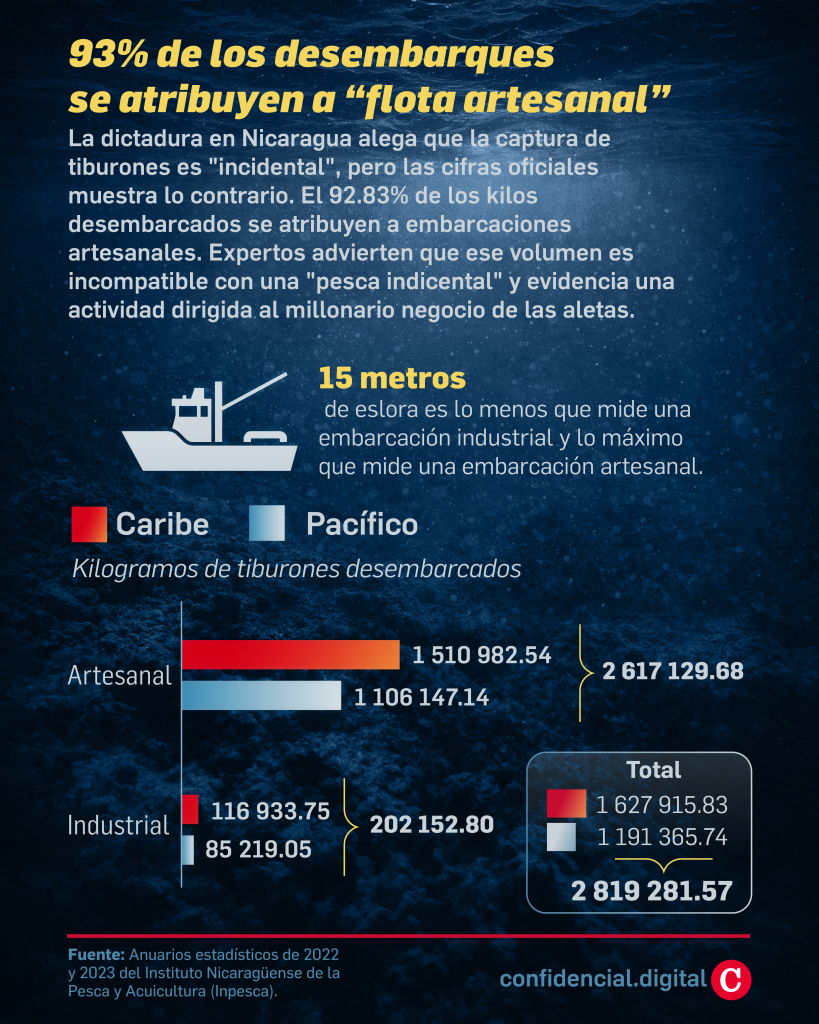
While “industrial fishing: is carried out for commercial purposes, using vessels of more than 15 meters in length, as well as larger fishing techniques and gear,” according to the government entity.
Wilson, a Blufileño who has been involved in shark finning, points out that the business “would not be sustained” by artisanal fishermen, since they catch a shark “occasionally”, while the “more industrialized” fishermen do it “commonly”.
“An artisanal fisherman takes you six or seven fins, once or twice a month, and with that you make nothing. But an industrial fisherman can take several kilos and then you can do business,” he says.
Fishermen from Nicaragua’s Caribbean and Pacific coasts refer to the buyers of shark fins simply as “the Chinese.” They either do not know—or chose not to disclose—the names. According to their accounts, they sell the fins to a middleman, who then transports them to Managua, where “the Chinese” take over. From there, the fins are exported to the Asian market.
Six shark fin export certificates from 2023 and 2024 identify two companies:
The certificates, obtained by CONFIDENCIAL, document the export of 11,147.48 kg (about 11.14 tons) of shark fins from eight different species. All shipments were sent to the same destination: Hong Kong. The documents were authorized by the Ministry of Environment and Natural Resources (Marena) and signed by Judith Pérez Puerto, listed as the “administrative authority.” She is part of the ministry’s Directorate General of Natural Heritage and Biodiversity.
Nica Pepino exported 8,117.48 kg, and Man Kang 3,030 kg, between December 2023 and March, May, July, and September 2024, according to the certificates.
Nica Pepino is legally represented by Wei Qiang Chung Ye, and its headquarters are located in Managua’s Bolonia neighborhood, 80 yards south of the old gate of the Military Hospital in Managua, according to a database of the Agri-Food Safety Directorate (DIA) of the Nicaraguan Institute of Agricultural Protection and Health (IPSA).
“The company is exclusively dedicated to the collection and commercialization of seafood, especially sea cucumbers. We are also marketing dried shrimp and fish maw (fish stomachs),” said Carlos Manuel Wayman Castillo, partner of Nica Pepino, in a March 2025 interview with the television channel TN8, owned by the Ortega-Murillo family.
On that occasion, Wayman Castillo revealed that the company was building a four-story building in Managua. The project represented an investment of about $8 million, with mixed capital: “Chinese, Panamanian, and Nicaraguan.”
Man Kang S.A. is legally represented by Am Ni Lin, and its headquarters are located in the Piedra Menuda area, in the municipality of Nindirí, Masaya. There is little publicly available information online about either the individual or the company.
According to the certificates, Nica Pepino’s exports were sent to two importers: Yeung Yee Marine Ltd. (7,167.48 kg) and Cutle Logistic Company (950 kg). Man Kang shipped its shark fins (3,030 kg) to Wise Global Birdnest Company. All three importers are based in Hong Kong.
Arauz Vargas argues that the global shark fin trade is largely controlled by Taiwanese traders based in Hong Kong, who handle between 80% and 90% of the global market. “It’s a trade strictly managed by Taiwanese operators who distribute from Hong Kong to China and other destinations,” he says.
CONFIDENCIAL sent emails to Man Kang and Nica Pepino, as well as to Marena and Inpesca, requesting interviews and information about shark catches and fin exports. The emails were sent on March 3, 2026, but no responses had been received at the time of publication.

The data about these companies and Nicaragua’s exports is not known because of transparency from the Ortega-Murillo regime. Instead, it appears in a complaint filed with Costa Rica’s Environmental Prosecutor’s Office. In May 2025, biologist Arauz Vargas and lawyer Walter Brenes Soto requested an investigation into an alleged illegal operation in Costa Rica: the “laundering” of shark fins.
The case focuses on the “illegal export of wildlife,” specifically hammerhead shark fins, through re-export operations conducted via Costa Rican ports.
According to the document, between September 26, 2023, and September 13, 2024, seven transactions were identified involving a total of 12,590.48 kilograms of dried fins, with a declared value of US$164,268.40.
Nicaragua plays a key role in the investigation, as all recorded operations list it as the origin of the shark fins.
The central inconsistency lies in the discrepancy between the quantities authorized by Nicaraguan authorities and what was actually exported from Costa Rica.
Based on CITES export permits issued by Marena, Nicaragua only authorized the export of 1,833 kilograms of hammerhead shark fins. However, Costa Rican customs records show that more than 12,500 kilograms of hammerhead fins were exported to Hong Kong under the specific tariff classification for this species.
This surplus of 10,757.48 kilograms lacks supporting documentation and, according to scientific estimates cited in the complaint, is equivalent to fins from at least 12,000 hammerhead sharks.
The complaint states that this situation “points to a possible illegal and large-scale trade” involving a critically endangered species.

The complaint further argues that these exports violate ruling 912-2023 of the First Chamber of the Supreme Court of Justice, which mandated the protection of hammerhead sharks under Costa Rica’s Wildlife Conservation Law. It also questions the authority of the Costa Rican Fisheries and Aquaculture Institute (Incopesca) to authorize these procedures, arguing that only the National System of Conservation Areas (SINAC) has the legal power to issue CITES permits.
The complainants have requested the identification of individuals and companies responsible for these re-exports, as well as the opening of criminal proceedings to establish accountability. The case remains unresolved.
In an interview with CONFIDENCIAL, Arauz Vargas stated: “They take advantage of these re-exports to launder fins caught in Costa Rica. It is a crime because they are falsifying information and opening containers that should be sealed.”
The situation in Nicaragua and the complaint in Costa Rica show that shark finning is a regional issue. Latin America has become a key region in the global supply of shark fins, largely driven by demand from Asian markets. Peru and Ecuador are among the countries with the highest volumes of catches and exports.
Peru is identified as the main shark fin trader in Latin America. Between 2019 and 2024, it exported 1.7 million kilograms (about 1,736.45 tons) to Asian markets, according to data from the media outlet Ojo Público.
Additionally, Peru serves as a transit hub, where fins enter from Ecuador and are then re-exported to Asia, according to international organizations and media reports.
Shark fishing is not only a loss of biodiversity—it also threatens ocean stability and human economies. Fabio Buitrago explains that removing top predators triggers what ecologists call a “trophic cascade.”
“There is an interconnection among organisms within the same ecosystem, driven by predator-prey relationships. Sharks sit at the top of that food web,” he explains.
The Nicaraguan ecologist outlines the consequences of shark slaughter as follows:
Ecological consequences:
Social consequences

Species protected under CITES are classified into three Appendices, depending on the level of protection they require. All shark species caught in Nicaragua are listed under Appendix II, which includes “species that are not necessarily threatened with extinction, but whose trade must be controlled to avoid uses incompatible with their survival,” according to the Convention’s website.
Appendix I includes all species threatened with extinction, whose trade is permitted only under exceptional circumstances. Appendix III covers “species that are protected in at least one country, which has requested the assistance of other CITES Parties to control their trade.”
Although CITES has restricted international trade in certain shark species, there are no effective legal or criminal penalties for those who ignore these rules and continue shark fishing.
The Nicaraguan ecologist explains that “the administrative authority for CITES in Nicaragua is Marena, which has the legal responsibility to approve permits related to species regulated under the Convention.”
However, in Nicaragua, “they find ways to ensure that Marena does not obstruct the development of the fishing sector—which, for those in Inpesca, means not putting on the brakes, or not regulating or limiting the exploitation of resources that are already under threat.”
Inpesca’s role is identified as the main obstacle to shark conservation. According to Buitrago, there is a structural conflict of interest: “You can’t put the wolf in charge of the sheep. An institution tasked with maximizing fishing resources cannot also be responsible for conserving a resource that generates significant revenue.”
Inpesca has a dual role that compromises sustainability:
“It is both judge and party, because they decide what, how, when, and how much you’re going to pay,” the ecologist says.
Additionally, Nicaragua is failing to comply with international CITES regulations by not producing a Non-Detriment Finding (NDF). This document, which should be prepared by an independent scientific authority, is essential to ensure that extraction is sustainable. “Under the Convention’s rules, without such a finding, exports should not be allowed. Nicaragua would be violating international regulations,” says Arauz.
Experts argue that sharks should no longer be treated as “commercial species,” but as wildlife. In Nicaragua, all natural resources with market value—such as mining, timber, and fisheries—have been removed from Marena’s jurisdiction and handed over to institutions focused on exploitation, including Inpesca, the Ministry of Energy and Mines, and the National Forestry Institute (Inafor). Marena is left managing only biodiversity that does not generate immediate revenue.
“There should be a complete separation between conservation and exploitation interests,” Buitrago proposes. He suggests creating an entity dedicated exclusively to marine resources, with no economic ties to exploitation—similar to a “Ministry of the Sea.”
“Inpesca has no real interest in conserving marine natural resources, because its primary function is exploitation,” he adds.
Environmentalists warn that as long as regulation remains in the hands of those who profit from shark fin exports, “bycatch” will continue to serve as the legal label for the killing of sharks off Nicaragua’s coast.
Archivado como:
PUBLICIDAD 3M

Periodista y editor en CONFIDENCIAL. Licenciado en Comunicación Social por la Universidad Centroamericana (UCA). Máster de la Escuela de Periodismo de la Universidad Autónoma de Madrid (UAM) - El País. Finalista del Premio Latinoamericano de Periodismo de Investigación “Javier Valdez” del Instituto Prensa y Sociedad (IPYS).


PUBLICIDAD 3D