AA
Share

 Las noticias del día en tu correo
Recibe lo más destacado de la cobertura de CONFIDENCIAL todos los días.
Más boletines
The best of our coverage, in English
Sign up for our weekly newsletter. We will send it to you every Friday at 10:00 am (Nicaragua time)
More Newsletters
PUBLICIDAD 4D
PUBLICIDAD 5D
Eleazar Blandón worked picking watermelons at 44 degrees Celsius. He died after being abandoned at the doors of a health center.
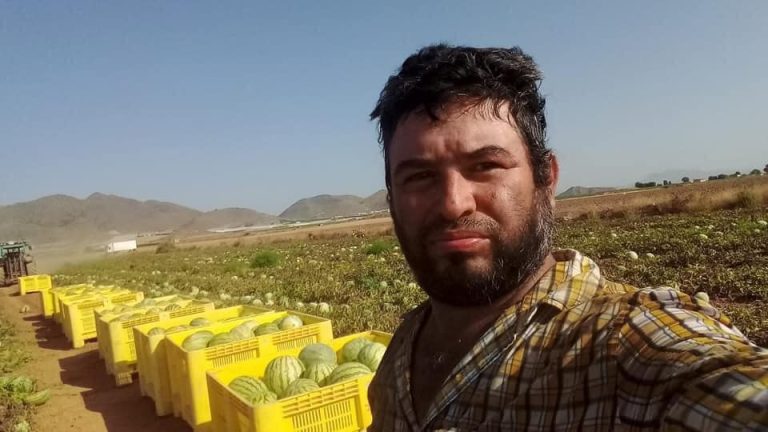
Eleazar Blandón en una foto que le envió a su hermana Ana un par de días antes de morir. // Foto: Cortesía
Justice has finally come—five years later—for the family of Eleazar Blandón, a 42-year-old Nicaraguan farmworker who died on August 1, 2020, from heatstroke after being abandoned outside a health center in Lorca (Murcia), Spain. Judge Emilia Ros, from the court in Lorca, has decided to prosecute agricultural businessman Pedro Manuel P. T. for involuntary manslaughter. Blandón had been working for him without proper documentation and was left alone outside the clinic after hours of laboring under the scorching sun in a watermelon field.
The judge believes there is “sufficient evidence” to prosecute the businessman for several crimes: involuntary manslaughter, offenses against property and the socioeconomic order, and violations of labor rights, according to a report by eldiario.es.
Although Eleazar began to feel unwell long before being abandoned—with labored breathing, pale skin, and staggering—no one called an ambulance. On the contrary, the businessman “did not suspend” the work at the watermelon field and even “allowed” him to be moved to another site to unload a truck, the court ruling states.
According to the court resolution previewed by Spanish newspaper El País, “Eleazar’s workday ran from 7:00 a.m. to 3:00 p.m. with only a single break at 10:00 a.m. The working conditions were not adapted to the extreme heat.”
Eleazar Blandón, 42, left Nicaragua in October 2019 in search of work in Spain. He was raising four children from his previous marriage, and his wife was five months pregnant at the time. His plan was to work and return home to open a business in his hometown of Jinotega.
But upon arrival in Spain, he lived in precarious conditions. When the pandemic jeopardized his asylum process, he accepted a job on a watermelon farm, working 11-hour shifts in extreme heat, without water.
In 2020, after his death, his siblings told CONFIDENCIAL about two painful coincidences: 19 years earlier, Eleazar’s father, also a migrant, had died of heatstroke in Texas. And just a week before Eleazar’s death, his mother had managed to collect enough money to buy him a plane ticket home. He was supposed to return in October 2020 but had started working at the plantation to save for what he still needed.
According to the case file, at around 3:30 p.m. on August 1, 2020, a van stopped outside the Lorca-Sutullena health center. Eleazar’s body was literally dumped from the vehicle, still in his work clothes, before the vehicle fled the scene.
Emergency Coordination Service 112 was immediately notified, and a mobile unit from the Emergency Medical Service arrived shortly afterward. But it was too late—Eleazar had died from heatstroke. Temperatures in Lorca that Saturday had soared past 40 degrees Celsius (104°F).
The Guardia Civil arrested Eleazar’s employer the next day, although at the time it was not known who had abandoned the day laborer at the emergency room door. His boss initially denied knowing him. This was the first time that the national had worked with the Ecuadorian businessman Pedro Manuel P. T.
Spanish media reported that in his first statement to the Civil Guard, the employer claimed he was driving with two other workers when he “found someone on the side of the road” and took him to a nearby clinic in Lorca, in southern Spain. The Nicaraguan was later transferred to a hospital, where he arrived without a pulse and in cardiac arrest, according to medical records.
After that initial statement, the Ecuadorian businessman changed his story and admitted to authorities that the deceased was indeed his worker. He said the man had been working with him for two or three days and had not yet been registered with Social Security.
In 2020, Eleazar’s sister Ana, also a migrant in Spain, said that one day he called her crying. “They humiliate you here,” he told her. “They call me a donkey, they yell at me, they say I’m slow. They throw dirt in your face when you’re bent over. I’m not used to being treated like this.”
Sometimes Eleazar would kneel in the fields because of severe back pain, but he would be scolded—he was expected to stay bent over to work faster.
Eleazar’s death shocked both Spain and Nicaragua. International media outlets shared his story, highlighting the exploitation and abandonment undocumented migrant workers often endure.
PUBLICIDAD 3M
PUBLICIDAD 3D

Alertas en tu celular
Suscribite a las alertas informativas de Confidencial en Telegram.

Boletines
Lo mejor de nuestra cobertura noticiosa en tu correo electrónico.

Anuncios
Obtené una propuesta comercial de acuerdo a tus objetivos y presupuesto.

Test Político
Explorá tus ideas sobre nuestra política, economía y sociedad con nuestro Test Político.