AA
Share

 Las noticias del día en tu correo
Recibe lo más destacado de la cobertura de CONFIDENCIAL todos los días.
Más boletines
The best of our coverage, in English
Sign up for our weekly newsletter. We will send it to you every Friday at 10:00 am (Nicaragua time)
More Newsletters
PUBLICIDAD 4D
PUBLICIDAD 5D
Almudena Bernabéu: “There is a criminal regime”; investigations must bring the perpetrators who ordered and planned the crime to trial

La jurista española Almudena Bernabéu, directora del Centro Guernica para la Justicia Internacional, habla durante una rueda de prensa en San José, Costa Rica, el 19 de julio de 2025. // Foto | EFE/Jeffrey Arguedas
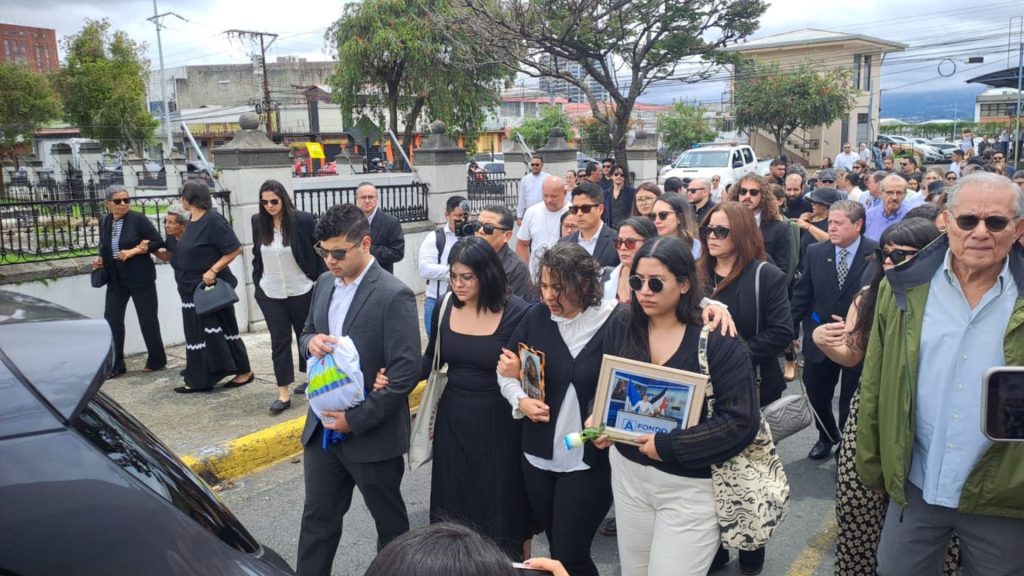
The Costa Rican Prosecutor’s Office has charged five Costa Ricans suspected of being the perpetrators of the murder of retired Major Roberto Samcam, a Nicaraguan refugee in Costa Rica who was executed at his home in Moravia, San José, one year ago, on June 19, 2025.
Four of the defendants in this case, which was filed in a criminal court on June 11, 2026, are currently in custody, including 21-year-old Luis Fernando Carvajal, who is accused of being the gunman who shot Samcam; another defendant is Danilo Chaves Medina, who is accused of being one of the intermediaries in the criminal organization.
However, the Prosecutor’s Office does not include Nicaraguan Kenny Navarrete Vallecillo, originally from Diriamba, in the indictment. He is currently imprisoned in the Alajuela prison, and according to the investigation by the Judicial Investigation Agency (OIJ), he managed more than $16,000 from prison, which he used to hire the hitmen who killed Samcam.
“As far as I know, he is not named,” in the indictment, says Spanish criminal defense attorney Almudena Bernabéu, director of the international law firm Guernica 37, which represents Claudia Vargas—Samcam’s widow—in the proceedings “as both a victim and a civil plaintiff.” Bernabéu believes that the case of Navarrete—who is linked in Nicaragua to the Carazo-based paramilitary group “Los Colochos” and to the DID (the Army’s political intelligence agency)—“is part of an investigation that the OIJ is currently expanding.”
In an interview on the program Esta Semana, which aired on CONFIDENCIAL’s YouTube channel on Sunday, June 21, 2026, at 8:00 p.m., due to television censorship in Nicaragua, Bernabéu discussed the investigation into Samcam’s murder and what he described as the “two levels of justice.” The first is expected to lead to a criminal trial in the coming months against the direct perpetrators, while subsequent investigations could bring the intellectual authors—the individuals who ordered, financed, and planned the crime—before other courts.
The legal expert referred to “the decline of a criminal regime, an apparatus, a system, which does not eliminate individual criminal liability.” “I don’t want to generate euphoria or false expectations, but from my perspective as an international lawyer, it is an honor and a responsibility for me. I believe we need to investigate this thoroughly and devote the time it deserves. I believe the Nicaraguan people deserve it, and we must try,” she stated.
One year after the murder of Roberto Samcam in Costa Rica, the Public Prosecutor’s Office filed charges last week against five Costa Ricans identified as the perpetrators of the crime. What is the assessment of Roberto Samcam’s family’s attorneys regarding the OIJ’s investigation and the charges filed by the Public Prosecutor’s Office?
Indeed, it has been a year, and sometimes we don’t realize just how quickly that passes in terms of criminal law. The assessment is positive. There was some initial slowness during the first few months—amid the shock felt by the Nicaraguan exile community and Costa Rican society in general over Roberto Samcam’s murder, which seemed to leave a huge void—but in reality, the assessment is very positive.
In terms of criminal law, when investigating a crime with new elements—such as the fact that the perpetrators are hitmen, hired individuals—as stated in the indictment, who have few direct ties to the murdered person, the victim—one does not truly know the level of complexity the case will entail. We have closely monitored the investigation throughout the year, and they have been diligent. The OIJ and the Prosecutor’s Office have been working on the case and are meeting their deadlines; we are awaiting the formal filing of the complaint and the identification of the complainant, and the case will go to trial within the timeframe provided for by Costa Rican procedural law.
Generally speaking, the law has been upheld, and all those involved in carrying out the murder are in custody.
The indictment states that all the perpetrators of this crime received payment to kill Roberto Samcam, a Nicaraguan refugee in Costa Rica. Who hired them?
Part of what we’re trying to determine is who. It’s clear that they were hired and that they received monetary payments. Among the accused, a couple of individuals have been identified who, in my own words—not those of the indictment—handled the logistics of carrying out the murder. And at this time, the investigation is continuing, focusing on the individuals who have been charged. I believe that the testimonies and the trial itself will yield additional information. The goal is to effectively determine who is behind this hiring—that is, ultimately, the perpetrators who wanted Roberto Samcam dead.
The OIJ’s objective is the prompt enforcement of criminal law, starting with the perpetrators—that is, the result of the death, what was found on the cameras, and what was found on the cell phones—to determine who was directly involved in Roberto’s execution. That is the first of several steps, and it is the one that has been completed at this time. But the investigation has not stopped, and it remains to be seen what evidence will emerge from both this part of the investigation and other ongoing lines of inquiry.
The investigation reveals some evidence of a motive other than the payment of money for the commission of this crime. Did the hitmen know who they were tailing, and who this person was that they were going to kill?
The indictment merely suggests, based on the preliminary statements that were taken—they will now testify at trial and will have attorneys, whether court-appointed or privately retained— But based on the preliminary statements summarized in the indictment, everything points to the fact that they did not know who had hired them. In fact, they only knew about the intermediary—the people who made the payment. So, that is the part of the investigation that is expected to be expanded upon.
Roberto Samcam was out of Costa Rica during the first part of 2025 and returned from a trip on Sunday, June 15; he was killed on Thursday, June 19. Is it known when this group of Costa Ricans received the order to kill the former Army major?
Not in terms of the exact day or time, but there is indeed information in the case file and in the indictment stating that he returned after a long stay in the United States, where he had been with his family in California. He did indeed return on Sunday, the 15th, and that naturally suggests they knew of his return and therefore carried out the murder in the days that followed. And the second piece of information is that when video footage from the area where they lived was obtained, it was possible to visually identify some of the hitmen involved in the murder; it was determined that two of them had been physically present at an event at the Casa de España the day before the murder.
Everything suggests that, indeed, when these individuals were hired and given the assignment to assassinate Roberto Samcam, they proceeded to take several steps over the course of several days until they carried out the assassination on the 19th (of June 2025).
In the OIJ’s expanded investigation report—to which we, as journalists, had access—a Nicaraguan named Kenny Navarrete Vallecillo, originally from Diriamba, is identified. He is currently imprisoned in the Alajuela jail, and the investigation states that from prison he managed a considerable amount of money—more than $16,000— and identifies him as the person who orchestrated this crime and had ties to the perpetrators. Isn’t Kenny Navarrete named in this indictment?
As far as I know, he isn’t named. That investigation, as far as we know from the OIJ, is set to be expanded. This individual was identified not only in this case but also in connection with other assignments—though not on this scale, since, fortunately, not as many people have been murdered—but he was found to be involved from prison and orchestrated other payments in other incidents. So, the OIJ is currently expanding that investigation.
This Nicaraguan man imprisoned in Costa Rica is also implicated in the investigation for his ties to a paramilitary group in Carazo known as “Los Colochos,” as well as for his connections to the Army’s Defense Intelligence Directorate, which handles political intelligence and military espionage. In this indictment, are any individuals linked to the Nicaraguan dictatorship named as part of the proceedings?
Not directly, not yet, but the idea is that the investigation will be based on the hypothesis that the events in Carazo (the repression there) link several people who have been attacked, who have been the victims of assassination attempts, or who have been murdered, such as Roberto Sancam himself. So, that is one of the lines of investigation being pursued by the OIJ: people linked to the events in Carazo who went into exile in 2018 as a result of those events. And there are many connections between what happened in Carazo, of course, and the people who later went into exile. So, that is one of the hypotheses the OIJ is pursuing and exploring in greater depth.
And what comes next in this legal process? How is the family involved as the aggrieved party? Are you, as attorneys in this trial, part of the investigation?
Both. Under Costa Rican law, there were two key stages for Claudia Vargas’s family and for Claudia herself, the widow of Roberto Samcam. First, she was recognized as a victim—a status that is formally acknowledged in the proceedings—and that took place a few months ago. Naturally, as a result, she spoke on several occasions with the OIJ. We, as attorneys—and with the support of Federico Campos, the criminal defense attorney who has selflessly been supporting the case in Costa Rica as the family’s private counsel—have been working with both the Prosecutor’s Office and the OIJ.
And now, in the indictment, we will file a formal motion expressing our formal intention to act as a civil party in the proceedings leading up to the oral trial, which we believe will take place sometime in 2027, within the one-year timeframe established by law.
So what remains for us now is to file the complaint on behalf of Claudia and her family, which grants us a status equivalent to—though never identical to—that of the Prosecutor’s Office, in that we can present evidence on behalf of our clients. We are an active party with a certain degree of agency in the proceedings, and the idea is to make the most of that, but it can also be very useful in the context of an oral trial regarding the situation of the Nicaraguan community in exile—in relation, of course, to Carazo and that line of investigation.
Given the evidence presented in the Prosecutor’s Office’s indictment—which is based on the OIJ’s investigation—is there sufficient grounds for a judge to eventually issue a guilty verdict finding that these individuals bore direct responsibility for the murder of Roberto Samcam?
Yes, I believe that if one sticks to the text of the indictment and, having reviewed the investigation through the various phases of the case file, there is a sufficient compilation and systematization of the evidence in that indictment to presume that these individuals will be found guilty. I think this is proceeding fairly smoothly.
And what is needed to get to the bottom of this investigation and the demand raised by Claudia Vargas, Roberto Samcam’s widow, and the entire Nicaraguan community, which is calling for justice and for the identification of the masterminds who ordered, financed, and planned Roberto Samcam’s murder?
I would speak of two levels of justice. This investigation, which will lead to a trial in the coming months, is a first step toward achieving justice. It’s very important to underscore the gravity of Roberto Samcam’s murder—not only in terms of the individual and the personal and family tragedy, but also the impact it has on an entire community and that long arm of repression, and I don’t think that’s speculation—it’s Nicaragua, or certain Nicaraguan agencies. There is a deliberate effort on the part of the current regime in Nicaragua to silence these people, and they are sparing no effort to achieve this. They have forced thousands of people into exile and continue to repress these individuals and their families in various ways.
But then there is a second level of justice—one that requires a closer examination—the decline of a criminal regime that, as it evolves, is dedicated to repressing and inventing new ways to apply those levels of repression and to strangle the community by forcing it to leave, and even further, into exile. So, on that second level of justice—which I believe is what Claudia is demanding and to which we at Guernica 37 are particularly committed and connected—and the work we are carrying out is where we are headed.
We are involved in a criminal case against a group of criminals who buy weapons with money they’re given and are paid a price to murder a person. And based on our experience with criminal cases, information always comes to light in the testimonies; there’s always a glimpse of something that can contribute to that further investigation into the second level of justice—and at some point, there will be a legal mechanism that will allow us to bring this before a court.
Does Costa Rican jurisdiction allow this process to be pursued to its conclusion if the investigation opens the door to identifying and pursuing an investigation into political accountability—whether involving individuals linked to the regime—or would this require exploring other international jurisdictions?
A bit of both. Costa Rican jurisdiction has—though it is little known—a provision for universal jurisdiction, as it is commonly known, under which, in principle, only the gravity of the crime could trigger or lead to the opening of cases in Costa Rican courts. Here is Claudia, his widow, and here is the most significant concentration of Nicaraguans outside Nicaragua itself—the largest group of refugees in terms of numbers and also the one most deeply rooted in Costa Rica—which could make this the perfect venue for a case of this magnitude.
But there are other alternatives we’ve also discussed. In the case of Roberto Samcam, we’ve discussed the Spanish courts. And based on these considerations, there are avenues—there are forums—to pursue this case and to continue investigating in depth the Nicaraguan government’s involvement in this murder.
This requires a certain level of coordination, a certain level of management. So, I know that the timelines are long and the investigations are complex, and I don’t want to create either false hope or unrealistic expectations, but from my perspective as an international lawyer—for me, it is both an honor and a responsibility—I believe we need to investigate this thoroughly and devote the time it deserves. I believe the Nicaraguan people deserve it, and we must try.
Can these responsibilities be attributed to individuals within a system that, as you have described it, has the characteristics of a repressive and criminal apparatus?
Without a doubt. The fact that I speak of a system in no way eliminates—on the contrary, I believe it reinforces—individual criminal or penal responsibility. In fact, this represented a step forward from the Nuremberg trials in Germany, and that is the key to international criminal law.
If one wants to be rigorous about the truths behind these atrocities—which, moreover, persist over time and stem from systems—one must discuss the apparatus itself. For example, how a law is passed to strip citizens of their nationality, thereby allowing the confiscation of property from all exiles—that doesn’t happen overnight.
And the hope of Guernica 37 is that, in this investigation, we will be able to address that system, those operations, and the operational level—how it is conceived, how it is implemented, and who is individually responsible for making it work. At the level of orders, at the level of those in charge, and at the executive level—that is the investigation we are attempting to conduct.
PUBLICIDAD 3M
PUBLICIDAD 3D