AA
Share

 Las noticias del día en tu correo
Recibe lo más destacado de la cobertura de CONFIDENCIAL todos los días.
Más boletines
The best of our coverage, in English
Sign up for our weekly newsletter. We will send it to you every Friday at 10:00 am (Nicaragua time)
More Newsletters
PUBLICIDAD 4D
PUBLICIDAD 5D
Acevedo says Nicaragua remains a bipartisan concern in Washington despite competing crises across Latin America

Vista de unos tacos de cocaína incautados por la Policía de El Salvador, en enero de 2026, a una embarcación que procedía de Nicaragua. | Foto: X del ministro Gustavo Villatoro
Nicaraguan-American analyst Eddy Acevedo, who has more than 20 years of experience in different areas of U.S. foreign policy toward Latin America, believes that the expansion of drug trafficking in Nicaragua “deserves greater attention, and the role played by the Armed Forces, security forces, and the Police in the drug trade must be analyzed.”
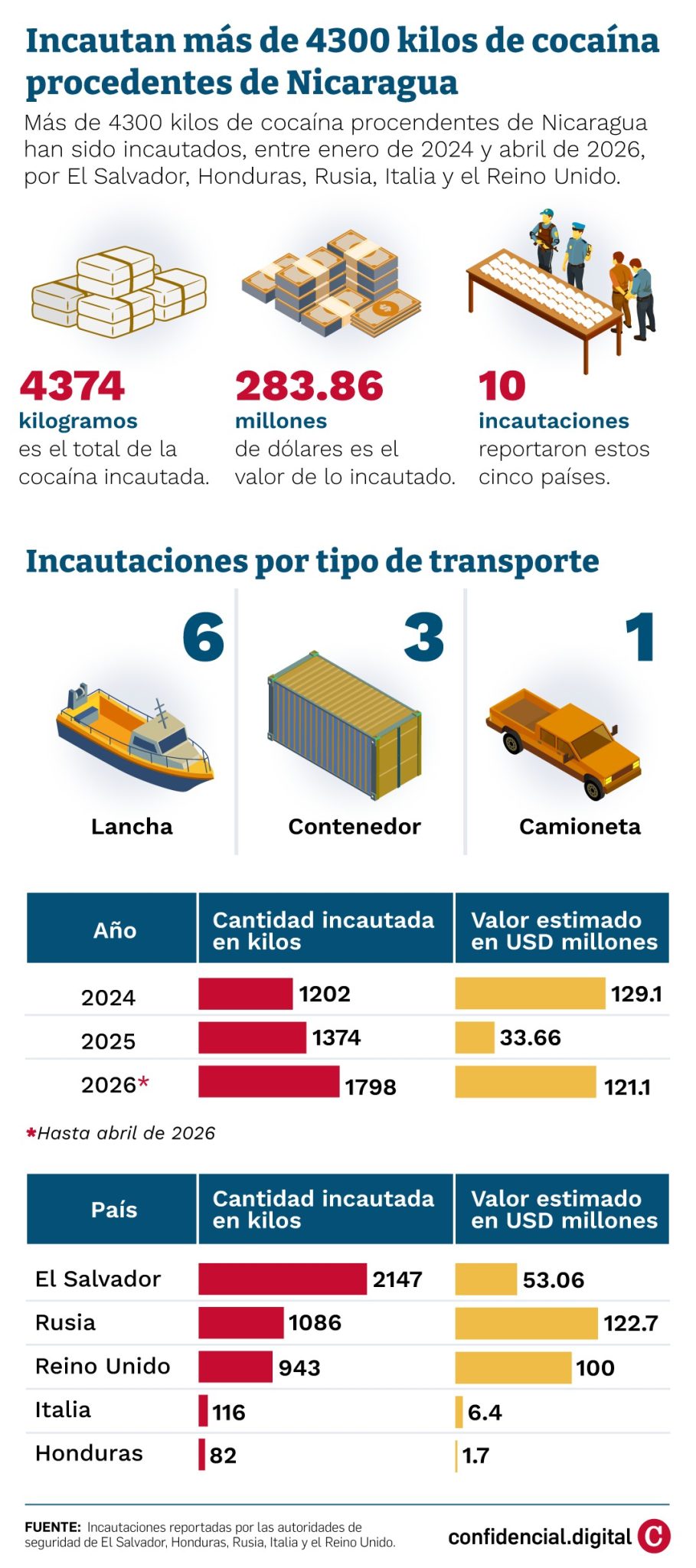
In an interview on the program Esta Semana, broadcast on CONFIDENCIAL’s YouTube channel due to television censorship in Nicaragua, Acevedo analyzed the trafficking of more than 4,300 kilos of cocaine originating from Nicaragua that, over the past two years, has been intercepted in ports in Russia, Italy, and Great Britain in Europe, as well as in Pacific waters off Central America in El Salvador.
“The Ortega-Murillo regime controls Nicaragua as if it were cartel territory. It does not allow other cartels or gangs to operate within the country because they themselves are controlling that type of movement and the transit of drugs,” Acevedo stated.
The former congressional adviser, promoter of the Nica Act, has worked as an expert at United States Agency for International Development and the Wilson Center, and currently serves as vice president for policy and government relations at the National Endowment for Democracy.
When asked about the recent political attacks by dictator Daniel Ortega against President Donald Trump, Acevedo responded that “the United States is not ignoring Nicaragua,” and that there is a “bipartisan” policy to impose sanctions on more than 60 senior officials of the regime.
“There are other (priority) issues in the region, such as Venezuela and Cuba, but I can assure you that Nicaragua is never ignored,” Acevedo said, confirming that a congressional hearing dedicated to Nicaragua’s crisis will be held on May 20.
For the second time in less than two weeks, dictator Daniel Ortega launched a political attack against the president of the United States. First, he called him a ‘murderer and deranged,’ and now he says he is ‘not afraid of an invasion,’ when no one is threatening to invade Nicaragua. Is there any reaction to these attacks in the United States, or are they still ignoring Daniel Ortega?
This is nothing new. We know — and it is very well documented — the Ortega-Murillo regime’s hostility toward U.S. leadership, regardless of who occupies the White House. I do not believe the United States is ignoring Nicaragua. Recently, new sanctions were advanced, and for many years both political parties have worked in a bipartisan manner to hold the regime accountable. Over the past eight years, the United States has imposed economic sanctions on more than 60 Nicaraguan officials and several entities for their involvement in illicit activities, including corruption and human rights violations.
Nicaragua remains a priority here in Washington. Of course, there are other issues in the region, such as Venezuela and Cuba, but I can assure you that Nicaragua is never ignored.
President Trump has never mentioned Nicaragua by name. Marco Rubio, however, has done so on several occasions. The secretary of state said in Costa Rica: ‘Nicaragua is a dictatorship and an enemy of humanity.’ And on April 18, he announced sanctions against Deputy Interior Minister Luis Cañas, who is one of the enforcers of Nicaragua’s exile policies. Is policy toward Nicaragua being handled by Rubio, who is also in charge of Cuba?
The secretary of state knows Nicaragua very well, and certainly he and the leadership of the State Department — such as Chris Landau, who is the department’s number two official and is also focused on many Latin American issues — are handling the White House’s Latin America policy, and that includes Nicaragua.
In that speech, Ortega said he is ‘not afraid,’ but another part of his message was devoted to attacking the opposition in exile, the political prisoners he banished to the United States, and even priests and journalists. If he is not afraid, how do you explain these virulent attacks against the opposition?
The paranoia of the Ortega-Murillo regime is incredible, reaching this extreme point. Truly, there are no limits to the regime’s brutality. It continues attacking the Church, priests, religious groups, civil society, and former political prisoners. And the list goes on. The Nicaraguan people have shown tremendous bravery and courage in continuing to long for freedom and democracy.
On the issue of religious freedom, the U.S. Commission on International Religious Freedom published a report this week once again documenting Nicaragua’s campaign to eliminate religious freedom in the country. The report documented how many processions and religious activities have been banned throughout the country, and how the government has continued restricting Holy Week celebrations for nearly four consecutive years. We have also seen deeply troubling images of destruction inside Nicaraguan churches caused by the violence of the security forces.
How is Nicaragua’s opposition in exile, while the country itself remains under a police state, perceived in the United States, in Congress, the State Department, and the White House? What role does it play in a democratic transition?
The opposition has suffered tremendously. Many opposition members were imprisoned for years, tortured, and subjected to inhumane treatment. Later, they were forced into exile, expelled from the country, and now some of those leaders continue living under this kind of terror.
Many Nicaraguans are facing transnational repression, according to reports we have seen from Costa Rica, for example, indicating that some leaders are being intimidated and even killed in Costa Rica simply for being part of Nicaragua’s opposition.
The opposition has suffered greatly over these years, but they also have to find a way to work together and send a very clear message to the Nicaraguan people about how democracy and freedom can be achieved in the future.
CONFIDENCIAL published an investigation into drug trafficking from Nicaragua to other countries. More than 4,300 kilos of cocaine have been intercepted over the past two years, half of it in ports in Great Britain, Russia, and Italy in Europe, and the other half, more than 2,000 kilos seized in the Pacific off El Salvador, drug shipments headed to the United States. Has there been any reaction from the United States regarding the expansion of drug trafficking in Nicaragua?
More attention is needed. When people talk about drugs in Latin America, they usually focus on what is happening in Colombia, Venezuela, or the Northern Triangle. But Nicaragua has not really been part of that conversation, and I believe it deserves far more attention.
We have seen how corruption and weak security infrastructure have turned Nicaragua into a crucial transit point for drug trafficking. Nicaragua has reduced its cooperation in anti-drug efforts, and over the past year the situation became so bad that the United States ultimately had to end its operations with the DEA there.
It is also important to recognize the role played by the regime, the Armed Forces, the security forces, and the Police in the drug trade. The regime controls the country as if it were cartel territory. It does not allow other cartels or gangs to operate inside the country because they themselves control that kind of movement and the transit of drugs.
The experts analyzing the increase in drug shipments intercepted abroad say that, because of the scale involved, Nicaragua has stopped being merely a bridge or transit point and has instead become a storage hub where drugs are kept before being shipped in different directions toward the United States and Europe.
Yes, and we have also seen for a long time planes leaving Venezuela for Central America, landing in Nicaragua, and from Nicaragua the drugs were then moved toward the United States. So this is something that I believe deserves far more attention and resources, because the role Nicaragua is playing is much more significant than people realize.
Just before Donald Trump’s second presidency began, Nicaragua’s dictatorship halted or suspended the use of the international airport as a springboard for promoting illegal migration to the United States. In 2024, hundreds of thousands of migrants from Caribbean, African, and Asian countries passed through the airport on their way to the U.S. Nicaragua is now cooperating with the United States by receiving around 10,000 deported Nicaraguans annually. Does this mean that the promotion of illegal migration went unpunished?
This is ridiculous. Nicaragua had become an epicenter of migration issues because Ortega was using the security forces and the military to transport people from the Costa Rican border to Honduras, while allowing the airport to serve as a hub for international trafficking routes. I traveled to Panama and Costa Rica to see this with my own eyes, and the role the regime was playing in migration — trying to generate more money for its own pockets — was obvious. During those years there were many charter flights, and huge numbers of people traveled to Nicaragua through Haiti or Cuba. We saw charter flights arriving from India, France, and Germany with direct connections to Nicaragua. Eventually, the State Department had to impose restrictions and sanctions against charter flight companies that were using Nicaragua to facilitate illegal migration.
Former U.S. chargé d’affaires in Nicaragua Kevin O’Reilly said this week, during a forum at the Inter-American Dialogue in which you and Manuel Orozco also participated, that Chinese influence in Nicaragua “is a chronic problem” and that the dictatorship’s alliance with Putin “is an acute problem.” What does this distinction mean for the United States regarding the dictatorship’s relationship with China and Russia?
China’s influence in Nicaragua involves both economic and security issues. The Chinese, like the Russians, continue providing the regime with certain tools that help enable this kind of repression. But China is also using its influence over Nicaragua to push regional Central American institutions to remove Taiwan from many of those mechanisms. We have seen this with CABEI (the Central American Bank for Economic Integration), with SICA, and that effort is continuing because China sees Nicaragua as a partner in trying to push Taiwan out.
The problem of Russia in Nicaragua has worsened. Cooperation has deepened, and we know the Russians maintain that spy facility used against the United States. But what concerns me most is that Nicaragua’s Parliament, which Ortega controls, passed a law allowing the Russians to use Nicaraguan territory to deploy their military personnel, ships, and aircraft without any problem. That becomes a threat to U.S. security in our region.
In less than two weeks, on May 20, a hearing on Nicaragua will be held in the U.S. Congress. What does this hearing mean? Is interest in Nicaragua, or its level of priority, increasing in Congress?
Yes. It is remarkable to think that the Nica Act was introduced almost ten years ago and became a priority in the U.S. Congress. We launched it under the leadership of Congresswoman Ileana Ros-Lehtinen, Albio Sires, Senator Ted Cruz, and many others with whom we worked together to advance that legislation.
After President Trump signed the Nica Act into law, the RENACER Act also followed, and that bipartisan attention toward Nicaragua in the U.S. Congress continued. This hearing taking place in Congress this month is another opportunity to keep attention focused on the crisis and what is happening in Nicaragua.
PUBLICIDAD 3M
PUBLICIDAD 3D

Alertas en tu celular
Suscribite a las alertas informativas de Confidencial en Telegram.

Boletines
Lo mejor de nuestra cobertura noticiosa en tu correo electrónico.

Anuncios
Obtené una propuesta comercial de acuerdo a tus objetivos y presupuesto.

Test Político
Explorá tus ideas sobre nuestra política, economía y sociedad con nuestro Test Político.