AA
Share

 Las noticias del día en tu correo
Recibe lo más destacado de la cobertura de CONFIDENCIAL todos los días.
Más boletines
The best of our coverage, in English
Sign up for our weekly newsletter. We will send it to you every Friday at 10:00 am (Nicaragua time)
More Newsletters
PUBLICIDAD 4D
PUBLICIDAD 5D
The extraordinary political and humanitarian gesture by Spain in response to the crime against Nicaraguan “stateless persons”.
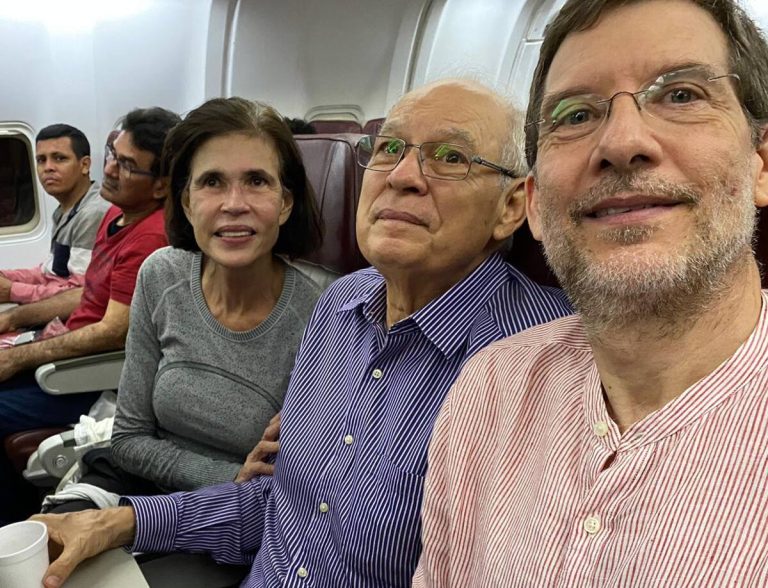
Los recién excarcelados políticos: Juan Lorenzo Holmann, Pedro Joaquín y Cristiana Chamorro Barrios. // Foto: Cortesía | Archivo
On February 9, 2023, the Ortega-Murillo dictatorship released 222 political prisoners who had endured years of torture and solitary confinement in the prisons of El Chipote and La Modelo in Nicaragua and deported them to the United States. Among those exiled were the seven opposition presidential pre-candidates, imprisoned five months before the November 2021 elections, along with dozens of activists and civic leaders who supported the April 2018 uprising and participated in the national dialogue with the government—an effort crushed by state repression and a police state.
When the “freedom flight” landed at Dulles Airport in Virginia and the released prisoners began disembarking from the OMNI company plane contracted by USAID, a judge from the Managua Court of Appeals read out a decree announcing that the 222 were “traitors to the homeland” and had been stripped of their Nicaraguan nationality, rendering them “stateless.”
In reality, the spurious decree merely carried out the sentence anticipated by dictator Daniel Ortega in November 2021, when he proclaimed himself the winner of a sham election without political competition. In a nationwide broadcast, he lashed out at political prisoners: “They are the sons of bitches of Yankee imperialists,” he shouted, and ordered: “They should be taken to the United States—they are not Nicaraguan, they have no homeland!”
The crime of statelessness as political persecution was rejected by most democratic nations in Latin America and Europe. Amid that widespread condemnation, the Spanish government stood out for its extraordinary political and humanitarian gesture, extending international protection to the Nicaraguan “stateless” by offering them the possibility of acquiring Spanish nationality “by letter of naturalization.”
One week after the first mass decree of “statelessness,” on February 15, 2023, the dictatorship carried out another act of vengeance against 94 citizens, nearly all in exile. In addition to declaring them “traitors to the homeland” without any trial or legal process, it ordered the illegal confiscation of all their assets. Once again, the Spanish government announced that its offer of nationality through naturalization would also apply to these 94 individuals and to “any Nicaraguan citizen who in the future may become stateless due to decisions by the government of Daniel Ortega.”
Spain’s solidarity marked a turning point in the international protection of Nicaraguan “stateless persons.” Between 2023 and 2026, Spain’s Council of Ministers granted citizenship by naturalization to more than 135 Nicaraguans, while the regime deported another 125 political prisoners to Guatemala, stripping them of their nationality.
According to the United Nations, more than 452 citizens have been declared “stateless,” not including cases that were not published in decrees or were carried out in secret trials. Many more have been barred from entering the country, denied the right to renew passports and identity documents, and exist in a state of de facto statelessness.
The “stateless” represent a cross-section of Nicaraguan society targeted by political persecution for opposing the dictatorship. Among them are bishops and Catholic priests, writers and public intellectuals, leaders and activists from across the political spectrum, unaffiliated “blue and white” citizens, student leaders, civic leaders, private businesspeople, producers and farmers, former FSLN guerrilla commanders, former National Army officers, independent journalists, human rights defenders, academics and former university rectors, former diplomats, feminists, artists, evangelical pastors, and former public officials. They also symbolize the moral defeat of a dictatorship that has never managed to extract confessions through torture or bribes in prison, nor silence them in exile, nor quell the demand for democracy, freedom, and justice.
The mass promotion of statelessness in Nicaragua far exceeds the practices of military dictatorships in Chile and Argentina in the last century, and even those of Cuba and Venezuela in the 21st century, which have used this repressive measure selectively against opponents. Criminal lawyer Reed Brody, known as the “dictator hunter” and a member of the UN Group of Human Rights Experts on Nicaragua (GHREN), considers that “the large-scale use in Nicaragua of arbitrary deprivation of nationality as a mechanism of selective political repression is exceptional both in scope and systematic nature, and constitutes a violation of numerous norms of international law, particularly the 1961 Convention on the Reduction of Statelessness, ratified by Nicaragua.”
Indeed, since the creation of GHREN in March 2022, its reports to the UN Human Rights Council and the UN General Assembly have called on the international community for one or more states to bring a case against Nicaragua before the World Court for violations of international conventions to prevent statelessness and torture. However, no such case has yet been filed.
Spain’s gesture of international protection has been an important step, but insufficient to punish the dictatorship’s crimes, which remain unpunished. There are at least four additional reasons why states should consider bringing the Ortega-Murillo dictatorship before international justice:
The World Court is the only international forum whose jurisprudence recognizes the rogue state of Ortega and Murillo. If Nicaragua invokes the Court’s 1986 ruling against US aggression and other decisions in territorial disputes with Honduras, Costa Rica, and Colombia, it cannot deny the Court’s authority to hear a case against it for violating the treaty to prevent statelessness.
The decrees issued by the Managua Court of Appeals against the 222 and the 94 in 2023, along with the new Constitution ratified in 2025 that elevates statelessness to constitutional status, constitute clear evidence of these crimes and the responsibility of the Nicaraguan state. With this evidence, it is reasonable and feasible to carry out a trial in a relatively short time and without major costs.
A ruling condemning Nicaragua for the crime of statelessness would expose the political isolation of the regime’s leadership and sanction the state for violating an international treaty. It would also confirm the illegitimacy of Ortega’s government, born from the fraudulent 2021 election, and the illegitimacy of the “co-presidency” established in 2025 through Rosario Murillo’s constitutional reform to legalize a “dynastic succession.”
Finally, democratic states—friends of Nicaragua in the OAS and the European Union—that promote a case and condemnation against the Ortega-Murillo dictatorship before the World Court have the opportunity to inaugurate a political strategy based on international law and regional and multilateral cooperation, as an alternative to the power-based politics of the Monroe Doctrine. A condemnation at the World Court could be the first step toward building an international alliance to support a democratic transition in Nicaragua. There are no guarantees of success, but it is better to explore this path out of dictatorship than to leave Nicaragua’s fate solely in the hands of the transactional politics of Donald Trump.
*This article was originally published in El País.
PUBLICIDAD 3M
PUBLICIDAD 3D

Alertas en tu celular
Suscribite a las alertas informativas de Confidencial en Telegram.

Boletines
Lo mejor de nuestra cobertura noticiosa en tu correo electrónico.

Anuncios
Obtené una propuesta comercial de acuerdo a tus objetivos y presupuesto.

Test Político
Explorá tus ideas sobre nuestra política, economía y sociedad con nuestro Test Político.