AA
Share

 Las noticias del día en tu correo
Recibe lo más destacado de la cobertura de CONFIDENCIAL todos los días.
Más boletines
The best of our coverage, in English
Sign up for our weekly newsletter. We will send it to you every Friday at 10:00 am (Nicaragua time)
More Newsletters
PUBLICIDAD 4D
PUBLICIDAD 5D
Carolina Jimenez and David Smilde: “The tragedy is that both Maduro and the opposition see Trump as a way to stay in power, or to obtain it.”
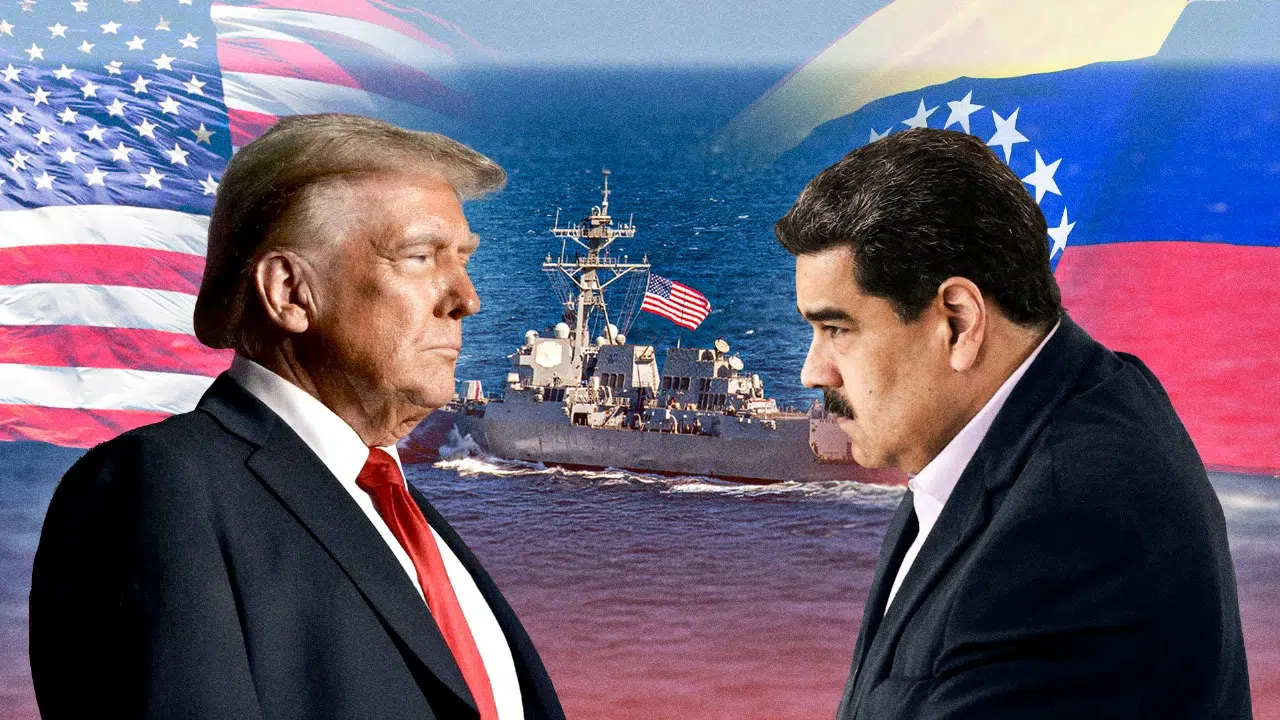
Fotoarte con las imágenes del presidente de EE. UU., Donald Trump (izq.), y su homólogo de Venezuela, Nicolás Maduro. Fotoarte: CONFIDENCIAL
The “war games” of the Trump Administration against Nicolas Maduro’s dictatorship have drawn international attention to the US military strategy and its theory that increasing military pressure will provoke an internal rupture and regime change with Maduro’s departure.
Sociologist David Smilde, a professor at Tulane University and an expert on Venezuela and US–Venezuelan relations for three decades, calls this theory “too simplistic.” He argues that within the upper ranks of the Maduro government “there is still an ideology and a sense of self-preservation among those who have their hands in illicit economies, fear justice, and believe their only security lies with chavismo,” and that “Maduro does everything possible to convince them there will be a witch hunt, keeping the Armed Forces united.”
For her part, Venezuelan human rights advocate Carolina Jiménez, president of the Washington Office on Latin America (WOLA), believes that “Venezuela’s tragic dilemma is being trapped as a country in a strategy from both sides — the Maduro regime and the opposition led by Maria Corina Machado — who see the Trump Administration as the way to stay in power or to seize power.”
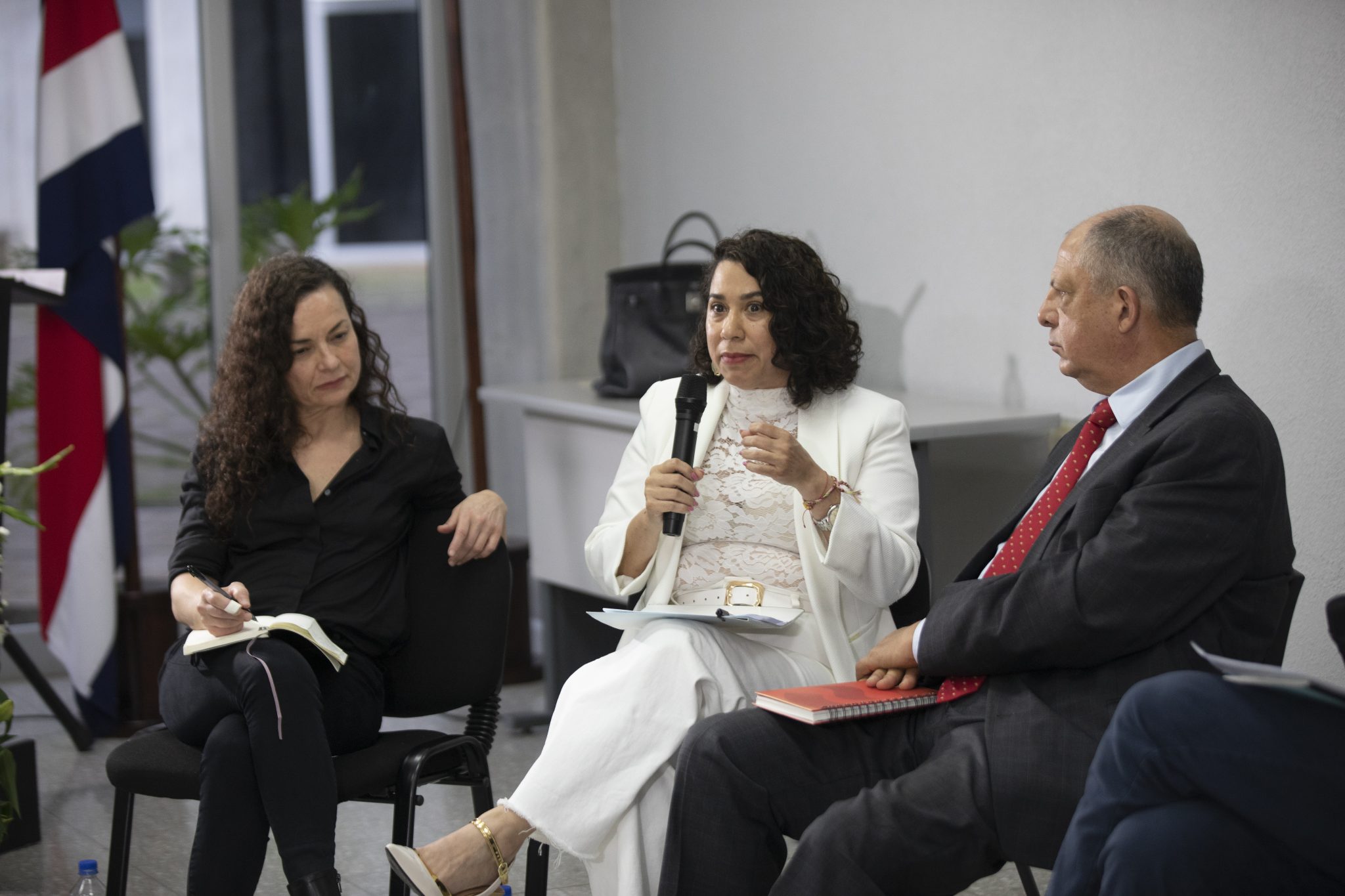
In a conversation on the program Esta Semana, broadcast on Confidencial’s YouTube channel due to TV censorship in Nicaragua, Smilde and Jimenez examined the “gray zones” of Venezuela’s crisis following the electoral fraud against Edmundo González after the opposition victory of July 28, 2024, and described a Venezuelan people “desperate and abandoned” amid a severe humanitarian crisis.
So far, 17 attacks have been carried out in international waters against boats allegedly belonging to drug traffickers, leaving 66 unidentified dead. Are these anti-narcotics operations, acts of war, or extrajudicial executions?
Carolina Jiménez: Sadly, the number has increased, because this morning (November 7, 2025) we woke up to news of another attack in the Caribbean Sea, in international waters, bringing the total to 70. We are in the painful task of having to add more dead to the list.
When a state takes the law into its own hands under the pretext of fighting drug trafficking — bombing boats that show no resistance or threat — and we see no attempt at capture or interception, only the immediate use of lethal force, all minimal use-of-force protocols are violated. The shift from legal, proportional, moderate force to lethal force means we are clearly witnessing extrajudicial executions under international law. We at WOLA said this from day one; other international organizations have said so as well, and the UN High Commissioner for Human Rights has also stated it. There is a consensus within the human rights and international community that these are grave violations of international human rights law.
The United States has deployed about ten ships, including a submarine, and thousands of soldiers around the Caribbean waters of Venezuela. Soon, the aircraft carrier Gerald Ford, the largest and most modern in the US fleet, may join them. What is the goal of this military deployment? Is it really about fighting drugs, or is there another political objective?
David Smilde: There are multiple motivations. The stated justification is the fight against drug trafficking — but that makes little sense. Venezuela is not one of the main sources of cocaine entering the United States. Much of the cocaine passing through Venezuela goes to Europe; only 10 to 15 percent goes through Venezuela to the US, most of that comes through the Pacific.
What’s really hitting US cities is fentanyl — and that doesn’t come from Venezuela; it comes from Mexico, from precursors imported from China. So, the narcotics justification doesn’t hold up.
Meanwhile, Marco Rubio, the Secretary of State and also National Security Advisor, has long sought regime change in Venezuela. So there’s that motivation, especially among political actors in South Florida. Rubio has essentially rebranded a regime-change operation as a drug war, using anti-terrorism language for Trump — and, of course, Trump campaigned on this. He promised to bomb the cartels, which plays well with his base. With Trump, almost everything is theater.
The United States has said it is preparing ground attacks in Venezuela under the pretext of destroying the drug flow, and it doesn’t rule out attacks on military bases it considers part of the cartels. What consequences could ground attacks in Venezuelan territory have?
Carolina Jiménez: First, we’d have to consider the consequences inside the United States itself. It would be a grave violation of domestic law, since such actions should require Congressional approval, yet these attacks are happening without it. So we’d see a serious overreach of executive power in the United States. In Venezuela, it would be uncharted territory. In Latin America we haven’t seen this kind of attack for decades, and it would be extremely serious for any Latin American country if the US violated its sovereignty and caused civilian casualties.
It’s clear that Venezuelans feel a strong need to move toward democracy, and July 28, 2024, was the clearest proof of that. Edmundo González Urrutia won the elections overwhelmingly — but he won them peacefully, through the vote. Unfortunately, that will was completely disregarded, and the Venezuelans’ attempt to have it respected was met with repression. However, that doesn’t mean Venezuelans want bombs dropped on their territory. I insist — one of the gravest concerns would be the damage to the country, the possible deaths of innocent civilians, and we must acknowledge that Venezuela has different violent groups. There are the so-called armed colectivos, which are paramilitary groups; it also has a complex Armed Forces structure, co-opted by Maduro’s power. We don’t know how they might respond to this. So when you play with gunpowder, that gunpowder can explode — and we’re facing an unknown and very dangerous situation.
The increasingly overt goal of this strategy of military pressure — short of a ground invasion — is to weaken Maduro’s regime, provoke internal divisions, or trigger a rupture that removes him from power. But given the regime’s nature — a collusion of interests among civic, military, and economic elites — some analysts question how effective this premise of the U.S. strategy really is. Is it realistic to think military pressure could drive Maduro from power?
David Smilde: I’m one of those analysts who questions that strategy. The Venezuelan opposition has long pushed the message that the regime is weak. In the elections, there was an overwhelming majority who voted against it, so there must be a lot of discontent. But it’s important to recognize that after the July 28 election — that slap in the face — even I was surprised that there were virtually no defections. In 2017, more people broke away from the regime.
It’s hard to grasp that they still hold on to an ideology — that they’re revolutionaries engaged in an anti-imperialist struggle. There’s a sense of unity among them that many people overlook, as well as a drive for self-preservation among those still involved in illicit economies. They fear justice and believe their only safety lies with chavismo, while Maduro’s government does everything possible to convince people that there will be a witch hunt.
The main theory behind this intervention is the idea that Maduro is the head of a drug cartel — the Cartel de los Soles refers to the military. So, what incentive would the generals of the Armed Forces have when they’re already painted as drug traffickers? It almost seems like a plan by Maduro himself to ensure the Armed Forces remain united behind him. I think it’s overly simplistic to assume that this kind of pressure will cause a rupture. Another scenario would be targeting Maduro directly, or carrying out the so-called extraction of Maduro and those around him. That also seems simplistic to me, because it doesn’t guarantee a transition; it could just lead to a reshuffle within chavismo, which might be worse than the current situation. There’s a very simplistic sociology of power underlying the idea that this type of pressure will break the regime.
Where does the opposition led by María Corina Machado stand now? Is it part of the US military-pressure strategy, or does it have autonomy?
ChatGPT said:
Carolina Jiménez: María Corina Machado has been publicly supportive of this U.S. strategy from day one; in various ways, she has expressed that support. The elected president, Edmundo González, is different — he maintains relationships more focused on Europe, takes a more moderate tone, and represents a more central leadership. Recently, we saw the president-elect meet with dissident chavismo, some of whom were even ministers under Hugo Chávez, showing that his political project is open to those who supported Chávez in the past. I think this sends a positive message that a potential transition would not lead to a witch hunt against former chavismo supporters. In other words, this leadership communicates two clear messages.
But indeed, the most internationally recognized figure — and the one who also led the 2024 campaign — is María Corina Machado, to the point that she received the Nobel Peace Prize. She has been very clear in her support of the U.S. strategy.
The New York Times reported that Nicolás Maduro was sending very clear messages to Donald Trump, letting him know that he was willing to hand over all the concessions he had granted for oil and mineral exploitation to the Russians and Chinese — or to American companies. The great tragedy of Venezuela is that it seems both the
Does the Trump administration have a political timeframe to influence the crisis in Venezuela? Can it keep the situation in suspense indefinitely, or is it obliged to put its strategy into action in the coming weeks or months?
David Smilde: The Trump administration is experiencing some wear with this operation. In recent weeks, polls have shown that the majority of the population does not support any kind of attack on Venezuela. There were also elections in New York, Virginia, and New Jersey — not directly relevant to this issue, but they serve as a barometer of Trump’s support. The candidates Trump backed lost by large margins, which was a significant blow. Trump has a great capacity to dismiss favorable polls as fake news, but electoral results are harder to ignore. This aligns with reports we’ve seen in recent days that Trump has doubts about moving forward with a military operation in Venezuela, as well as news that the aircraft carrier Gerald R. Ford left the Mediterranean, though it has now spent two days in a fixed position off the coast of Morocco.
All of this points to wear and tear on the operation, and that Trump is thinking twice. But we also have to remember that Trump is a specialist at keeping everyone off balance. We’ve seen cycles of three or four days where he changes his mind — is an attack imminent? Is he backing off? — that’s Trump’s method. I do believe that the more the U.S. public learns about this operation, the less support it has. The flood of opinion pieces and analytical reports over the past three weeks has been extremely negative. So, yes, his options are somewhat limited, and the longer time passes, the less likely it becomes that they will carry out any military attack.
Where does Latin America stand in this crisis and the US policy of using force in international waters and potentially Venezuelan territory? Is it a passive spectator, or is this due to internal divisions in today’s Latin America?
Carolina Jiménez: In general, and historically, there has been broad rejection of U.S. intervention in Latin American affairs, but right now we’re seeing a lot of silence. On one hand, the Trump administration has shown that it holds countries accountable and is fully willing to exact a price — its tariff policy has been one way to exercise coercion over the region. That has affected how states choose to speak out, or remain silent, regarding U.S. policies. The second point is that Trump picked his enemy quite carefully this time. Maduro is deeply unpopular in Latin America. If you look at who dares to support him or speak out on social media, it’s mostly Gustavo Petro; Lula has also said that these military attacks in the Caribbean and the Eastern Pacific are illegal, but in a fairly moderate way. Maduro’s government has been very diplomatically isolated, and very few countries recognized his 2024 “victory,” because everyone knows it was effectively an open electoral fraud.
That doesn’t mean these countries are unaware that the United States is committing illegal actions, but it’s very difficult for them to openly support the Venezuelan government. It’s even harder to show solidarity with the Venezuelan people without going through Nicolás Maduro.
María Corina Machado has repeatedly said that if this policy succeeds and Maduro is removed from power, Cuba and Nicaragua will be next. Are these “war games” in Venezuela a laboratory for U.S. policies toward the dictatorships in Cuba and Nicaragua?
David Smilde: Without a doubt, that’s Marco Rubio’s motivation: Cuba survived the past 20 years thanks to Venezuela’s support, and if Venezuela’s democracy is restored, the thinking goes, Cuba and Nicaragua will follow. But I also think that’s very simplistic. Cuba has been entrenched for a long time, and you shouldn’t underestimate the skill of the elite that has privileged access to economic and military resources, as well as control over the population.
How exactly would Cuba fall if Venezuela falls? Venezuela’s support for Cuba today is minimal, and Cuba’s leaders have shown indifference to what’s happening to their population. I don’t see a popular uprising, or a loss of support from the Armed Forces. So how would this really play out? People use metaphors like it will be a domino effect, but Cuba has been in place for about 60 years; everyone keeps thinking it’s about to fall, yet it has held firm. Nicaragua is in the same situation. You know much more about this than I do, but there we also have an authoritarian government willing to do whatever it takes to stay in power. Another type of mechanism would be needed to change that. Direct military intervention is possible — you can remove a regime — but what comes afterward is always highly uncertain. That’s the problem. I don’t see how this would necessarily change the situation in those other countries.
Returning to Venezuela: if direct military intervention isn’t on Trump’s agenda, and military pressure doesn’t seem likely to produce the regime change the U.S. is projecting, what about the vast majority of Venezuelans who voted against Maduro, who voted for Edmundo González, and whose election was stolen? Are they mere spectators, or do they have a role in this crisis?
Carolina Jiménez: That’s the question we all have. After July 28, 2024, one of the Maduro regime’s main strategies has been the sustained increase in repression — a very exemplary form of repression that cannot be underestimated — and the surveillance system. Right now, they’ve just revived an app that allows people to report what their neighbors or friends are doing, and whether they might be dangerous to the homeland. Well, you in Nicaragua know this very well; it’s also well known in Cuba. It exerts a huge pressure, tears apart social fabric, but further entrenches censorship in the country. Never before had a woman won the Nobel Peace Prize. You may have many disagreements with María Corina Machado, but you can’t deny that it was national news — and the only three radio announcers who reported it are “on vacation” today.
That society that voted against Maduro has never stopped demanding a peaceful change of government, but it is truly demoralized by censorship, repression, and increasingly intense surveillance. I don’t think what was expressed on July 28, 2024, is dead; I believe there will be other opportunities for that national sentiment to resurface. But these are very difficult times because Venezuela is also facing a complex humanitarian emergency. One in three Venezuelans lives in food insecurity. The vast majority of people have to focus on putting bread on the table and sending their children to school, while most teachers have fled the country or cannot teach on a daily basis. These kinds of realities heavily affect the political agenda of any society and also determine whether a society can, or cannot, resist authoritarianism.
If military pressure is not necessarily going to lead to a regime change, Trump has no plans for a military invasion, and the Venezuelan people are crushed, it seems this crisis in Venezuela is likely to be prolonged.
David Smilde: The population of Venezuela is in an extremely dire and tragic situation because people are desperate. They voted with their hearts in their hands, went to elections under unfair conditions, yet they won by a wide margin — and chavismo didn’t accept it. For about a month, there were some comments from the presidents of Colombia, Brazil, and Mexico. But after that, nothing. The people in Venezuela feel abandoned. What’s happening now is an important lesson: if the progressive forces, which were thought to have influence, did nothing, if the world forgets a population living in such despair, that creates space for someone like Trump. I know many people who aren’t militaristic, even some who supported chavismo until recently, who are now focused on the possibility of a military invasion because they are desperate. In this situation, they feel that the only person who cares is Trump.
It’s clear that there will be moments in the future when they need to organize for elections, to engage in politics, but to do that there must be a renewed multilateral international effort regarding Venezuela — from the region, from the European Union, and not just the United States. We need to return to that approach to try to find some solution for the Venezuelan people, who are in desperate need.
PUBLICIDAD 3M
PUBLICIDAD 3D