AA
Share

 Las noticias del día en tu correo
Recibe lo más destacado de la cobertura de CONFIDENCIAL todos los días.
Más boletines
The best of our coverage, in English
Sign up for our weekly newsletter. We will send it to you every Friday at 10:00 am (Nicaragua time)
More Newsletters
PUBLICIDAD 4D
PUBLICIDAD 5D
For the second consecutive year, Nicaragua is the Latin American country with the worst score in RSF’s World Press Freedom Index.
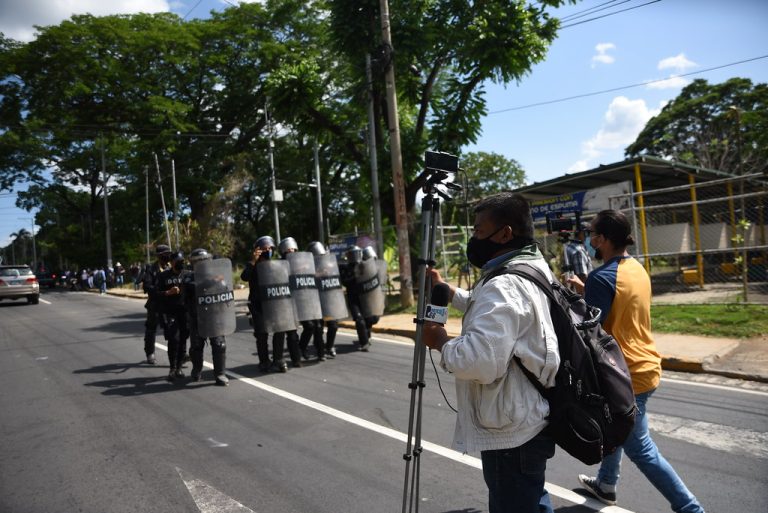
Foto: Archivo | Confidencial
Nicaragua was positioned, for the second consecutive year, as the Latin American country with the worst score in the World Press Freedom Index of Reporters Without Borders (RSF). The country is ranked 168th, out of 180 nations evaluated, according to the index, released on Thursday, April 30, 2026.
“In Nicaragua, the media landscape is simply in ruins, a victim of systematic repression and a permanent deterioration of the conditions for the exercise of the profession,” RSF emphasizes in its 2026 World Ranking.
Nicaragua is “at the bottom of the regional table”, surpassed by countries such as Cuba (160) and Venezuela (159), “where press freedom remains at its lowest level”, according to the organization.
For RSF, it is “worrying” that there is “a tendency” in Latin America to replicate some “traditional forms of censorship” that prevail in Nicaragua, such as state repression and direct attacks on journalists and the media.
“In a region like the Americas, marked by violence against the press, instead of protecting journalists, governments threaten them,” warns RSF.
As is the case in Nicaragua, under the dictatorship of Daniel Ortega and Rosario Murillo, several governments in the Americas have directed their attacks against the media.
The organization stresses that the president of the United States, Donald Trump, “turned regular attacks on the press and journalists into a systematic practice”. This fact relegated the country to 64th place in the ranking, after falling seven positions.
El Salvador maintained its downward trend and ranked 143rd, representing a loss of 74 positions since President Nayib Bukele came to power in 2019.
Meanwhile, Ecuador recorded the largest drop in the region, falling 31 positions to 125th place after the murders of journalists in the last year.
Peru, which was also marked by the murder of four journalists in 2025, lost 14 positions in the 2026 ranking to 144th place.
Mexico was ranked 122nd and “is the country in the region with one of the worst scores in the security indicator, only negatively surpassed by Nicaragua,” remarked RSF.
According to RSF, for the first time in 25 years of the World Press Freedom Index, more than half of the world’s countries are in a “difficult” or “very serious” situation.
“Freedom of information has been deteriorating and the outlook, gradually darkening,” the agency warns. “Journalists continue to be killed or imprisoned for their work, but the tactics of attacking press freedom are changing,” it adds.
RSF measures the state of press freedom in the world on the basis of five indicators: political, legal, economic, social, safety of journalists. Between 2025 and 2026, the legal indicator fell the most, deteriorating in more than 60% of the countries, i.e. in 110 of the 180.
The organization believes that “the widening of the scope of defense and national security secrecy has become a means of prohibiting coverage of issues of general interest in many countries. This trend, prominent in authoritarian regimes, has spread to democracies and is accompanied by the abusive use of laws against journalists in the name of the fight against terrorism.”
Among the regimes closed to the press, “Russia has become a specialist in the use of laws against terrorism, separatism or extremism in order to restrict freedom of information,” warns RSF. These techniques of instrumentalization of national security measures “are also observed in neighboring Belarus, Burma, Nicaragua and Egypt,” they stress.
PUBLICIDAD 3M
PUBLICIDAD 3D